

dark spots on scales; irregular pink bands on head; a triangular black spot
at upper P base; median fins with pale, bubble-like spots.
Attain 14 cm. Indo-West Pacific, south to Durban, abundant in Delagoa Bay; a shallow-water species of rocky or
weedy bottoms along shores of continents and large islands.
Often identified as H. nigrescens (Bloch & Schneider), but
this name cannot be convincingly linked to any known
species of Halichoeres.
220.30 Halichoeres hortulanus
(Lacepede, 1801)
PLATES 91 & 92
Checkerboard wrasse
Geruite lipvis
Labrus hortulanus Lacepede, 1801: 449, 518, PI. 29, Fig. 2 (Indian
Ocean). Labrus centriquadrus Lacepede, 1801: 437, 493 (Madagascar,
Mauritius and Reunion). Halichoeres centriquadrus: Smith, SFSA No.
793*. Halichoeres hortulanus: Smith, 1980: 181; Randall & Smith, 1982:
4*.
D IX,ll; A 111,11; P 14 (rarely 13); LL 26, anterior LL scales with 1
pore; GR 20-25; a near-vertical band of small scales behind eye; scales
dorsally on head extending to or slightly anterior to a vertical at rear edge
of eye; suborbital pores increasing with age from 12 in juveniles (3-4 cm)
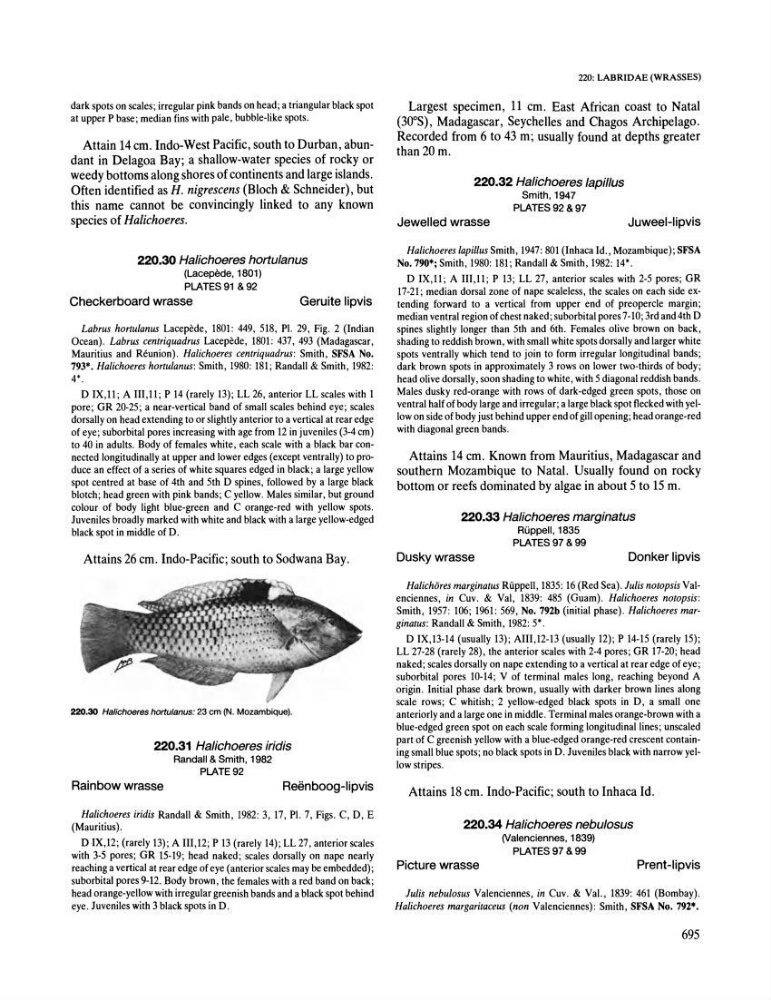
to 40 in adults. Body of females white, each scale with a black bar connected longitudinally at upper and lower edges (except ventrally) to produce an effect of a series of white squares edged in black; a large yellow
spot centred at base of 4th and 5th D spines, followed by a large black
blotch; head green with pink bands; C yellow. Males similar, but ground
colour of body light blue-green and C orange-red with yellow spots.
Juveniles broadly marked with white and black with a large yellow-edged
black spot in middle of D.
Attains 26 cm. Indo-Pacific; south to Sodwana Bay.
220.30 Halichoeres hortulanus: 23 em (N. Mozambique).
220.31 Halichoeres iridis
Randall & Smith, 1982
PLATE 92
Rainbow wrasse
Reenboog-lipvis
Halichoeres iridis Randall & Smith, 1982: 3, 17, PI. 7, Figs. C, D, E
(Mauritius) .
D IX,12; (rarely 13); A III,12; P 13 (rarely 14); LL 27, anterior scales
with 3-5 pores; GR 15-19; head naked; scales dorsally on nape nearly
reaching a vertical at rear edge of eye (anterior scales may be embedded);
suborbital pores 9-12. Body brown, the females with a red band on back;
head orange-yellow with irregular greenish bands and a black spot behind
eye. Juveniles with 3 black spots in D.
220: LABRIDAE (WRASSES)
Largest specimen, 11 cm. East African coast to Natal
(30 0 S), Madagascar, Seychelles and Chagos Archipelago.
Recorded from 6 to 43 m; usually found at depths greater
than 20m.
220.32 Halichoeres lapillus
Smith,1947
PLATES 92 & 97
Jewelled wrasse
Juweel-lipvis
Halichoeres lapillus Smith, 1947: 801 (Inhaca Id., Mozambique); SFSA
No. 790*; Smith, 1980: 181; Randall & Smith, 1982: 14*.
D IX,ll; A III,ll; P 13; LL 27, anterior scales with 2-5 pores; GR
17-21; median dorsal zone of nape scaleless, the scales on each side extending forward to a vertical from upper end of preopercle margin;
median ventral region of chest naked; suborbital pores 7-10; 3rd and 4th D
spines slightly longer than 5th and 6th. Females olive brown on back,
shading to reddish brown, with small white spots dorsally and larger white
spots ventrally which tend to join to form irregular longitudinal bands;
dark brown spots in approximately 3 rows on lower two-thirds of body;
head olive dorsally, soon shading to white, with 5 diagonal reddish bands.
Males dusky red-orange with rows of dark-edged green spots, those on
ventral half of body large and irregular; a large black spot flecked with yellow on side of body just behind upper end of gill opening; head orange-red
with diagonal green bands.
Attains 14 cm. Known from Mauritius, Madagascar and
southern Mozambique to Natal. Usually found on rocky
bottom or reefs dominated by algae in about 5 to 15 m.
220.33 Halichoeres marginatus
Ruppell, 1835
PLATES 97 & 99
Dusky wrasse
Donker lipvis
HalichOres marginatus Riippell, 1835: 16 (Red Sea). Julis notopsis Valenciennes, in Cuv. & Val, 1839: 485 (Guam). Halichoeres notopsis:
Smith, 1957: 106; 1961: 569, No. 792b (initial phase). Halichoeres marginatus: Randall & Smith, 1982: 5*.
D IX,13-14 (usually 13); AIII,12-13 (usually 12); P 14-15 (rarely 15);
LL 27-28 (rarely 28), the anterior scales with 2-4 pores; GR 17-20; head
naked; scales dorsally on nape extending to a vertical at rear edge of eye;
suborbital pores 10-14; V of terminal males long, reaching beyond A
origin. Initial phase dark brown, usually with darker brown lines along
scale rows; C whitish; 2 yellow-edged black spots in D, a small one
anteriorly and a large one in middle. Terminal males orange-brown with a
blue-edged green spot on each scale forming longitudinal lines; unscaled
part of C greenish yellow with a blue-edged orange-red crescent containing small blue spots; no black spots in D. Juveniles black with narrow yellow stripes.
Attains 18 cm. Indo-Pacific; south to Inhaca Id.
220.34 Halichoeres nebulosus
(Valenciennes, 1839)
PLATES 97 & 99
Picture wrasse
Prent-lipvis
Julis nebulosus Valenciennes, in Cuv. & Val., 1839: 461 (Bombay).
Halichoeres margaritaceus (non Valenciennes): Smith, SFSA No. 792*.
695
at upper P base; median fins with pale, bubble-like spots.
Attain 14 cm. Indo-West Pacific, south to Durban, abundant in Delagoa Bay; a shallow-water species of rocky or
weedy bottoms along shores of continents and large islands.
Often identified as H. nigrescens (Bloch & Schneider), but
this name cannot be convincingly linked to any known
species of Halichoeres.
220.30 Halichoeres hortulanus
(Lacepede, 1801)
PLATES 91 & 92
Checkerboard wrasse
Geruite lipvis
Labrus hortulanus Lacepede, 1801: 449, 518, PI. 29, Fig. 2 (Indian
Ocean). Labrus centriquadrus Lacepede, 1801: 437, 493 (Madagascar,
Mauritius and Reunion). Halichoeres centriquadrus: Smith, SFSA No.
793*. Halichoeres hortulanus: Smith, 1980: 181; Randall & Smith, 1982:
4*.
D IX,ll; A 111,11; P 14 (rarely 13); LL 26, anterior LL scales with 1
pore; GR 20-25; a near-vertical band of small scales behind eye; scales
dorsally on head extending to or slightly anterior to a vertical at rear edge
of eye; suborbital pores increasing with age from 12 in juveniles (3-4 cm)
to 40 in adults. Body of females white, each scale with a black bar connected longitudinally at upper and lower edges (except ventrally) to produce an effect of a series of white squares edged in black; a large yellow
spot centred at base of 4th and 5th D spines, followed by a large black
blotch; head green with pink bands; C yellow. Males similar, but ground
colour of body light blue-green and C orange-red with yellow spots.
Juveniles broadly marked with white and black with a large yellow-edged
black spot in middle of D.
Attains 26 cm. Indo-Pacific; south to Sodwana Bay.
220.30 Halichoeres hortulanus: 23 em (N. Mozambique).
220.31 Halichoeres iridis
Randall & Smith, 1982
PLATE 92
Rainbow wrasse
Reenboog-lipvis
Halichoeres iridis Randall & Smith, 1982: 3, 17, PI. 7, Figs. C, D, E
(Mauritius) .
D IX,12; (rarely 13); A III,12; P 13 (rarely 14); LL 27, anterior scales
with 3-5 pores; GR 15-19; head naked; scales dorsally on nape nearly
reaching a vertical at rear edge of eye (anterior scales may be embedded);
suborbital pores 9-12. Body brown, the females with a red band on back;
head orange-yellow with irregular greenish bands and a black spot behind
eye. Juveniles with 3 black spots in D.
220: LABRIDAE (WRASSES)
Largest specimen, 11 cm. East African coast to Natal
(30 0 S), Madagascar, Seychelles and Chagos Archipelago.
Recorded from 6 to 43 m; usually found at depths greater
than 20m.
220.32 Halichoeres lapillus
Smith,1947
PLATES 92 & 97
Jewelled wrasse
Juweel-lipvis
Halichoeres lapillus Smith, 1947: 801 (Inhaca Id., Mozambique); SFSA
No. 790*; Smith, 1980: 181; Randall & Smith, 1982: 14*.
D IX,ll; A III,ll; P 13; LL 27, anterior scales with 2-5 pores; GR
17-21; median dorsal zone of nape scaleless, the scales on each side extending forward to a vertical from upper end of preopercle margin;
median ventral region of chest naked; suborbital pores 7-10; 3rd and 4th D
spines slightly longer than 5th and 6th. Females olive brown on back,
shading to reddish brown, with small white spots dorsally and larger white
spots ventrally which tend to join to form irregular longitudinal bands;
dark brown spots in approximately 3 rows on lower two-thirds of body;
head olive dorsally, soon shading to white, with 5 diagonal reddish bands.
Males dusky red-orange with rows of dark-edged green spots, those on
ventral half of body large and irregular; a large black spot flecked with yellow on side of body just behind upper end of gill opening; head orange-red
with diagonal green bands.
Attains 14 cm. Known from Mauritius, Madagascar and
southern Mozambique to Natal. Usually found on rocky
bottom or reefs dominated by algae in about 5 to 15 m.
220.33 Halichoeres marginatus
Ruppell, 1835
PLATES 97 & 99
Dusky wrasse
Donker lipvis
HalichOres marginatus Riippell, 1835: 16 (Red Sea). Julis notopsis Valenciennes, in Cuv. & Val, 1839: 485 (Guam). Halichoeres notopsis:
Smith, 1957: 106; 1961: 569, No. 792b (initial phase). Halichoeres marginatus: Randall & Smith, 1982: 5*.
D IX,13-14 (usually 13); AIII,12-13 (usually 12); P 14-15 (rarely 15);
LL 27-28 (rarely 28), the anterior scales with 2-4 pores; GR 17-20; head
naked; scales dorsally on nape extending to a vertical at rear edge of eye;
suborbital pores 10-14; V of terminal males long, reaching beyond A
origin. Initial phase dark brown, usually with darker brown lines along
scale rows; C whitish; 2 yellow-edged black spots in D, a small one
anteriorly and a large one in middle. Terminal males orange-brown with a
blue-edged green spot on each scale forming longitudinal lines; unscaled
part of C greenish yellow with a blue-edged orange-red crescent containing small blue spots; no black spots in D. Juveniles black with narrow yellow stripes.
Attains 18 cm. Indo-Pacific; south to Inhaca Id.
220.34 Halichoeres nebulosus
(Valenciennes, 1839)
PLATES 97 & 99
Picture wrasse
Prent-lipvis
Julis nebulosus Valenciennes, in Cuv. & Val., 1839: 461 (Bombay).
Halichoeres margaritaceus (non Valenciennes): Smith, SFSA No. 792*.
695