

220: LABRIDAE (WRASSES)
paler with red spots; adult males deep green to blue green (may appear
black underwater), often with 1 and sometimes 2 pale greenish bars on
side of body.
A large species reaching 120 cm. Broadly distributed in
the Indo-Pacific, south to Transkei. This and other large
Caris turn over rocks with their jaws to expose such invertebrates as crabs and brittle stars hiding underneath .
Spottail caris
220.21 Goris caudimacula
(Quoy & Gaimard, 1834)
PLATE 90
Kolstert-coris
Julis caudimacula Quoy & Gaimard, 1834: 710, PI. 15, Fig. 2
(Mauritius). Caris caudimacula: Smith, SFSA No. 807*. Caris multicolor:
Smith, SFSA No. 808.
D IX,12; A III,12; P 13; LL 49-53; body depth 3.4-4.2 in SL; D spines
somewhat sharp except 1st which is moderately prolonged in adults; 2nd
D spine longer than 3rd; space between 1st 2 D spines not clearly broader
than spaces between remaining spines; C rounded; V not reaching A origin (V of other Caris herein reaching A origin at least in large adult
males). A large diffuse blackish spot at base of C; 4 salmon pink stripes on
body, the lowermost broken into irregular spots posteriorly; broad dark
bars may be present on upper side; head with irregular bands and a black
spot edged posteriorly with yellow on opercular flap; outer part of first 2
interspinous membranes of D blackish.
Maximum length 20 cm. Indian Ocean including Red
Sea, south to East London. A common reef species.
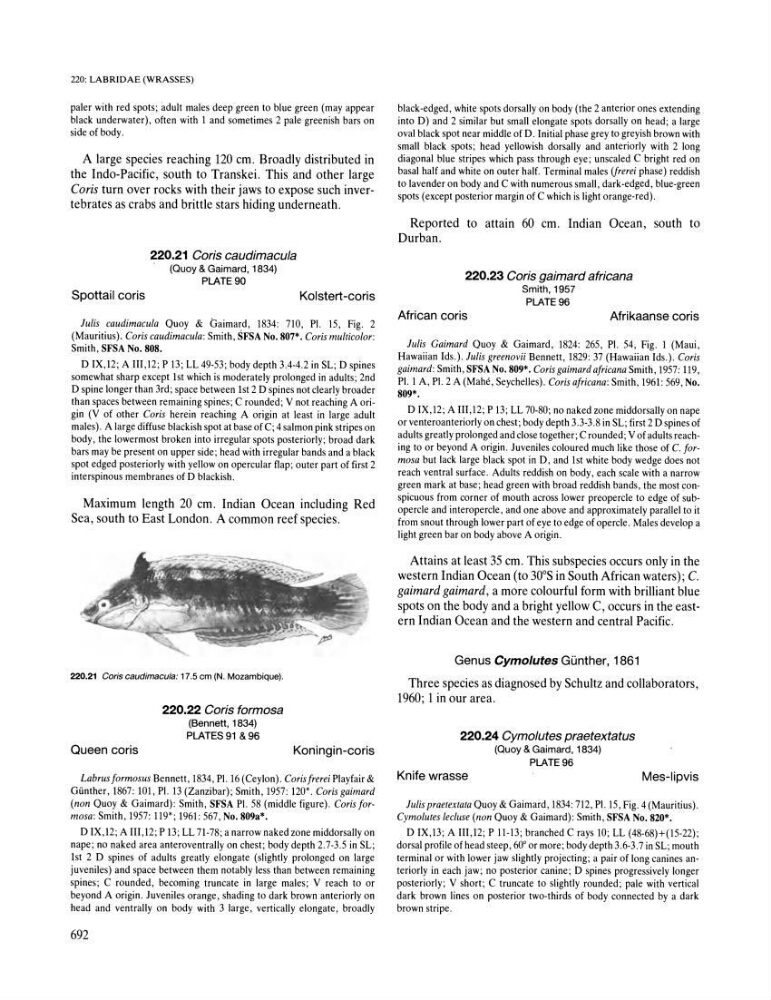
220.21 Coris caudimacula: 17.5 em (N. Mozambique).
Queen caris
220.22 Goris formosa
(Bennett, 1834)
PLATES 91 & 96
Koningin-coris
Labrus formosus Bennett, 1834, PI. 16 (Ceylon) . Caris frerei Playfair &
Gunther, 1867: 101, PI. 13 (Zanzibar); Smith, 1957: 120*. Caris gaimard
(non Quoy & Gaimard): Smith , SFSA PI. 58 (middle figure) . Caris formosa: Smith, 1957: 119*; 1961: 567, No. 809a*.
D IX,12; A III,12; P 13; LL 71-78; a narrow naked zone middorsally on
nape; no naked area anteroventrally on chest; body depth 2.7-3.5 in SL;
1st 2 D spines of adults greatly elongate (slightly prolonged on large
juveniles) and space between them notably less than between remaining
spines; C rounded, becoming truncate in large males ; V reach to or
beyond A origin. Juveniles orange, shading to dark brown anteriorly on
head and ventrally on body with 3 large, vertically elongate, broadly
692
black-edged , white spots dorsally on body (the 2 anterior ones extending
into D) and 2 similar but small elongate spots dorsally on head; a large
oval black spot near middle of D. Initial phase grey to greyish brown with
small black spots; head yellowish dorsally and anteriorly with 2 long
diagonal blue stripes which pass through eye; unscaled C bright red on
basal half and white on outer half. Terminal males ([rerei phase) reddish
to lavender on body and C with numerous small, dark-edged, blue-green
spots (except posterior margin of C which is light orange-red).
Reported to attain 60 cm. Indian Ocean, south to
Durban.
220.23 Goris gaimard africana
Smith,1957
PLATE 96
African caris
Afrikaanse caris
Julis Gaimard Quoy & Gaimard , 1824: 265 , PI. 54 , Fig. 1 (Maui,
Hawaiian Ids.). Julis greenovii Bennett, 1829: 37 (Hawaiian Ids .). Caris
gaimard: Smith, SFSA No. 809*. Caris gaimard africana Smith, 1957: 119,
PI. 1 A, PI. 2 A (Mahe, Seychelles). Caris africana: Smith, 1961: 569, No.
809*.
D IX ,12; A III,12; P 13; LL 70-80; no naked zone middorsally on nape
or venteroanteriorly on chest; body depth 3.3-3.8 in SL; first 2 D spines of
adults greatly prolonged and close together ; C rounded; V of ;ldults reaching to or beyond A origin. Juveniles coloured much like those of C. formosa but lack large black spot in D, and 1st white body wedge does not
reach ventral surface. Adults reddish on body, each scale with a narrow
green mark at base; head green with broad reddish bands, the most conspicuous from corner of mouth across lower preopercle to edge of subopercle and interopercle , and one above and approximately parallel to it
from snout through lower part of eye to edge of opercle. Males develop a
light green bar on body above A origin.
Attains at least 35 cm. This subspecies occurs only in the
western Indian Ocean (to 30 0 S in South African waters); C.
gaimard gaimard, a more colourful form with brilliant blue
spots on the body and a bright yellow C, occurs in the eastern Indian Ocean and the western and central Pacific.
Genus Cymolutes Gunther, 1861
Three species as diagnosed by Schultz and collaborators,
1960; 1 in our area.
220.24 Gymolutes praetextatus
(Quay & Gaimard , 1834)
PLATE 96
Knife wrasse
Mes-lipvis
Julis praetextata Quoy & Gaimard, 1834: 712, PI. 15, Fig. 4 (Mauritius).
Cymolutes lecluse (non Quoy & Gaimard): Smith, SFSA No. 820*.
D IX,13; A m,12 ; P 11-13; branched Crays 10; LL (48-68)+(15-22);
dorsal profile of head steep, 60° or more; body depth 3.6-3.7 in SL; mouth
terminal or with lower jaw slightly projecting; a pair of long canines anteriorly in each jaw; no posterior canine; D spines progressively longer
posteriorly ; V short; C truncate to slightly rounded; pale with vertical
dark brown lines on posterior two-thirds of body connected by a dark
brown stripe.
paler with red spots; adult males deep green to blue green (may appear
black underwater), often with 1 and sometimes 2 pale greenish bars on
side of body.
A large species reaching 120 cm. Broadly distributed in
the Indo-Pacific, south to Transkei. This and other large
Caris turn over rocks with their jaws to expose such invertebrates as crabs and brittle stars hiding underneath .
Spottail caris
220.21 Goris caudimacula
(Quoy & Gaimard, 1834)
PLATE 90
Kolstert-coris
Julis caudimacula Quoy & Gaimard, 1834: 710, PI. 15, Fig. 2
(Mauritius). Caris caudimacula: Smith, SFSA No. 807*. Caris multicolor:
Smith, SFSA No. 808.
D IX,12; A III,12; P 13; LL 49-53; body depth 3.4-4.2 in SL; D spines
somewhat sharp except 1st which is moderately prolonged in adults; 2nd
D spine longer than 3rd; space between 1st 2 D spines not clearly broader
than spaces between remaining spines; C rounded; V not reaching A origin (V of other Caris herein reaching A origin at least in large adult
males). A large diffuse blackish spot at base of C; 4 salmon pink stripes on
body, the lowermost broken into irregular spots posteriorly; broad dark
bars may be present on upper side; head with irregular bands and a black
spot edged posteriorly with yellow on opercular flap; outer part of first 2
interspinous membranes of D blackish.
Maximum length 20 cm. Indian Ocean including Red
Sea, south to East London. A common reef species.
220.21 Coris caudimacula: 17.5 em (N. Mozambique).
Queen caris
220.22 Goris formosa
(Bennett, 1834)
PLATES 91 & 96
Koningin-coris
Labrus formosus Bennett, 1834, PI. 16 (Ceylon) . Caris frerei Playfair &
Gunther, 1867: 101, PI. 13 (Zanzibar); Smith, 1957: 120*. Caris gaimard
(non Quoy & Gaimard): Smith , SFSA PI. 58 (middle figure) . Caris formosa: Smith, 1957: 119*; 1961: 567, No. 809a*.
D IX,12; A III,12; P 13; LL 71-78; a narrow naked zone middorsally on
nape; no naked area anteroventrally on chest; body depth 2.7-3.5 in SL;
1st 2 D spines of adults greatly elongate (slightly prolonged on large
juveniles) and space between them notably less than between remaining
spines; C rounded, becoming truncate in large males ; V reach to or
beyond A origin. Juveniles orange, shading to dark brown anteriorly on
head and ventrally on body with 3 large, vertically elongate, broadly
692
black-edged , white spots dorsally on body (the 2 anterior ones extending
into D) and 2 similar but small elongate spots dorsally on head; a large
oval black spot near middle of D. Initial phase grey to greyish brown with
small black spots; head yellowish dorsally and anteriorly with 2 long
diagonal blue stripes which pass through eye; unscaled C bright red on
basal half and white on outer half. Terminal males ([rerei phase) reddish
to lavender on body and C with numerous small, dark-edged, blue-green
spots (except posterior margin of C which is light orange-red).
Reported to attain 60 cm. Indian Ocean, south to
Durban.
220.23 Goris gaimard africana
Smith,1957
PLATE 96
African caris
Afrikaanse caris
Julis Gaimard Quoy & Gaimard , 1824: 265 , PI. 54 , Fig. 1 (Maui,
Hawaiian Ids.). Julis greenovii Bennett, 1829: 37 (Hawaiian Ids .). Caris
gaimard: Smith, SFSA No. 809*. Caris gaimard africana Smith, 1957: 119,
PI. 1 A, PI. 2 A (Mahe, Seychelles). Caris africana: Smith, 1961: 569, No.
809*.
D IX ,12; A III,12; P 13; LL 70-80; no naked zone middorsally on nape
or venteroanteriorly on chest; body depth 3.3-3.8 in SL; first 2 D spines of
adults greatly prolonged and close together ; C rounded; V of ;ldults reaching to or beyond A origin. Juveniles coloured much like those of C. formosa but lack large black spot in D, and 1st white body wedge does not
reach ventral surface. Adults reddish on body, each scale with a narrow
green mark at base; head green with broad reddish bands, the most conspicuous from corner of mouth across lower preopercle to edge of subopercle and interopercle , and one above and approximately parallel to it
from snout through lower part of eye to edge of opercle. Males develop a
light green bar on body above A origin.
Attains at least 35 cm. This subspecies occurs only in the
western Indian Ocean (to 30 0 S in South African waters); C.
gaimard gaimard, a more colourful form with brilliant blue
spots on the body and a bright yellow C, occurs in the eastern Indian Ocean and the western and central Pacific.
Genus Cymolutes Gunther, 1861
Three species as diagnosed by Schultz and collaborators,
1960; 1 in our area.
220.24 Gymolutes praetextatus
(Quay & Gaimard , 1834)
PLATE 96
Knife wrasse
Mes-lipvis
Julis praetextata Quoy & Gaimard, 1834: 712, PI. 15, Fig. 4 (Mauritius).
Cymolutes lecluse (non Quoy & Gaimard): Smith, SFSA No. 820*.
D IX,13; A m,12 ; P 11-13; branched Crays 10; LL (48-68)+(15-22);
dorsal profile of head steep, 60° or more; body depth 3.6-3.7 in SL; mouth
terminal or with lower jaw slightly projecting; a pair of long canines anteriorly in each jaw; no posterior canine; D spines progressively longer
posteriorly ; V short; C truncate to slightly rounded; pale with vertical
dark brown lines on posterior two-thirds of body connected by a dark
brown stripe.