

Attains 20 cm. Indo-Pacific; south to Natal. Lives over
open stretches of sand bottom and dives heqd-first into sand
with the approach of danger.
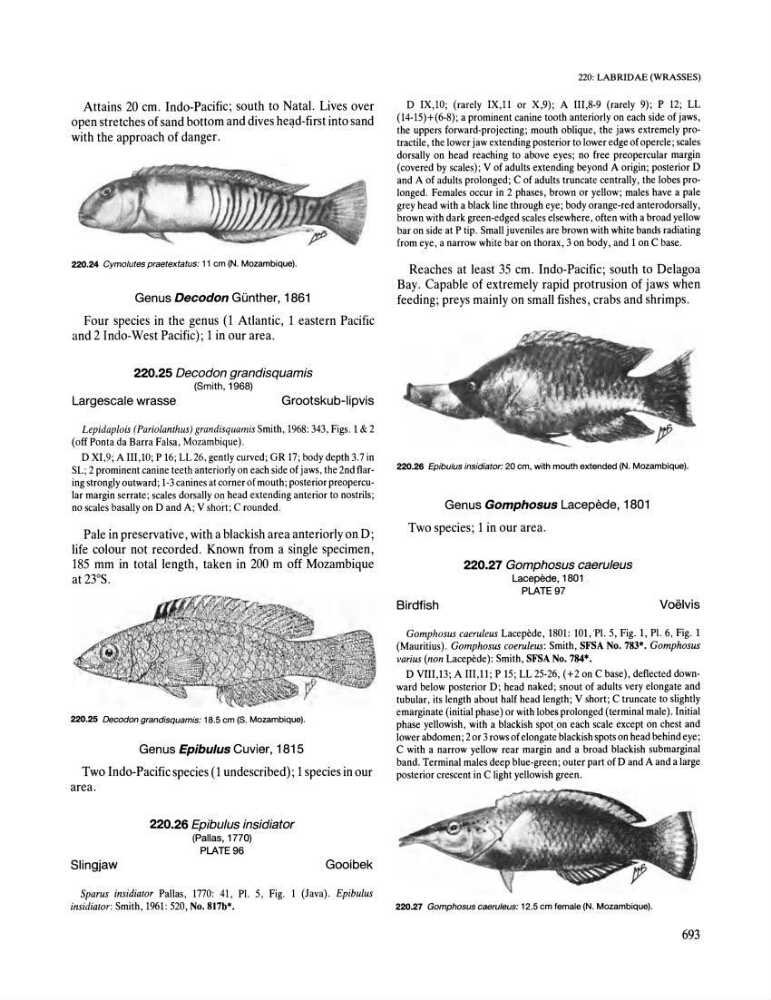
220.24 Cymo/utes praetextatus: 11 em (N . Mozambique).
Genus Decodon Gunther, 1861
Four species in the genus (1 Atlantic, 1 eastern Pacific
and 2 Indo-West Pacific); 1 in our area.
220.25 Decodon grandisquamis
(Smith, 1968)
Largescale wrasse
Grootskub-lipvis
Lepidaplois (Pariolanthus) grandisquamis Smith , 1968: 343 , Figs. 1 & 2
(off Ponta da Barra Falsa , Mozambique).
D XI,9; A III ,IO; P 16; LL 26, gently curved; GR 17; body depth 3.7 in
SL; 2 prominent canine teeth anteriorly on each side of jaws, the 2nd flaring strongly outward; 1-3 canines at corner of mouth; posterior preopercular margin serrate ; scales dorsally on head extending anterior to nostrils ;
no scales basally on D and A; V short ; C rounded .
Pale in preservative, with a blackish area anteriorly on D;
life colour not recorded. Known from a single specimen ,
185 mm in total length, taken in 200 m off Mozambique
at 23°S.
220.25 Decodon grandisquamis: 18.5 em (S. Mozambique).
Genus Epibulus Cuvier, 1815
Two Indo-Pacific species (1 undescribed); 1 species in our
area.
Slingjaw
220.26 Epibulus insidiator
(Pallas, 1770)
PLATE 96
Gooibek
Sparus insidiator Pallas, 1770: 41, PI. 5, Fig. 1 (Java) . Epibulus
insidiator: Smith, 1961: 520, No. 817b*.
220: LABRIDAE (WRASSES)
D IX,IO; (rarely IX,11 or X,9) ; A 111,8-9 (rarely 9); P 12; LL
(14-15)+(6-8); a prominent canine tooth anteriorly on each side of jaws,
the uppers forward-projecting; mouth oblique, the jaws extremely protractile, the lower jaw extending posterior to lower edge of opercle; scales
dorsally on head reaching to above eyes; no free preopercular margin
(covered by scales) ; V of adults extending beyond A origin; posterior D
and A of adults prolonged; C of adults truncate centrally, the lobes prolonged. Females occur in 2 phases, brown or yellow; males have a pale
grey head with a black line through eye; body orange-red anterodorsally,
brown with dark green-edged scales elsewhere, often with a broad yellow
bar on side at P tip. Small juveniles are brown with white bands radiating
from eye , a narrow white bar on thorax, 3 on body , and 1 on C base .
Reaches at least 35 cm. Indo-Pacific; south to Delagoa
Bay. Capable of extremely rapid protrusion of jaws when
feeding; preys mainly on small fishes, crabs and shrimps.
220.26 Epibu/us insidiator: 20 em, with mouth extended (N. Mozambique).
Genus Gomphosus Lacepede, 1801
Two species; 1 in our area.
Birdfish
220.27 Gomphosus caeruleus
Lacepede, 1801
PLATE 97
Voelvis
Gomphosus caeruleus Lacepede, 1801: 101, ·PI..5, Fig. 1, PI. 6, Fig. 1
(Mauritius) . Gomphosus coeruleus: Smith, SFSA No. 783*. Gomphosus
varius (non Lacepede): Smith, SFSA No. 784*.
D VIII,13; A 111,11; P 15; LL 25-26, (+2 on C base), deflected downward below posterior D; head naked; snout of adults very elongate and
tubular, its length about half head length ; V short; C truncate to slightly
emarginate (initial phase) or with lobes prolonged (terminal male). Initial
phase yellowish, with a blackish spot on each scale except on chest and
lower abdomen; 2 or 3 rows of elongate blackish spots on head behind eye;
C with a narrow yellow rear margin and a broad blackish submarginal
band. Terminal males deep blue-green ; outer part of D and A and a large
posterior crescent in C light yellowish green.
220.27 Gomphosus caeru/eus: 12.5 em female (N. Mozambique).
693
open stretches of sand bottom and dives heqd-first into sand
with the approach of danger.
220.24 Cymo/utes praetextatus: 11 em (N . Mozambique).
Genus Decodon Gunther, 1861
Four species in the genus (1 Atlantic, 1 eastern Pacific
and 2 Indo-West Pacific); 1 in our area.
220.25 Decodon grandisquamis
(Smith, 1968)
Largescale wrasse
Grootskub-lipvis
Lepidaplois (Pariolanthus) grandisquamis Smith , 1968: 343 , Figs. 1 & 2
(off Ponta da Barra Falsa , Mozambique).
D XI,9; A III ,IO; P 16; LL 26, gently curved; GR 17; body depth 3.7 in
SL; 2 prominent canine teeth anteriorly on each side of jaws, the 2nd flaring strongly outward; 1-3 canines at corner of mouth; posterior preopercular margin serrate ; scales dorsally on head extending anterior to nostrils ;
no scales basally on D and A; V short ; C rounded .
Pale in preservative, with a blackish area anteriorly on D;
life colour not recorded. Known from a single specimen ,
185 mm in total length, taken in 200 m off Mozambique
at 23°S.
220.25 Decodon grandisquamis: 18.5 em (S. Mozambique).
Genus Epibulus Cuvier, 1815
Two Indo-Pacific species (1 undescribed); 1 species in our
area.
Slingjaw
220.26 Epibulus insidiator
(Pallas, 1770)
PLATE 96
Gooibek
Sparus insidiator Pallas, 1770: 41, PI. 5, Fig. 1 (Java) . Epibulus
insidiator: Smith, 1961: 520, No. 817b*.
220: LABRIDAE (WRASSES)
D IX,IO; (rarely IX,11 or X,9) ; A 111,8-9 (rarely 9); P 12; LL
(14-15)+(6-8); a prominent canine tooth anteriorly on each side of jaws,
the uppers forward-projecting; mouth oblique, the jaws extremely protractile, the lower jaw extending posterior to lower edge of opercle; scales
dorsally on head reaching to above eyes; no free preopercular margin
(covered by scales) ; V of adults extending beyond A origin; posterior D
and A of adults prolonged; C of adults truncate centrally, the lobes prolonged. Females occur in 2 phases, brown or yellow; males have a pale
grey head with a black line through eye; body orange-red anterodorsally,
brown with dark green-edged scales elsewhere, often with a broad yellow
bar on side at P tip. Small juveniles are brown with white bands radiating
from eye , a narrow white bar on thorax, 3 on body , and 1 on C base .
Reaches at least 35 cm. Indo-Pacific; south to Delagoa
Bay. Capable of extremely rapid protrusion of jaws when
feeding; preys mainly on small fishes, crabs and shrimps.
220.26 Epibu/us insidiator: 20 em, with mouth extended (N. Mozambique).
Genus Gomphosus Lacepede, 1801
Two species; 1 in our area.
Birdfish
220.27 Gomphosus caeruleus
Lacepede, 1801
PLATE 97
Voelvis
Gomphosus caeruleus Lacepede, 1801: 101, ·PI..5, Fig. 1, PI. 6, Fig. 1
(Mauritius) . Gomphosus coeruleus: Smith, SFSA No. 783*. Gomphosus
varius (non Lacepede): Smith, SFSA No. 784*.
D VIII,13; A 111,11; P 15; LL 25-26, (+2 on C base), deflected downward below posterior D; head naked; snout of adults very elongate and
tubular, its length about half head length ; V short; C truncate to slightly
emarginate (initial phase) or with lobes prolonged (terminal male). Initial
phase yellowish, with a blackish spot on each scale except on chest and
lower abdomen; 2 or 3 rows of elongate blackish spots on head behind eye;
C with a narrow yellow rear margin and a broad blackish submarginal
band. Terminal males deep blue-green ; outer part of D and A and a large
posterior crescent in C light yellowish green.
220.27 Gomphosus caeru/eus: 12.5 em female (N. Mozambique).
693