

of close-set conical teeth; C small, truncate, or with lobes slightly prolonged; posterior margin of P concave; V pointed, reaching anus. Colour
of presumed female (from Playfair & Giinther) rosy with a series of blue
spots on back close to Dbase; 2 or 3 indistinct longitudinal series of pearly
spots along sides; axil of P blue; a greenish blotch on posterior part and a
broad blue patch on lower half of opercle; an indistinct blue band around
orbit and continuing onto snout. Colour of presumed male with 2
longitudinal purple streaks on upper side (from Smith, SFSA No. 776a*,
see Plate).
Attains 20 cm. Known from Zanzibar and Inhambane,
Mozambique. More specimens are needed to ascertain if
the more colourful form illustrated by Smith is conspecific
with C. gymnogenys.
Genus Cirrhilabrus Temminck & Schlegel, 1845
About 25 species, all Indo-Pacific, some undescribed; 1
in our area.
220.19 Cirrhilabrus exquisitus
Smith,1957
PLATE 94
Exquisite wrasse
Fyn lipvis
Cirrhilabrus exquisitus Smith, 1957: 109, Fig. 4, PI. 2, Fig. E (Pinda,
Mozambique); Randall & Shen, 1978: 16*.
D XI,8-9; A III,9; P 14-16; LL (16-18)+(5-7); median predorsal scales
5; horizontal scale rows on cheek 2; GR 17-19; rear preopercular margin
finely serrate; pupil of eye double; 3 pairs of canine teeth at front of upper
jaw, the lateral pairs progressively larger and recurved ; C of juveniles
rounded, of adults double emarginate. Complexly coloured (see Plate),
the dominant marking for both sexes a large oval black spot on C peduncle
just above LL.
Attains 11 cm. East Africa south to Sodwana Bay, to
French Polynesia, known from relatively few localities;
depth range 6 - 32 m. Occurs in aggregations on reefs; feeds
on zooplankton. Males maintain large harems, exhibiting
brilliant hues during courtship.
Genus Coris Lacepede 1801
Twenty species; 1 eastern Atlantic, the rest Indo-Pacific
(4 still undescribed). Four species occur in our area. C. variegata (Ramsay & Ogilby, 1886) may eventually be found
here so is included in the Key below.
KEY TO SPECIES
la LL 49-55 .... .... ......... ............ ..... ..... ...... .... ..................... .. . 2
Ib LL 61-80 .... .................... .. ...................... ... ...... . ............... 3
2a First D spine longest; 2nd spine longer than 3rd;
Prays 13; a large, diffuse blackish spot at C base;
no black behind eye; LL 49-53 ......................... .. e. caudimacula
2b First and 2nd D spines shorter than remaining spines;
Prays 14; no large blackish spot at C base; a
vertically elongate small black spot on head behind
eye; LL 51-55 ... ..... .... ....... ............................. ... Ie. variegata)
220: LABRIDAE (WRASSES)
3a LL 61-66; a hump on forehead of adults (slight on
females, large on males); P 14; juveniles whitish
with small black spots on head and anterior body
and 2 large semicircular orange-red spots on back;
mature females greenish with red spots anteriorly;
adult males dark blue-green, often with 1 or 2 pale
green bars on sides ................ ..... ..... ...... .... .............. e. aygu/a
3b LL scales 70-80; no hump on forehead; P 13; colour
not as in 3a; juveniles bright orange with blackedged white wedges dorsally on head and body ... ... .......... ... ..... 4
4a A narrow scaleless zone mid-dorsally on nape; a
broad scaleless area anteroventrally on chest;
body and base of C and D with small blackish spots
(initial-phase adult) or body with dark bars (terminal
male phase); no broad near-horizontal bands
across lower half of head ........... ... .. ......... ............. .. e. formosa
4b No scaleless zone dorsally on nape; no scaleless
area on chest; no black spots or dark bars on body
or fins; head green with 2 broad, curved nearhorizontal dark reddish or purple bands across
cheek and lower operculum ...... ... ............ .. .. e. gaimard africana
Clown caris
220.20 Coris aygula
Lacepede,1801
PLATE 96
Nar-coris
Caris aygula Lacepede, 1801: 96, PI. 4, lower Fig. (no locality). Caris
angulatus Lacepecte, 1801: 97, PI. 4, middle Fig . (no locality). Labrus
cingulum Lacepede, 1801: 517, PI. 28 , Fig. 1 (Mauritius). Caris angu/ata:
Smith, SFSA No. 806*.
D IX,12 ; A III,12; P 14; LL 61-66, sharply deflected downward below
posterior D (all Caris); head naked except nape (true of other Caris);
body depth 3.0-3.3 in SL; adults developing a hump on forehead which becomes very pronounced on large males; mouth terminal; jaws anteriorly
with a pair of strong protruding canines followed by a row of conical teeth
with an inner row of small nodular teeth and 1 or 2 teeth at corner of
mouth of adults (dentition comparable on other Caris); D spines flexible;
1st 2 D spines of adults closer together than remaining spines; C rounded
in young and females, nearly truncate in males with exserted rays.
Juveniles whitish with small black spots on head and anterior body and 2
large semicircular orange-red spots on back with a large ocellated black
spot above each in D; adult females greenish, the head and anterior body
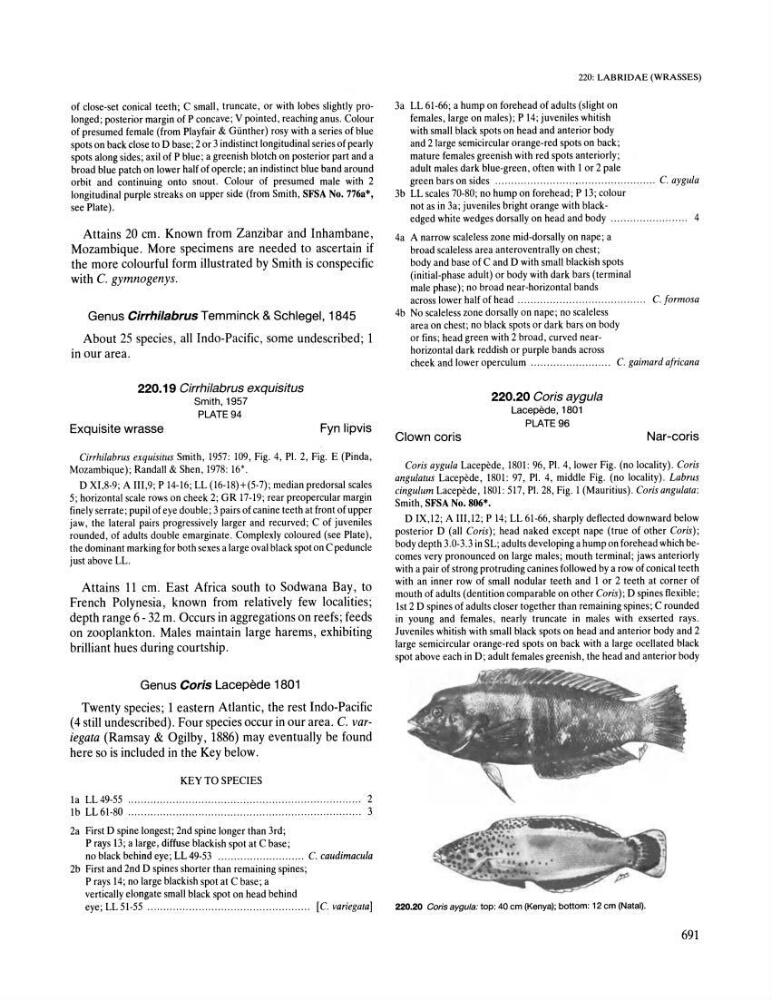
220.20 Caris aygu/a: top: 40 em (Kenya); bottom: 12 em (Natal).
691
of presumed female (from Playfair & Giinther) rosy with a series of blue
spots on back close to Dbase; 2 or 3 indistinct longitudinal series of pearly
spots along sides; axil of P blue; a greenish blotch on posterior part and a
broad blue patch on lower half of opercle; an indistinct blue band around
orbit and continuing onto snout. Colour of presumed male with 2
longitudinal purple streaks on upper side (from Smith, SFSA No. 776a*,
see Plate).
Attains 20 cm. Known from Zanzibar and Inhambane,
Mozambique. More specimens are needed to ascertain if
the more colourful form illustrated by Smith is conspecific
with C. gymnogenys.
Genus Cirrhilabrus Temminck & Schlegel, 1845
About 25 species, all Indo-Pacific, some undescribed; 1
in our area.
220.19 Cirrhilabrus exquisitus
Smith,1957
PLATE 94
Exquisite wrasse
Fyn lipvis
Cirrhilabrus exquisitus Smith, 1957: 109, Fig. 4, PI. 2, Fig. E (Pinda,
Mozambique); Randall & Shen, 1978: 16*.
D XI,8-9; A III,9; P 14-16; LL (16-18)+(5-7); median predorsal scales
5; horizontal scale rows on cheek 2; GR 17-19; rear preopercular margin
finely serrate; pupil of eye double; 3 pairs of canine teeth at front of upper
jaw, the lateral pairs progressively larger and recurved ; C of juveniles
rounded, of adults double emarginate. Complexly coloured (see Plate),
the dominant marking for both sexes a large oval black spot on C peduncle
just above LL.
Attains 11 cm. East Africa south to Sodwana Bay, to
French Polynesia, known from relatively few localities;
depth range 6 - 32 m. Occurs in aggregations on reefs; feeds
on zooplankton. Males maintain large harems, exhibiting
brilliant hues during courtship.
Genus Coris Lacepede 1801
Twenty species; 1 eastern Atlantic, the rest Indo-Pacific
(4 still undescribed). Four species occur in our area. C. variegata (Ramsay & Ogilby, 1886) may eventually be found
here so is included in the Key below.
KEY TO SPECIES
la LL 49-55 .... .... ......... ............ ..... ..... ...... .... ..................... .. . 2
Ib LL 61-80 .... .................... .. ...................... ... ...... . ............... 3
2a First D spine longest; 2nd spine longer than 3rd;
Prays 13; a large, diffuse blackish spot at C base;
no black behind eye; LL 49-53 ......................... .. e. caudimacula
2b First and 2nd D spines shorter than remaining spines;
Prays 14; no large blackish spot at C base; a
vertically elongate small black spot on head behind
eye; LL 51-55 ... ..... .... ....... ............................. ... Ie. variegata)
220: LABRIDAE (WRASSES)
3a LL 61-66; a hump on forehead of adults (slight on
females, large on males); P 14; juveniles whitish
with small black spots on head and anterior body
and 2 large semicircular orange-red spots on back;
mature females greenish with red spots anteriorly;
adult males dark blue-green, often with 1 or 2 pale
green bars on sides ................ ..... ..... ...... .... .............. e. aygu/a
3b LL scales 70-80; no hump on forehead; P 13; colour
not as in 3a; juveniles bright orange with blackedged white wedges dorsally on head and body ... ... .......... ... ..... 4
4a A narrow scaleless zone mid-dorsally on nape; a
broad scaleless area anteroventrally on chest;
body and base of C and D with small blackish spots
(initial-phase adult) or body with dark bars (terminal
male phase); no broad near-horizontal bands
across lower half of head ........... ... .. ......... ............. .. e. formosa
4b No scaleless zone dorsally on nape; no scaleless
area on chest; no black spots or dark bars on body
or fins; head green with 2 broad, curved nearhorizontal dark reddish or purple bands across
cheek and lower operculum ...... ... ............ .. .. e. gaimard africana
Clown caris
220.20 Coris aygula
Lacepede,1801
PLATE 96
Nar-coris
Caris aygula Lacepede, 1801: 96, PI. 4, lower Fig. (no locality). Caris
angulatus Lacepecte, 1801: 97, PI. 4, middle Fig . (no locality). Labrus
cingulum Lacepede, 1801: 517, PI. 28 , Fig. 1 (Mauritius). Caris angu/ata:
Smith, SFSA No. 806*.
D IX,12 ; A III,12; P 14; LL 61-66, sharply deflected downward below
posterior D (all Caris); head naked except nape (true of other Caris);
body depth 3.0-3.3 in SL; adults developing a hump on forehead which becomes very pronounced on large males; mouth terminal; jaws anteriorly
with a pair of strong protruding canines followed by a row of conical teeth
with an inner row of small nodular teeth and 1 or 2 teeth at corner of
mouth of adults (dentition comparable on other Caris); D spines flexible;
1st 2 D spines of adults closer together than remaining spines; C rounded
in young and females, nearly truncate in males with exserted rays.
Juveniles whitish with small black spots on head and anterior body and 2
large semicircular orange-red spots on back with a large ocellated black
spot above each in D; adult females greenish, the head and anterior body
220.20 Caris aygu/a: top: 40 em (Kenya); bottom: 12 em (Natal).
691