

220: LABRJDAE (WRASSES)
Reaches 12 cm. Red Sea and Indian Ocean, south to
Natal. Rare in less than 20 m. Closely related to A.
melanurus Bleeker, 1862 of the Pacific.
220.3 Anampses meleagrides
Valenciennes, 1840
PLATES 89 & 93
Yellowtail tamarin
Geelstert -tamarin
Anampses meleagrides Valenciennes, in Cuv. & Val., 1840: 12
(Mauritius); Smith, 1961: 569, No. 786a*;Randall, 1972: 166*; 1983: 123*.
Anampses amboinensis Bleeker, 1857: 80 (Ambon).
D IX,12; A m,12; P 13; LL 26; total GR 18-20; dentition as in A.
caeruleopunctatus; C of small juveniles rounded, of adults truncate to
emarginate. Females dark brown, becoming reddish anteriorly on snout,
with small round white spots (one per scale on body); C abruptly bright
yellow; males dark orange-brown with a blue spot (may be vertically elongate) on each scale of body; head with irregular narrow blue bands, D and
A dull orange, narrowly striped with blue; C orange with small darkedged blue spots and a whitish crescent, edged anteriorly in blue, at rear of
fin.
Attains 22 cm. Western Pacific to Red Sea and east
Africa; south to Sodwana Bay.
Genus Anchichoerops Barnard, 1927
A single species known only from South Africa.
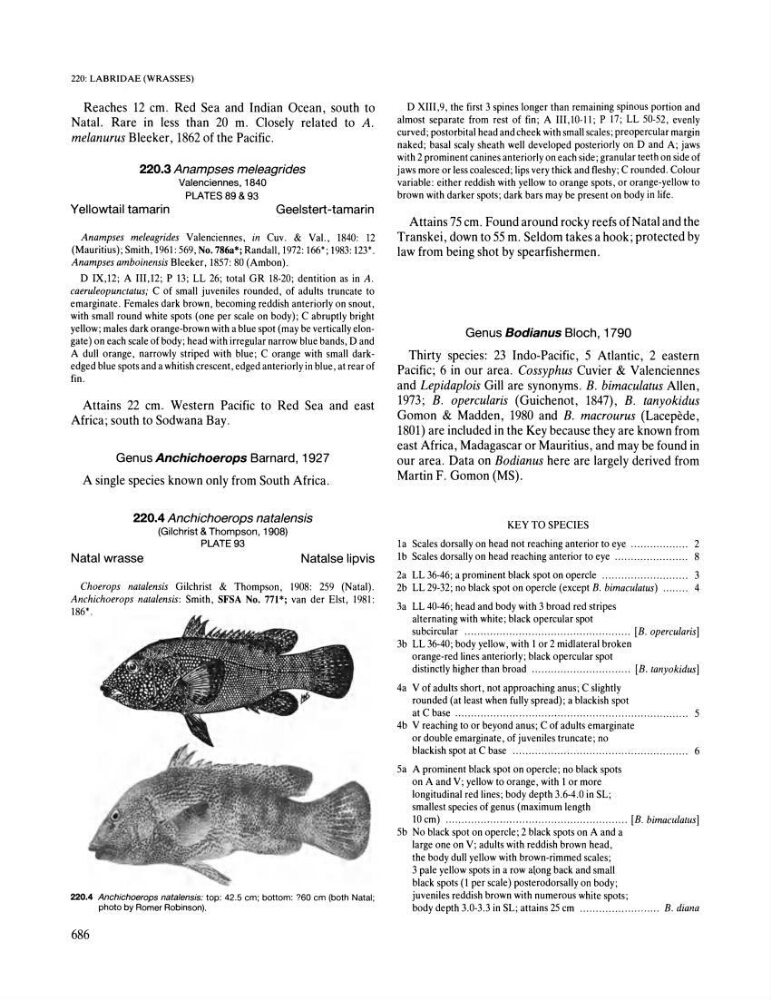
220.4 Anchichoerops natalensis
(Gilchrist & Thompson, 1908)
PLATE 93
Natal wrasse
Natalse lipvis
Choerops natalensis Gilchrist & Thompson, 1908: 259 (Natal).
Anchichoerops natalensis: Smith, SFSA No. 771*; van der Elst, 1981:
186* .
220.4 Anchichoerops natalensis: top: 42.5 cm; bottom: ?60 em (both Natal;
photo by Romer Robinson).
686
D XIII,9, the first 3 spines longer than remaining spinous portion and
almost separate from rest of fin; A 111,10-11; P 17; LL 50-52, evenly
curved; postorbital head and cheek with small scales; preopercular margin
naked; basal scaly sheath well developed posteriorly on D and A; jaws
with 2 prominent canines anteriorly on each side; granular teeth on side of
jaws more or less coalesced; lips very thick and fleshy; C rounded. Colour
variable: either reddish with yellow to orange spots, or orange-yellow to
brown with darker spots; dark bars may be present on body in life.
Attains 75 cm. Found around rocky reefs of Natal and the
Transkei, down to 55 m. Seldom takes a hook; protected by
law from being shot by spearfishermen.
Genus Bodianus Bloch, 1790
Thirty species: 23 Indo-Pacific, 5 Atlantic, 2 eastern
Pacific; 6 in our area. Cossyphus Cuvier & Valenciennes
and Lepidaplois Gill are synonyms. B. bimac.ulatus Allen,
1973; B. opercularis (Guichenot, 1847), B. tanyokidus
Gomon & Madden, 1980 and B. macrourus (Lacepede,
1801) are included in the Key because they are known from
east Africa, Madagascar or Mauritius, and may be found in
our area. Data on Bodianus here are largely derived from
Martin F. Gomon (MS).
KEY TO SPECIES
1 a Scales dorsally on head not reaching anterior to eye .................. 2
1 b Scales dorsally on head reaching anterior to eye ....................... 8
2a LL 36-46; a prominent black spot on opercle ........................... 3
2b LL 29-32; no black spot on opercle (except B. bimaculatus)
4
3a LL 40-46; head and body with 3 broad red stripes
alternating with white; black opercular spot
subcircular .................................................... [B.opercularis]
3b LL 36-40; body yellow, with 1 or 2 midlateral broken
orange-red lines anteriorly; black opercular spot
distinctly higher than broad ............................... [B. tanyokidus]
4a V of adults short, not approaching anus; C slightly
rounded (at least when fully spread); a blackish spot
at C base ......................................................................... 5
4b V reaching to or beyond anus; C of adults emarginate
or double emarginate, of juveniles truncate; no
blackish spot at C base ......................................... .............. 6
5a A prominent black spot on opercle; no black spots
on A and V; yellow to orange, with 1 or more
longitudinal red lines; body depth 3.6-4.0 in SL;
smallest species of genus (maximum length
10 cm) ......................................................... [B. bimaculatus]
5b No black spot on opercle; 2 black spots on A and a
large one on V; adults with reddish brown head,
the body dull yellow with brown-rimmed scales;
3 pale yellow spots in a row along back and small
black spots (1 per scale) posterodorsally on body;
juveniles reddish brown with numerous white spots;
body depth 3.0-3.3 in SL; attains 25 cm ......................... B. diana
Reaches 12 cm. Red Sea and Indian Ocean, south to
Natal. Rare in less than 20 m. Closely related to A.
melanurus Bleeker, 1862 of the Pacific.
220.3 Anampses meleagrides
Valenciennes, 1840
PLATES 89 & 93
Yellowtail tamarin
Geelstert -tamarin
Anampses meleagrides Valenciennes, in Cuv. & Val., 1840: 12
(Mauritius); Smith, 1961: 569, No. 786a*;Randall, 1972: 166*; 1983: 123*.
Anampses amboinensis Bleeker, 1857: 80 (Ambon).
D IX,12; A m,12; P 13; LL 26; total GR 18-20; dentition as in A.
caeruleopunctatus; C of small juveniles rounded, of adults truncate to
emarginate. Females dark brown, becoming reddish anteriorly on snout,
with small round white spots (one per scale on body); C abruptly bright
yellow; males dark orange-brown with a blue spot (may be vertically elongate) on each scale of body; head with irregular narrow blue bands, D and
A dull orange, narrowly striped with blue; C orange with small darkedged blue spots and a whitish crescent, edged anteriorly in blue, at rear of
fin.
Attains 22 cm. Western Pacific to Red Sea and east
Africa; south to Sodwana Bay.
Genus Anchichoerops Barnard, 1927
A single species known only from South Africa.
220.4 Anchichoerops natalensis
(Gilchrist & Thompson, 1908)
PLATE 93
Natal wrasse
Natalse lipvis
Choerops natalensis Gilchrist & Thompson, 1908: 259 (Natal).
Anchichoerops natalensis: Smith, SFSA No. 771*; van der Elst, 1981:
186* .
220.4 Anchichoerops natalensis: top: 42.5 cm; bottom: ?60 em (both Natal;
photo by Romer Robinson).
686
D XIII,9, the first 3 spines longer than remaining spinous portion and
almost separate from rest of fin; A 111,10-11; P 17; LL 50-52, evenly
curved; postorbital head and cheek with small scales; preopercular margin
naked; basal scaly sheath well developed posteriorly on D and A; jaws
with 2 prominent canines anteriorly on each side; granular teeth on side of
jaws more or less coalesced; lips very thick and fleshy; C rounded. Colour
variable: either reddish with yellow to orange spots, or orange-yellow to
brown with darker spots; dark bars may be present on body in life.
Attains 75 cm. Found around rocky reefs of Natal and the
Transkei, down to 55 m. Seldom takes a hook; protected by
law from being shot by spearfishermen.
Genus Bodianus Bloch, 1790
Thirty species: 23 Indo-Pacific, 5 Atlantic, 2 eastern
Pacific; 6 in our area. Cossyphus Cuvier & Valenciennes
and Lepidaplois Gill are synonyms. B. bimac.ulatus Allen,
1973; B. opercularis (Guichenot, 1847), B. tanyokidus
Gomon & Madden, 1980 and B. macrourus (Lacepede,
1801) are included in the Key because they are known from
east Africa, Madagascar or Mauritius, and may be found in
our area. Data on Bodianus here are largely derived from
Martin F. Gomon (MS).
KEY TO SPECIES
1 a Scales dorsally on head not reaching anterior to eye .................. 2
1 b Scales dorsally on head reaching anterior to eye ....................... 8
2a LL 36-46; a prominent black spot on opercle ........................... 3
2b LL 29-32; no black spot on opercle (except B. bimaculatus)
4
3a LL 40-46; head and body with 3 broad red stripes
alternating with white; black opercular spot
subcircular .................................................... [B.opercularis]
3b LL 36-40; body yellow, with 1 or 2 midlateral broken
orange-red lines anteriorly; black opercular spot
distinctly higher than broad ............................... [B. tanyokidus]
4a V of adults short, not approaching anus; C slightly
rounded (at least when fully spread); a blackish spot
at C base ......................................................................... 5
4b V reaching to or beyond anus; C of adults emarginate
or double emarginate, of juveniles truncate; no
blackish spot at C base ......................................... .............. 6
5a A prominent black spot on opercle; no black spots
on A and V; yellow to orange, with 1 or more
longitudinal red lines; body depth 3.6-4.0 in SL;
smallest species of genus (maximum length
10 cm) ......................................................... [B. bimaculatus]
5b No black spot on opercle; 2 black spots on A and a
large one on V; adults with reddish brown head,
the body dull yellow with brown-rimmed scales;
3 pale yellow spots in a row along back and small
black spots (1 per scale) posterodorsally on body;
juveniles reddish brown with numerous white spots;
body depth 3.0-3.3 in SL; attains 25 cm ......................... B. diana