

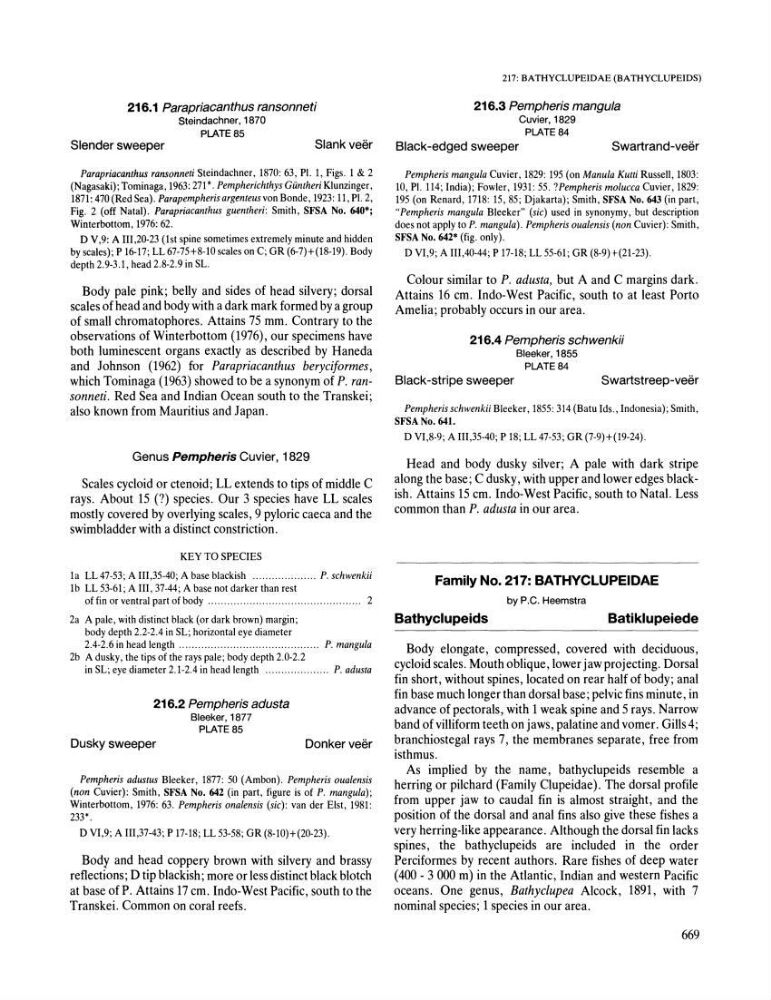
216.1 Parapriacanthus ransonneti
Steindachner, 1870
PLATE 85
Slender sweeper
Siank veer
Parapriacanthus ransonneti Steindachner, 1870: 63, PI. 1, Figs. 1 & 2
(Nagasaki); Tominaga, 1963: 271 *. Pempherichthys Guntheri Klunzinger,
1871: 470 (Red Sea). Parapempheris argenteus von Bonde, 1923: 11, PI. 2,
Fig. 2 (off Natal). Parapriacanthus guentheri: Smith, SFSA No. 640*;
Winterbottom, 1976: 62.
D V,9: A 111,20-23 (1st spine sometimes extremely minute and hidden
by scales); P 16-17; LL 67-75+8-10 scales on C; GR (6-7)+(18-19). Body
depth 2.9-3.1, head 2.8-2.9 in SL.
Body pale pink; belly and sides of head silvery; dorsal
scales of head and body with a dark mark formed by a group
of small chromatophores. Attains 75 mm. Contrary to the
observations of Winterbottom (1976), our specimens have
both luminescent organs exactly as described by Haneda
and Johnson (1962) for Parapriacanthus beryciformes,
which Tominaga (1963) showed to be a synonym of P. ransonneti. Red Sea and Indian Ocean south to the Transkei;
also known from Mauritius and Japan.
Genus Pempheris Cuvier, 1829
Scales cycloid or ctenoid; LL extends to tips of middle C
rays. About 15 (?) species. Our 3 species have LL scales
mostly covered by overlying scales, 9 pyloric caeca and the
swimbladder with a distinct constriction.
KEY TO SPECIES
la LL 47-53; A 111,35-40; A base blackish .................... P. schwenkii
Ib LL 53-61; A III, 37-44; A base not darker than rest
offin or ventral part of body ................................................ 2
2a A pale, with distinct black (or dark brown) margin;
body depth 2.2-2.4 in SL; horizontal eye diameter
2.4-2.6 in head length ............................................ P. mangula
2b A dusky, the tips of the rays pale; body depth 2.0-2.2
in SL; eye diameter 2.1-2.4 in head length .................... P. adusta
216.2 Pempheris adusta
Bleeker, 1877
PLATE 85
Dusky sweeper
Donkerveer
Pempheris adustus Bleeker, 1877: 50 (Ambon). Pempheris oualensis
(non Cuvier): Smith, SFSA No. 642 (in part, figure is of P. mangula);
Winterbottom, 1976: 63. Pempheris onalensis (sic): van der Elst, 1981:
233*.
D VI,9; A 111,37-43; P 17-18; LL 53-58; GR (8-10)+(20-23).
Body and head coppery brown with silvery and brassy
reflections; D tip blackish; more or less distinct black blotch
at base ofP. Attains 17 cm. Indo-West Pacific, south to the
Transkei. Common on coral reefs.
217: BATHYCLUPEIDAE (BATHYCLUPEIDS)
216.3 Pempheris mangula
Cuvier, 1829
PLATE 84
Black-edged sweeper
Swartrand-veer
Pempheris mangula Cuvier, 1829: 195 (on Manula Kutti Russell, 1803:
10, PI. 114; India); Fowler, 1931: 55. ?Pempheris molucca Cuvier, 1829:
195 (on Renard, 1718: 15,85; Djakarta); Smith, SFSA No. 643 (in part,
"Pempheris mangula Bleeker" (sic) used in synonymy, but description
does not apply to P. mangula). Pempheris oualensis (non Cuvier): Smith,
SFSA No. 642* (fig. only).
D VI,9; A UI,40-44; P 17-18; LL 55-61; GR (8-9) t(21-23).
Colour similar to P. adusta, but A and C margins dark.
Attains 16 cm. Indo-West Pacific, south to at least Porto
Amelia; probably occurs in our area.
216.4 Pempheris schwenkii
Bleeker, 1855
PLATE 84
Black-stripe sweeper
Swartstreep-veer
Pempheris schwenkii Bleeker, 1855: 314 (Batu Ids., Indonesia); Smith,
SFSA No. 641.
D VI,8-9; A III,35-40; P 18; LL 47-53; GR (7-9)+(19-24).
Head and body dusky silver; A pale with dark stripe
along the base; C dusky, with upper and lower edges blackish. Attains 15 cm. Indo-West Pacific, south to Natal. Less
common than P. adusta in our area.
Family No. 217: BATHYCLUPEIDAE
by P.C. Heemstra
Bathyclupeids
Batiklupeiede
Body elongate, compressed, covered with deciduous,
cycloid scales. Mouth oblique, lower jaw projecting. Dorsal
fin short, without spines, located on rear half of body; anal
fin base much longer than dorsal base; pelvic fins minute, in
advance of pectorals, with 1 weak spine and 5 rays. Narrow
band of villi form teeth on jaws, palatine and vomer. Gills 4;
branchiostegal rays 7, the membranes separate, free from
isthmus.
As implied by the name, bathyclupeids resemble a
herring or pilchard (Family Clupeidae). The dorsal profile
from upper jaw to caudal fin is almost straight, and the
position of the dorsal and anal fins also give these fishes a
very herring-like appearance. Although the dorsal fin lacks
spines, the bathyclupeids are included in the order
Perciformes by recent authors. Rare fishes of deep water
(400 - 3 000 m) in the Atlantic, Indian and western Pacific
oceans. One genus, Bathyclupea Alcock, 1891, with 7
nominal species; 1 species in our area.
669
Steindachner, 1870
PLATE 85
Slender sweeper
Siank veer
Parapriacanthus ransonneti Steindachner, 1870: 63, PI. 1, Figs. 1 & 2
(Nagasaki); Tominaga, 1963: 271 *. Pempherichthys Guntheri Klunzinger,
1871: 470 (Red Sea). Parapempheris argenteus von Bonde, 1923: 11, PI. 2,
Fig. 2 (off Natal). Parapriacanthus guentheri: Smith, SFSA No. 640*;
Winterbottom, 1976: 62.
D V,9: A 111,20-23 (1st spine sometimes extremely minute and hidden
by scales); P 16-17; LL 67-75+8-10 scales on C; GR (6-7)+(18-19). Body
depth 2.9-3.1, head 2.8-2.9 in SL.
Body pale pink; belly and sides of head silvery; dorsal
scales of head and body with a dark mark formed by a group
of small chromatophores. Attains 75 mm. Contrary to the
observations of Winterbottom (1976), our specimens have
both luminescent organs exactly as described by Haneda
and Johnson (1962) for Parapriacanthus beryciformes,
which Tominaga (1963) showed to be a synonym of P. ransonneti. Red Sea and Indian Ocean south to the Transkei;
also known from Mauritius and Japan.
Genus Pempheris Cuvier, 1829
Scales cycloid or ctenoid; LL extends to tips of middle C
rays. About 15 (?) species. Our 3 species have LL scales
mostly covered by overlying scales, 9 pyloric caeca and the
swimbladder with a distinct constriction.
KEY TO SPECIES
la LL 47-53; A 111,35-40; A base blackish .................... P. schwenkii
Ib LL 53-61; A III, 37-44; A base not darker than rest
offin or ventral part of body ................................................ 2
2a A pale, with distinct black (or dark brown) margin;
body depth 2.2-2.4 in SL; horizontal eye diameter
2.4-2.6 in head length ............................................ P. mangula
2b A dusky, the tips of the rays pale; body depth 2.0-2.2
in SL; eye diameter 2.1-2.4 in head length .................... P. adusta
216.2 Pempheris adusta
Bleeker, 1877
PLATE 85
Dusky sweeper
Donkerveer
Pempheris adustus Bleeker, 1877: 50 (Ambon). Pempheris oualensis
(non Cuvier): Smith, SFSA No. 642 (in part, figure is of P. mangula);
Winterbottom, 1976: 63. Pempheris onalensis (sic): van der Elst, 1981:
233*.
D VI,9; A 111,37-43; P 17-18; LL 53-58; GR (8-10)+(20-23).
Body and head coppery brown with silvery and brassy
reflections; D tip blackish; more or less distinct black blotch
at base ofP. Attains 17 cm. Indo-West Pacific, south to the
Transkei. Common on coral reefs.
217: BATHYCLUPEIDAE (BATHYCLUPEIDS)
216.3 Pempheris mangula
Cuvier, 1829
PLATE 84
Black-edged sweeper
Swartrand-veer
Pempheris mangula Cuvier, 1829: 195 (on Manula Kutti Russell, 1803:
10, PI. 114; India); Fowler, 1931: 55. ?Pempheris molucca Cuvier, 1829:
195 (on Renard, 1718: 15,85; Djakarta); Smith, SFSA No. 643 (in part,
"Pempheris mangula Bleeker" (sic) used in synonymy, but description
does not apply to P. mangula). Pempheris oualensis (non Cuvier): Smith,
SFSA No. 642* (fig. only).
D VI,9; A UI,40-44; P 17-18; LL 55-61; GR (8-9) t(21-23).
Colour similar to P. adusta, but A and C margins dark.
Attains 16 cm. Indo-West Pacific, south to at least Porto
Amelia; probably occurs in our area.
216.4 Pempheris schwenkii
Bleeker, 1855
PLATE 84
Black-stripe sweeper
Swartstreep-veer
Pempheris schwenkii Bleeker, 1855: 314 (Batu Ids., Indonesia); Smith,
SFSA No. 641.
D VI,8-9; A III,35-40; P 18; LL 47-53; GR (7-9)+(19-24).
Head and body dusky silver; A pale with dark stripe
along the base; C dusky, with upper and lower edges blackish. Attains 15 cm. Indo-West Pacific, south to Natal. Less
common than P. adusta in our area.
Family No. 217: BATHYCLUPEIDAE
by P.C. Heemstra
Bathyclupeids
Batiklupeiede
Body elongate, compressed, covered with deciduous,
cycloid scales. Mouth oblique, lower jaw projecting. Dorsal
fin short, without spines, located on rear half of body; anal
fin base much longer than dorsal base; pelvic fins minute, in
advance of pectorals, with 1 weak spine and 5 rays. Narrow
band of villi form teeth on jaws, palatine and vomer. Gills 4;
branchiostegal rays 7, the membranes separate, free from
isthmus.
As implied by the name, bathyclupeids resemble a
herring or pilchard (Family Clupeidae). The dorsal profile
from upper jaw to caudal fin is almost straight, and the
position of the dorsal and anal fins also give these fishes a
very herring-like appearance. Although the dorsal fin lacks
spines, the bathyclupeids are included in the order
Perciformes by recent authors. Rare fishes of deep water
(400 - 3 000 m) in the Atlantic, Indian and western Pacific
oceans. One genus, Bathyclupea Alcock, 1891, with 7
nominal species; 1 species in our area.
669