

217: BATHYCLVPEIDAE (BATHYCLVPEIDS)
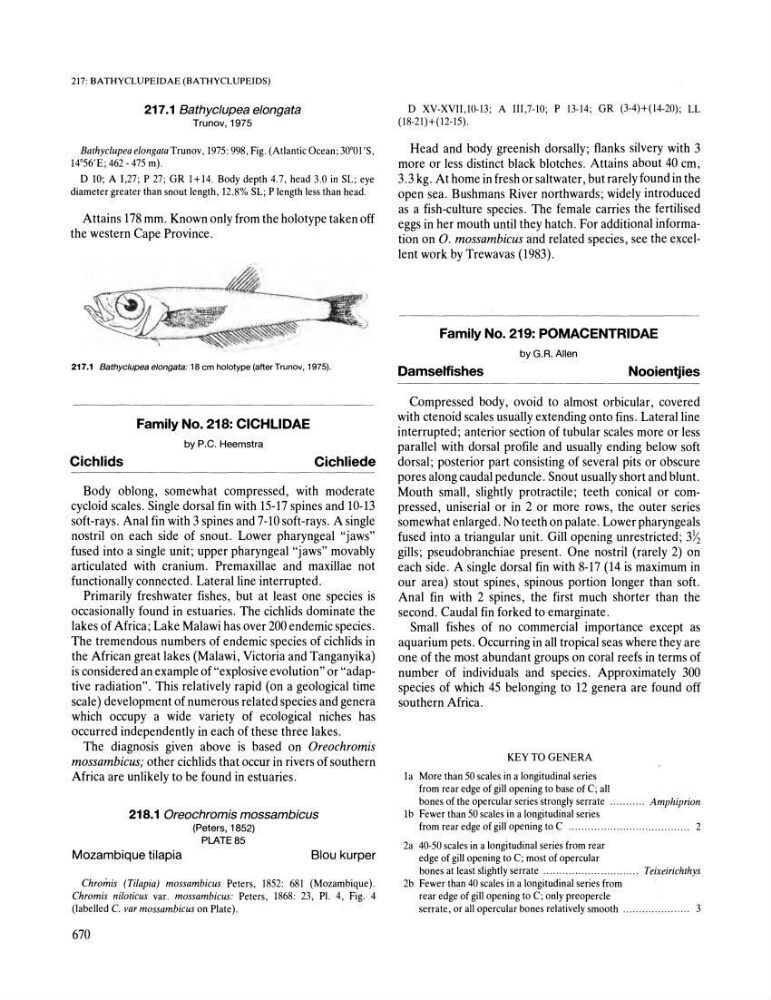
217.1 Bathyclupea elongata
Trunov, 1975
8athyclupea elongata Trunov, 1975: 998, Fig. (Atlantic Ocean; 30°01 'S,
W56'E; 462 - 475 m).
010; A 1,27; P 27; GR 1+14. Body depth 4.7, head 3.0 in SL; eye
diameter greater than snout length, 12.8% SL; P length less than head.
Attains 178 mm. Known only from the holotype taken off
the western Cape Province.
217.1 8athyclupea elongata: 18 em holotype (after Trunov, 1975).
Family No. 218: CICHLIDAE
by P.C. Heemstra
Cichlids
Cichliede
Body oblong, somewhat compressed, with moderate
cycloid scales. Single dorsal fin with 15-17 spines and 10-13
soft-rays. Anal fin with 3 spines and 7-10 soft-rays. A single
nostril on each side of snout. Lower pharyngeal "jaws"
fused into a single unit; upper pharyngeal "jaws" movably
articulated with cranium. Premaxillae and maxillae not
functionally connected. Lateral line interrupted.
Primarily freshwater fishes, but at least one species is
occasionally found in estuaries. The cichlids dominate the
lakes of Africa; Lake Malawi has over 200 endemic species.
The tremendous numbers of endemic species of cichlids in
the African great lakes (Malawi, Victoria and Tanganyika)
is considered an example of "explosive evolution" or "adaptive radiation". This relatively rapid (on a geological time
scale) development of numerous related species and genera
which occupy a wide variety of ecological niches has
occurred independently in each of these three lakes.
The diagnosis given above is based on Oreochromis
mossambicus; other cichlids that occur in rivers of southern
Africa are unlikely to be found in estuaries.
218.1 Oreochromis mossambicus
(Peters, 1852)
PLATE 85
Mozambique tilapia
Blou kurper
Chromis (Ti/apia) mossambicus Peters, 1852: 681 (Mozambique).
Chromis niloticus var. mossambicus: Peters, 1868: 23, PI. 4, Fig. 4
(labelled C. var mossambicus on Plate).
670
o XV-XVII ,10-13; A III ,7-10; P 13-14; GR (3-4)+(14-20); LL
(18-21) + (12-15).
Head and body greenish dorsally; flanks silvery with 3
more or less distinct black blotches. Attains about 40 cm,
3.3 kg. At home in fresh or saltwater, but rarely found in the
open sea. Bushmans River northwards; widely introduced
as a fish-culture species. The female carries the fertilised
eggs in her mouth until they hatch. For additional information on O. mossambicus and related species, see the excellent work by Trewavas (1983).
Family No. 219: POMACENTRIDAE
by G.R. Allen
Damselfishes
Nooientjies
Compressed body, ovoid to almost orbicular, covered
with ctenoid scales usually extending onto fins. Lateral line
interrupted; anterior section of tubular scales more or less
parallel with dorsal profile and usually ending below soft
dorsal; posterior part consisting of several pits or obscure
pores along caudal peduncle. Snout usually short and blunt.
Mouth small, slightly protractile; teeth conical or compressed, uniserial or in 2 or more rows, the outer series
somewhat enlarged. No teeth on palate. Lower pharyngeals
fused into a triangular unit. Gill opening unrestricted; 3~
gills; pseudobranchiae present. One nostril (rarely 2) on
each side. A single dorsal fin with 8-17 (14 is maximum in
our area) stout spines, spinous portion longer than soft.
Anal fin with 2 spines, the first much shorter than the
second. Caudal fin forked to emarginate.
Small fishes of no commercial importance except as
aquarium pets. Occurring in all tropical seas where they are
one of the most abundant groups on coral reefs in terms of
number of individuals and species. Approximately 300
species of which 45 belonging to 12 genera are found off
southern Africa.
KEY TO GENERA
la More than 50 scales in a longitudinal series
from rear edge of gill opening to base of C; all
bones of the opercular series strongly serrate ........... Amphiprion
1 b Fewer than 50 scales in a longitudinal series
from rear edge of gill opening to C ...................................... 2
2a 40-50 scales in a longitudinal series from rear
edge of gill opening to C; most of opercular
bones at least slightly serrate .............................. Teixeirichthys
2b Fewer than 40 scales in a longitudinal series from
rear edge of gill opening to C; only preopercle
serrate, or all opercular bones relatively smooth .... .. ...... .. ....... 3
217.1 Bathyclupea elongata
Trunov, 1975
8athyclupea elongata Trunov, 1975: 998, Fig. (Atlantic Ocean; 30°01 'S,
W56'E; 462 - 475 m).
010; A 1,27; P 27; GR 1+14. Body depth 4.7, head 3.0 in SL; eye
diameter greater than snout length, 12.8% SL; P length less than head.
Attains 178 mm. Known only from the holotype taken off
the western Cape Province.
217.1 8athyclupea elongata: 18 em holotype (after Trunov, 1975).
Family No. 218: CICHLIDAE
by P.C. Heemstra
Cichlids
Cichliede
Body oblong, somewhat compressed, with moderate
cycloid scales. Single dorsal fin with 15-17 spines and 10-13
soft-rays. Anal fin with 3 spines and 7-10 soft-rays. A single
nostril on each side of snout. Lower pharyngeal "jaws"
fused into a single unit; upper pharyngeal "jaws" movably
articulated with cranium. Premaxillae and maxillae not
functionally connected. Lateral line interrupted.
Primarily freshwater fishes, but at least one species is
occasionally found in estuaries. The cichlids dominate the
lakes of Africa; Lake Malawi has over 200 endemic species.
The tremendous numbers of endemic species of cichlids in
the African great lakes (Malawi, Victoria and Tanganyika)
is considered an example of "explosive evolution" or "adaptive radiation". This relatively rapid (on a geological time
scale) development of numerous related species and genera
which occupy a wide variety of ecological niches has
occurred independently in each of these three lakes.
The diagnosis given above is based on Oreochromis
mossambicus; other cichlids that occur in rivers of southern
Africa are unlikely to be found in estuaries.
218.1 Oreochromis mossambicus
(Peters, 1852)
PLATE 85
Mozambique tilapia
Blou kurper
Chromis (Ti/apia) mossambicus Peters, 1852: 681 (Mozambique).
Chromis niloticus var. mossambicus: Peters, 1868: 23, PI. 4, Fig. 4
(labelled C. var mossambicus on Plate).
670
o XV-XVII ,10-13; A III ,7-10; P 13-14; GR (3-4)+(14-20); LL
(18-21) + (12-15).
Head and body greenish dorsally; flanks silvery with 3
more or less distinct black blotches. Attains about 40 cm,
3.3 kg. At home in fresh or saltwater, but rarely found in the
open sea. Bushmans River northwards; widely introduced
as a fish-culture species. The female carries the fertilised
eggs in her mouth until they hatch. For additional information on O. mossambicus and related species, see the excellent work by Trewavas (1983).
Family No. 219: POMACENTRIDAE
by G.R. Allen
Damselfishes
Nooientjies
Compressed body, ovoid to almost orbicular, covered
with ctenoid scales usually extending onto fins. Lateral line
interrupted; anterior section of tubular scales more or less
parallel with dorsal profile and usually ending below soft
dorsal; posterior part consisting of several pits or obscure
pores along caudal peduncle. Snout usually short and blunt.
Mouth small, slightly protractile; teeth conical or compressed, uniserial or in 2 or more rows, the outer series
somewhat enlarged. No teeth on palate. Lower pharyngeals
fused into a triangular unit. Gill opening unrestricted; 3~
gills; pseudobranchiae present. One nostril (rarely 2) on
each side. A single dorsal fin with 8-17 (14 is maximum in
our area) stout spines, spinous portion longer than soft.
Anal fin with 2 spines, the first much shorter than the
second. Caudal fin forked to emarginate.
Small fishes of no commercial importance except as
aquarium pets. Occurring in all tropical seas where they are
one of the most abundant groups on coral reefs in terms of
number of individuals and species. Approximately 300
species of which 45 belonging to 12 genera are found off
southern Africa.
KEY TO GENERA
la More than 50 scales in a longitudinal series
from rear edge of gill opening to base of C; all
bones of the opercular series strongly serrate ........... Amphiprion
1 b Fewer than 50 scales in a longitudinal series
from rear edge of gill opening to C ...................................... 2
2a 40-50 scales in a longitudinal series from rear
edge of gill opening to C; most of opercular
bones at least slightly serrate .............................. Teixeirichthys
2b Fewer than 40 scales in a longitudinal series from
rear edge of gill opening to C; only preopercle
serrate, or all opercular bones relatively smooth .... .. ...... .. ....... 3