

215: CHEILODACfYLIDAE (FINGERFINS)
pools on south Cape coast and has been caught in 240 m off
Natal. One of the commonest fishes along our rocky shores,
but hardly ever takes a bait.
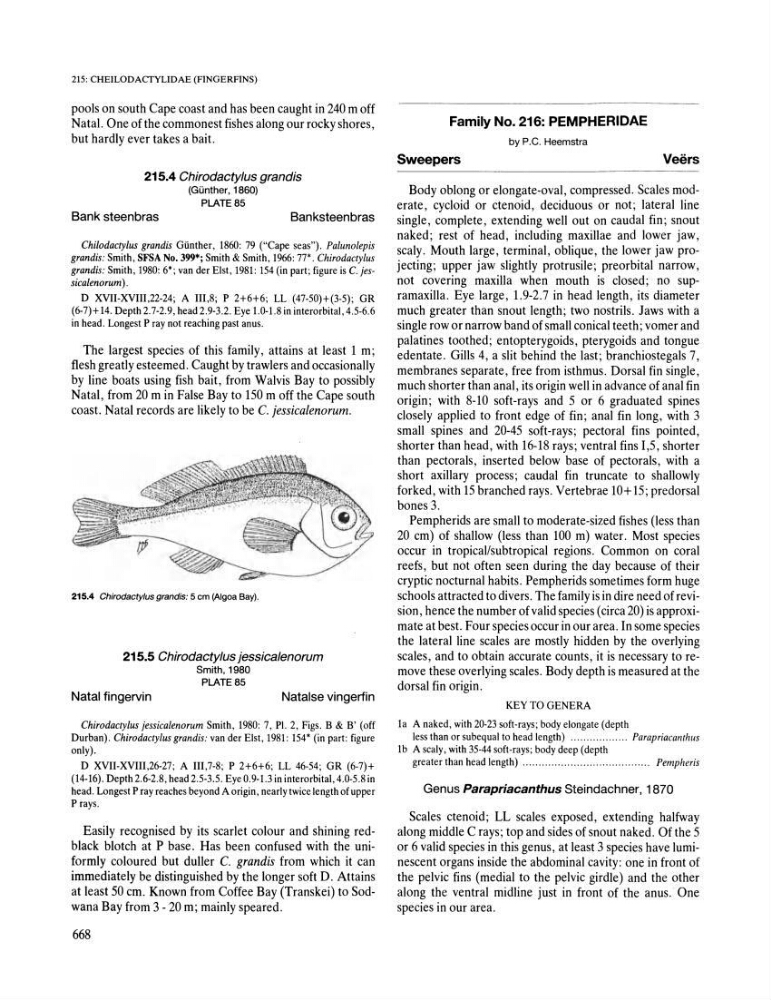
215.4 Chirodactylus grandis
(Gunther, 1860)
PLATE 85
Bank steenbras
Banksteenbras
Chilodactylus grandis Giinther, 1860: 79 (HCape seas"). Palunolepis
grandis: Smith, SFSA No. 399*; Smith & Smith , 1966: 77*. Chirodactylus
grandis: Smith, 1980: 6*; van der Elst, 1981: 154 (in part; figure is C. jessicalenorum) .
D XVII-XVIII,22-24; A III,8; P 2+6+6; LL (47-50)+(3-5); GR
(6-7)+14. Depth 2.7-2.9, head 2.9-3.2. Eye 1.0-1.8 in interorbital, 4.5-6.6
in head. Longest P ray not reaching past anus.
The largest species of this family, attains at least 1 m;
flesh greatly esteemed. Caught by trawlers and occasionally
by line boats using fish bait, from Walvis Bay to possibly
Natal, from 20 m in False Bay to 150 m off the Cape south
coast. Natal records are likely to be C. jessicalenorum.
215.4 Chirodactylus grandis: 5 em (Algoa Bay).
215.5 Chirodactylus jessicalenorum
Smith,1980
PLATE 85
Natal fingervin
Natalse vingerfin
Chirodactylus jessicalenorum Smith, 1980: 7, PI. 2, Figs. B & B' (off
Durban) . Chirodactylus grandis: van der Elst, 1981: 154* (in part: figure
only).
D XVII-XVIII ,26-27; A III ,7-8; P 2+6+6; LL 46-54; GR (6-7)+
(14-16). Depth 2.6-2.8, head 2.5-3.5. Eye 0.9-1.3 in interorbital, 4.0-5 .8 in
head. Longest P ray reaches beyond A origin, nearly twice length of upper
Prays.
Easily recognised by its scarlet colour and shining redblack blotch at P base. Has been confused with the uniformly coloured but duller C. grandis from which it can
immediately be distinguished by the longer soft D. Attains
at least 50 cm. Known from Coffee Bay (Transkei) to Sodwana Bay from 3 - 20 m; mainly speared.
668
Family No. 216: PEMPHERIDAE
by P.C. Heemstra
Sweepers
Veers
Body oblong or elongate-oval, compressed. Scales moderate, cycloid or ctenoid, deciduous or not; lateral line
single, complete, extending well out on caudal fin; snout
naked; rest of head, including maxillae and lower jaw,
scaly. Mouth large, terminal, oblique, the lower jaw projecting; upper jaw slightly protrusile; preorbital narrow,
not covering maxilla when mouth is closed; no supramaxilla. Eye large, 1.9-2.7 in head length, its diameter
much greater than snout length; two nostrils. Jaws with a
single row or narrow band of small conical teeth; vomer and
palatines toothed; entopterygoids, pterygoids and tongue
edentate. Gills 4, a slit behind the last; branchiostegals 7,
membranes separate, free from isthmus. Dorsal fin single,
much shorter than anal, its origin well in advance of anal fin
origin; with 8-10 soft-rays and 5 or 6 graduated spines
closely applied to front edge of fin; anal fin long, with 3
small spines and 20-45 soft-rays; pectoral fins pointed,
shorter than head, with 16-18 rays; ventral fins 1,5, shorter
than pectorals, inserted below base of pectorals, with a
short axillary process; caudal fin truncate to shallowly
forked, with 15 branched rays. Vertebrae 10+ 15; predorsal
bones 3.
Pempherids are small to moderate-sized fishes (less than
20 cm) of shallow (less than 100 m) water. Most species
occur in tropical/subtropical regions. Common on coral
reefs, but not often seen during the day because of their
cryptic nocturnal habits. Pempherids sometimes form huge
schools attracted to divers. The family is in dire need of revision, hence the number of valid species (circa 20) is approximate at best. Four species occur in our area. In some species
the lateral line scales are mostly hidden by the overlying
scales, and to obtain accurate counts, it is necessary to remove these overlying scales. Body depth is measured at the
dorsal fin origin.
KEY TO GENERA
la A naked, with 20-23 soft-rays; body elongate (depth
less than or subequal to head length) .................. Parapriacanthlls
Ib A scaly, with 35-44 soft-rays; body deep (depth
greater than head length) .................................. .. .... Pempheris
Genus Parapriacanthu5 Steindachner, 1870
Scales ctenoid; LL scales exposed, extending halfway
along middle C rays; top and sides of snout naked. Of the 5
or 6 valid species in this genus, at least 3 species have luminescent organs inside the abdominal cavity: one in front of
the pelvic fins (medial to the pelvic girdle) and the other
along the ventral midline just in front of the anus. One
species in our area.
pools on south Cape coast and has been caught in 240 m off
Natal. One of the commonest fishes along our rocky shores,
but hardly ever takes a bait.
215.4 Chirodactylus grandis
(Gunther, 1860)
PLATE 85
Bank steenbras
Banksteenbras
Chilodactylus grandis Giinther, 1860: 79 (HCape seas"). Palunolepis
grandis: Smith, SFSA No. 399*; Smith & Smith , 1966: 77*. Chirodactylus
grandis: Smith, 1980: 6*; van der Elst, 1981: 154 (in part; figure is C. jessicalenorum) .
D XVII-XVIII,22-24; A III,8; P 2+6+6; LL (47-50)+(3-5); GR
(6-7)+14. Depth 2.7-2.9, head 2.9-3.2. Eye 1.0-1.8 in interorbital, 4.5-6.6
in head. Longest P ray not reaching past anus.
The largest species of this family, attains at least 1 m;
flesh greatly esteemed. Caught by trawlers and occasionally
by line boats using fish bait, from Walvis Bay to possibly
Natal, from 20 m in False Bay to 150 m off the Cape south
coast. Natal records are likely to be C. jessicalenorum.
215.4 Chirodactylus grandis: 5 em (Algoa Bay).
215.5 Chirodactylus jessicalenorum
Smith,1980
PLATE 85
Natal fingervin
Natalse vingerfin
Chirodactylus jessicalenorum Smith, 1980: 7, PI. 2, Figs. B & B' (off
Durban) . Chirodactylus grandis: van der Elst, 1981: 154* (in part: figure
only).
D XVII-XVIII ,26-27; A III ,7-8; P 2+6+6; LL 46-54; GR (6-7)+
(14-16). Depth 2.6-2.8, head 2.5-3.5. Eye 0.9-1.3 in interorbital, 4.0-5 .8 in
head. Longest P ray reaches beyond A origin, nearly twice length of upper
Prays.
Easily recognised by its scarlet colour and shining redblack blotch at P base. Has been confused with the uniformly coloured but duller C. grandis from which it can
immediately be distinguished by the longer soft D. Attains
at least 50 cm. Known from Coffee Bay (Transkei) to Sodwana Bay from 3 - 20 m; mainly speared.
668
Family No. 216: PEMPHERIDAE
by P.C. Heemstra
Sweepers
Veers
Body oblong or elongate-oval, compressed. Scales moderate, cycloid or ctenoid, deciduous or not; lateral line
single, complete, extending well out on caudal fin; snout
naked; rest of head, including maxillae and lower jaw,
scaly. Mouth large, terminal, oblique, the lower jaw projecting; upper jaw slightly protrusile; preorbital narrow,
not covering maxilla when mouth is closed; no supramaxilla. Eye large, 1.9-2.7 in head length, its diameter
much greater than snout length; two nostrils. Jaws with a
single row or narrow band of small conical teeth; vomer and
palatines toothed; entopterygoids, pterygoids and tongue
edentate. Gills 4, a slit behind the last; branchiostegals 7,
membranes separate, free from isthmus. Dorsal fin single,
much shorter than anal, its origin well in advance of anal fin
origin; with 8-10 soft-rays and 5 or 6 graduated spines
closely applied to front edge of fin; anal fin long, with 3
small spines and 20-45 soft-rays; pectoral fins pointed,
shorter than head, with 16-18 rays; ventral fins 1,5, shorter
than pectorals, inserted below base of pectorals, with a
short axillary process; caudal fin truncate to shallowly
forked, with 15 branched rays. Vertebrae 10+ 15; predorsal
bones 3.
Pempherids are small to moderate-sized fishes (less than
20 cm) of shallow (less than 100 m) water. Most species
occur in tropical/subtropical regions. Common on coral
reefs, but not often seen during the day because of their
cryptic nocturnal habits. Pempherids sometimes form huge
schools attracted to divers. The family is in dire need of revision, hence the number of valid species (circa 20) is approximate at best. Four species occur in our area. In some species
the lateral line scales are mostly hidden by the overlying
scales, and to obtain accurate counts, it is necessary to remove these overlying scales. Body depth is measured at the
dorsal fin origin.
KEY TO GENERA
la A naked, with 20-23 soft-rays; body elongate (depth
less than or subequal to head length) .................. Parapriacanthlls
Ib A scaly, with 35-44 soft-rays; body deep (depth
greater than head length) .................................. .. .... Pempheris
Genus Parapriacanthu5 Steindachner, 1870
Scales ctenoid; LL scales exposed, extending halfway
along middle C rays; top and sides of snout naked. Of the 5
or 6 valid species in this genus, at least 3 species have luminescent organs inside the abdominal cavity: one in front of
the pelvic fins (medial to the pelvic girdle) and the other
along the ventral midline just in front of the anus. One
species in our area.