

D VII+I,19-21; A 11+1,17-21; GR (2+5)+(7-11); no scutes. LL very
irregular and sinuous, describing a convex curve above and a concave
curve behind P.
Adults brown dorsally, silvery white below LL with lobes
of D and A black distally; juveniles with brownish black
bands on sides. Common to 100 cm, reaches sexual maturity
at ca. 55 cm, reported to attain 180 cm. South African angling record 32 kg. An inshore or estuarine species found in
surface waters to a depth of at least 50 m and everywhere
highly esteemed as a gamefish. Prefers live or moving bait,
and may often be seen in pursuit of mullet at the surface.
Mediterranean Sea, southward along the entire African
coast and around the Cape to Delagoa Bay.
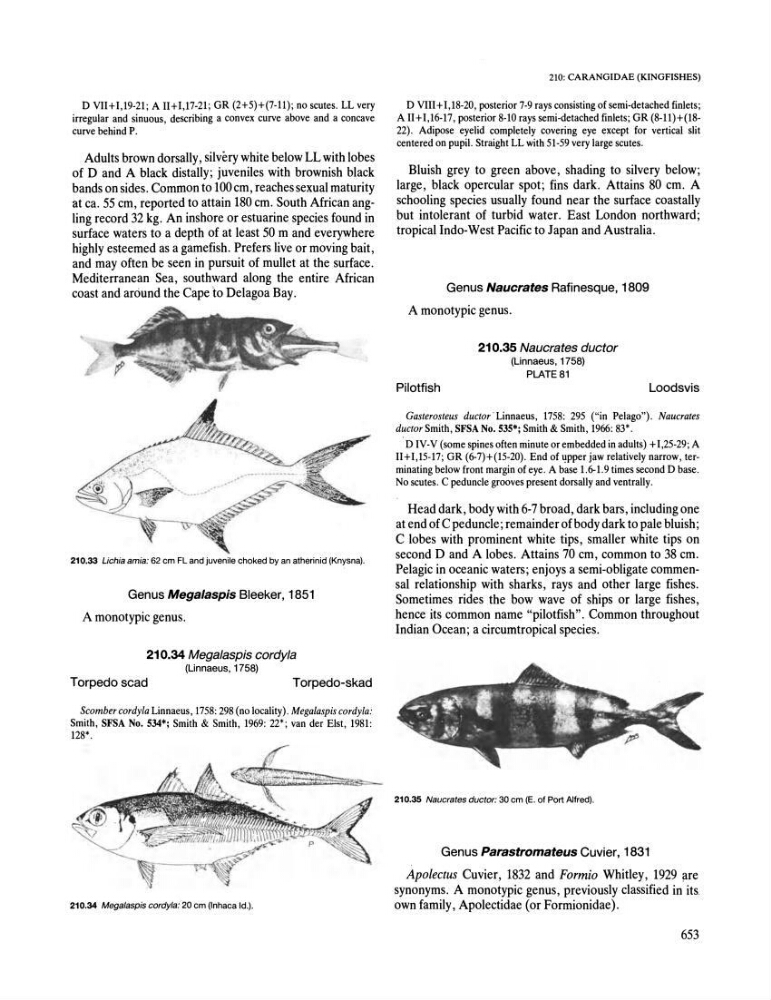
210.33 Lichia amia: 62 cm FL and juvenile choked by an atherinid (Knysna).
Genus Mega/aspis Bleeker, 1851
A monotypic genus.
210.34 Megalaspis eordyla
(Linnaeus, 1758)
Torpedo scad
Torpedo-skad
Scomber cordyla Linnaeus, 1758: 298 (no locality). Megalaspis cordyla:
Smith, SFSA No. 534*; Smith & Smith, 1969: 22*; van der Elst, 1981:
128*.
210.34 Mega/aspis cordy/a: 20 cm (Inhaca Id.).
210: CARANGIDAE (KINGFISHES)
D VIII + 1,18-20, posterior 7-9 rays consisting of semi-detached finlets;
A II + 1,16-17, posterior 8-10 rays semi-detached finlets; GR (8-11)+(1822). Adipose eyelid completely covering eye except for vertical slit
centered on pupil. Straight LL with 51-59 very large scutes.
Bluish grey to green above, shading to silvery below;
large, black opercular spot; fins dark. Attains 80 cm. A
schooling species usually found near the surface coastally
but intolerant of turbid water. East London northward;
tropical Indo-West Pacific to Japan and Australia.
Genus Naucrates Rafinesque, 1809
A monotypic genus.
Pilotfish
210.35 Nauerates duetor
(Linnaeus, 1758)
PLATE 81
Loodsvis
Gasterosteus ductor Linnaeus, 1758: 295 ("in Pelago"). Naucrates
ductor Smith, SFSA No. 535*; Smith & Smith, 1966: 83*.
D IV-V (some spines often minute or embedded in adults) + 1,25-29; A
11+1,15-17; GR (6-7)+(15-20). End of I!Pper jaw relatively narrow, terminating below front margin of eye. A base 1.6-1.9 times second Dbase.
No scutes. C peduncle grooves present dorsally and ventrally.
Head dark, body with 6-7 broad, dark bars, including one
at end of C peduncle; remainder of body dark to pale bluish;
C lobes with prominent white tips, smaller white tips on
second D and A lobes. Attains 70 cm, common to 38 cm.
Pelagic in oceanic waters; enjoys a semi-obligate commensal relationship with sharks, rays and other large fishes.
Sometimes rides the bow wave of ships or large fishes,
hence its common name "pilotfish". Common throughout
Indian Ocean; a circumtropical species.
210.35 Naucrates ductor: 30 cm (E. of Port Alfred).
Genus Parastromateus Cuvier, 1831
Apolectus Cuvier, 1832 and Formio Whitley, 1929 are
synonyms. A mono typic genus, previously classified in its.
own family, Apolectidae (or Formionidae).
653
irregular and sinuous, describing a convex curve above and a concave
curve behind P.
Adults brown dorsally, silvery white below LL with lobes
of D and A black distally; juveniles with brownish black
bands on sides. Common to 100 cm, reaches sexual maturity
at ca. 55 cm, reported to attain 180 cm. South African angling record 32 kg. An inshore or estuarine species found in
surface waters to a depth of at least 50 m and everywhere
highly esteemed as a gamefish. Prefers live or moving bait,
and may often be seen in pursuit of mullet at the surface.
Mediterranean Sea, southward along the entire African
coast and around the Cape to Delagoa Bay.
210.33 Lichia amia: 62 cm FL and juvenile choked by an atherinid (Knysna).
Genus Mega/aspis Bleeker, 1851
A monotypic genus.
210.34 Megalaspis eordyla
(Linnaeus, 1758)
Torpedo scad
Torpedo-skad
Scomber cordyla Linnaeus, 1758: 298 (no locality). Megalaspis cordyla:
Smith, SFSA No. 534*; Smith & Smith, 1969: 22*; van der Elst, 1981:
128*.
210.34 Mega/aspis cordy/a: 20 cm (Inhaca Id.).
210: CARANGIDAE (KINGFISHES)
D VIII + 1,18-20, posterior 7-9 rays consisting of semi-detached finlets;
A II + 1,16-17, posterior 8-10 rays semi-detached finlets; GR (8-11)+(1822). Adipose eyelid completely covering eye except for vertical slit
centered on pupil. Straight LL with 51-59 very large scutes.
Bluish grey to green above, shading to silvery below;
large, black opercular spot; fins dark. Attains 80 cm. A
schooling species usually found near the surface coastally
but intolerant of turbid water. East London northward;
tropical Indo-West Pacific to Japan and Australia.
Genus Naucrates Rafinesque, 1809
A monotypic genus.
Pilotfish
210.35 Nauerates duetor
(Linnaeus, 1758)
PLATE 81
Loodsvis
Gasterosteus ductor Linnaeus, 1758: 295 ("in Pelago"). Naucrates
ductor Smith, SFSA No. 535*; Smith & Smith, 1966: 83*.
D IV-V (some spines often minute or embedded in adults) + 1,25-29; A
11+1,15-17; GR (6-7)+(15-20). End of I!Pper jaw relatively narrow, terminating below front margin of eye. A base 1.6-1.9 times second Dbase.
No scutes. C peduncle grooves present dorsally and ventrally.
Head dark, body with 6-7 broad, dark bars, including one
at end of C peduncle; remainder of body dark to pale bluish;
C lobes with prominent white tips, smaller white tips on
second D and A lobes. Attains 70 cm, common to 38 cm.
Pelagic in oceanic waters; enjoys a semi-obligate commensal relationship with sharks, rays and other large fishes.
Sometimes rides the bow wave of ships or large fishes,
hence its common name "pilotfish". Common throughout
Indian Ocean; a circumtropical species.
210.35 Naucrates ductor: 30 cm (E. of Port Alfred).
Genus Parastromateus Cuvier, 1831
Apolectus Cuvier, 1832 and Formio Whitley, 1929 are
synonyms. A mono typic genus, previously classified in its.
own family, Apolectidae (or Formionidae).
653