

210: CARANGIDAE (KINGFISHES)
(10-12)+(30-33). Upper jaw with single series of minute teeth. Margin of
opercular membrane minutely serrated.
Blue to greenish above, silvery below; C bright red and
tips of D rays reddish; small black opercular spot. Attains
50 cm. A schooling species usually taken by trawl in 200 -
360 m. Not yet reported from our area, but almost certainly
present. Originally believed to be restricted to the Atlantic
Ocean; now known from Kenya, Japan, Indonesia, Australia
and Hawaiian Ids.
Genus Elagatis Bennett, 1840
A monotypic genus.
210.31 Elagatis bipinnulata
(Quay & Gaimard, 1825)
PLATE 81
Rainbow runner
Reenboog-pylvis
Seriola bipinnulata Quoy & Gaimard, 1825: 363, PI. 61, Fig. 3 (Keeling
Id. New Guinea). Elagatis bipinnulatus: Smith. SFSA No. 543*; van der
Elst, 1981: 125*.
o VI + 1,25-28+2; A 1+ 1,18-20+2. End of upper jaw terminating distinctly before eye (to below front margin of eye in young). A base relatively short, about 1.5 times soft 0 base. No scutes. C peduncle grooves
present dorsally and ventrally.
Dark olive green or blue above, white below; 2 narrow
light blue or bluish white stripes along sides, with a broader
olive or yellowish stripe between them; fins with an olive or
yellow tint. Attains 120 cm, common to 80 cm; world angling record 15.2 kg. A pelagic species, usually found at or
near the surface, sometimes far offshore. An excellent
food-fish with superb fighting abilities. Durban northward;
a circumtropical species, but apparently rare in eastern
Atlantic Ocean.
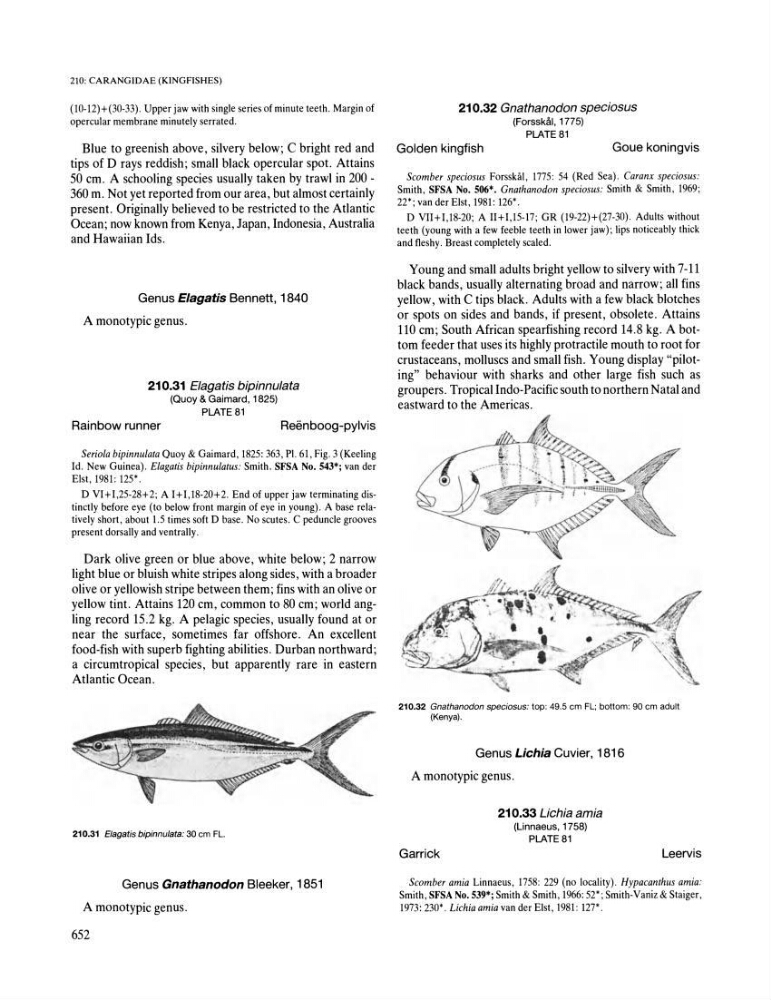
210.31 Elagatis bipinnulata: 30 em Fl.
Genus Gnathanodon Bleeker, 1851
A monotypic genus.
652
210.32 Gnathanodon speciosus
(Farsskal, 1775)
PLATE 81
Golden kingfish
Goue koningvis
Scomber speciosus Forsskal, 1775: 54 (Red Sea). Caranx speciosus:
Smith, SFSA No. 506*. Gnathanodon speciosus: Smith & Smith, 1969;
22*; van derElst, 1981: 126*.
o VII+1,18-20; A II+1,15-17; GR (19-22)+(27-30). Adults without
teeth (young with a few feeble teeth in lower jaw); lips noticeably thick
and fleshy. Breast completely scaled.
Young and small adults bright yellow to silvery with 7-11
black bands, usually alternating broad and narrow; all fins
yellow, with C tips black. Adults with a few black blotches
or spots on sides and bands, if present, obsolete. Attains
110 cm; South African spearfishing record 14.8 kg. A bottom feeder that uses its highly protractile mouth to root for
crustaceans, molluscs and small fish. Young display "piloting" behaviour with sharks and other large fish such as
groupers. Tropical Indo-Pacific south to northern Natal and
eastward to the Americas.
210.32 Gnathanodon speeiosus: top: 49.5 em FL; bottom: 90 em adult
(Kenya).
Genus Lichia Cuvier, 1816
A monotypic genus.
Garrick
210.33 Lichia amia
(Linnaeus, 1758)
PLATE 81
Leervis
Scomber amia Linnaeus, 1758: 229 (no locality). Hypacanthus amia:
Smith, SFSA No. 539*; Smith & Smith, 1966: 52*; Smith-Vaniz & Staiger,
1973: 230*. Lichia amia van der Elst, 1981: 127*.
(10-12)+(30-33). Upper jaw with single series of minute teeth. Margin of
opercular membrane minutely serrated.
Blue to greenish above, silvery below; C bright red and
tips of D rays reddish; small black opercular spot. Attains
50 cm. A schooling species usually taken by trawl in 200 -
360 m. Not yet reported from our area, but almost certainly
present. Originally believed to be restricted to the Atlantic
Ocean; now known from Kenya, Japan, Indonesia, Australia
and Hawaiian Ids.
Genus Elagatis Bennett, 1840
A monotypic genus.
210.31 Elagatis bipinnulata
(Quay & Gaimard, 1825)
PLATE 81
Rainbow runner
Reenboog-pylvis
Seriola bipinnulata Quoy & Gaimard, 1825: 363, PI. 61, Fig. 3 (Keeling
Id. New Guinea). Elagatis bipinnulatus: Smith. SFSA No. 543*; van der
Elst, 1981: 125*.
o VI + 1,25-28+2; A 1+ 1,18-20+2. End of upper jaw terminating distinctly before eye (to below front margin of eye in young). A base relatively short, about 1.5 times soft 0 base. No scutes. C peduncle grooves
present dorsally and ventrally.
Dark olive green or blue above, white below; 2 narrow
light blue or bluish white stripes along sides, with a broader
olive or yellowish stripe between them; fins with an olive or
yellow tint. Attains 120 cm, common to 80 cm; world angling record 15.2 kg. A pelagic species, usually found at or
near the surface, sometimes far offshore. An excellent
food-fish with superb fighting abilities. Durban northward;
a circumtropical species, but apparently rare in eastern
Atlantic Ocean.
210.31 Elagatis bipinnulata: 30 em Fl.
Genus Gnathanodon Bleeker, 1851
A monotypic genus.
652
210.32 Gnathanodon speciosus
(Farsskal, 1775)
PLATE 81
Golden kingfish
Goue koningvis
Scomber speciosus Forsskal, 1775: 54 (Red Sea). Caranx speciosus:
Smith, SFSA No. 506*. Gnathanodon speciosus: Smith & Smith, 1969;
22*; van derElst, 1981: 126*.
o VII+1,18-20; A II+1,15-17; GR (19-22)+(27-30). Adults without
teeth (young with a few feeble teeth in lower jaw); lips noticeably thick
and fleshy. Breast completely scaled.
Young and small adults bright yellow to silvery with 7-11
black bands, usually alternating broad and narrow; all fins
yellow, with C tips black. Adults with a few black blotches
or spots on sides and bands, if present, obsolete. Attains
110 cm; South African spearfishing record 14.8 kg. A bottom feeder that uses its highly protractile mouth to root for
crustaceans, molluscs and small fish. Young display "piloting" behaviour with sharks and other large fish such as
groupers. Tropical Indo-Pacific south to northern Natal and
eastward to the Americas.
210.32 Gnathanodon speeiosus: top: 49.5 em FL; bottom: 90 em adult
(Kenya).
Genus Lichia Cuvier, 1816
A monotypic genus.
Garrick
210.33 Lichia amia
(Linnaeus, 1758)
PLATE 81
Leervis
Scomber amia Linnaeus, 1758: 229 (no locality). Hypacanthus amia:
Smith, SFSA No. 539*; Smith & Smith, 1966: 52*; Smith-Vaniz & Staiger,
1973: 230*. Lichia amia van der Elst, 1981: 127*.