

210: CARANGIDAE (KINGFISHES)
210.36 Parastromateus niger
(Bloch,1795)
PLATE 81
Black pomfret
Swart pomfret
Stromateus niger Bloch, 1795: 93, PI. 422 (no locality). Apolectus niger:
Smith, SFSA No. 500*; Smith & Smith, 1963: 20*.
D IV-V (embedded and not apparent in all but young) +1,41-44; A
II + I ,35-39, profile of soft D and A nearly identical with elevated, broadly
rounded anterior lobes; minute V present in young, absent in adults.
Straight LL with 8-19 weak scutes, forming a slight keel on C peduncle.
Silvery grey to bluish brown, fins with dark edges; dark
blotch on rear margin of opercle opposite P; young with
dark bands and black, jugular V. Attains 55 cm. A pelagic
species often occurring in large schools in 15 - 40 m generally over muddy bottoms. An excellent food-fish, only
rarely takes a bait, and frequently swims on its side near surface. At times abundant in Delagoa Bay; eastward to southern Japan and Australia.
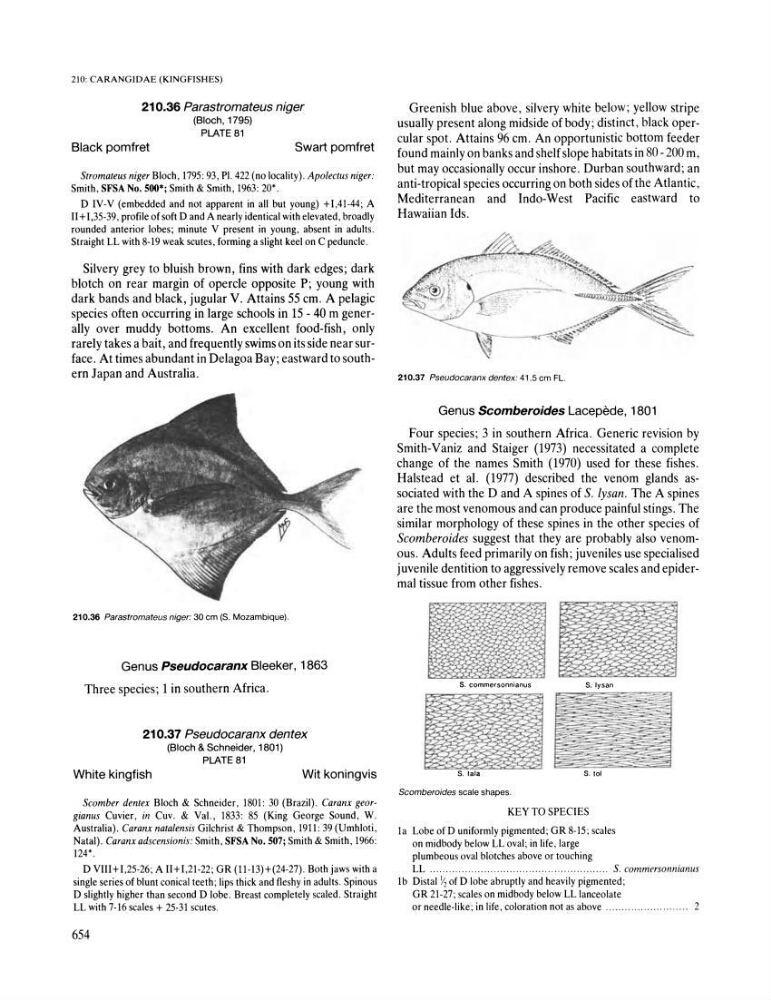
210.36 Parastromateus niger: 30 em (S. Mozambique).
Genus Pseudocaranx Bleeker, 1863
Three species; 1 in southern Africa.
210.37 Pseudocaranx dentex
(Bloch & Schneider, 1801)
PLATE 81
White kingfish
Wit koningvis
Scomber dentex Bloch & Schneider, 1801: 30 (Brazil). Caranx georgianus Cuvier, in Cuv. & Val., 1833: 85 (King George Sound, W.
Australia). Caranx natalensis Gilchrist & Thompson, 1911: 39 (Umhloti,
Natal). Caranx adscensionis: Smith, SFSA No. 507; Smith & Smith, 1966:
124*'
D VIII + 1,25-26; A II + 1,21-22; GR (11-13)+(24-27). Both jaws with a
single series of blunt conical teeth; lips thick and fleshy in adults. Spinous
D slightly higher than second D lobe. Breast completely scaled. Straight
LL with 7-16 scales + 25-31 scutes.
654
Greenish blue above, silvery white below; yellow stripe
usually present along midside of body; distinct, black opercular spot. Attains 96 cm. An opportunistic bottom feeder
found mainly on banks and shelf slope habitats in 80 - 200 m,
but may occasionally occur inshore. Durban southward; an
anti-tropical species occurring on both sides of the Atlantic,
Mediterranean and Indo-West Pacific eastward to
Hawaiian Ids.
210.37 Pseudocaranx dentex: 41.5 em Flo
Genus Scomberoides Lacepede, 1801
Four species; 3 in southern Africa. Generic revision by
Smith-Vaniz and Staiger (1973) necessitated a complete
change of the names Smith (1970) used for these fishes.
Halstead et al. (1977) described the venom glands associated with the D and A spines of S. lysan. The A spines
are the most venomous and can produce painful stings. The
similar morphology of these spines in the other species of
Scomberoides suggest that they are probably also venomous. Adults feed primarily on fish; juveniles use specialised
juvenile dentition to aggressively remove scales and epidermal tissue from other fishes.
Scomberoides seale shapes.
S. Iysan
=--=-----.='"
KEY TO SPECIES
la Lobe of D uniformly pigmented; GR 8-15; scales
on midbody below LL oval; in life, large
plumbeous oval blotches above or touching
LL ........................................................ S. commersonnianus
1 b Distal ~ of D lobe abruptly and heavily pigmented;
GR 21-27; scales on midbody below LL lanceolate
or needle-like; in life, coloration not as above ...... ................... 2
210.36 Parastromateus niger
(Bloch,1795)
PLATE 81
Black pomfret
Swart pomfret
Stromateus niger Bloch, 1795: 93, PI. 422 (no locality). Apolectus niger:
Smith, SFSA No. 500*; Smith & Smith, 1963: 20*.
D IV-V (embedded and not apparent in all but young) +1,41-44; A
II + I ,35-39, profile of soft D and A nearly identical with elevated, broadly
rounded anterior lobes; minute V present in young, absent in adults.
Straight LL with 8-19 weak scutes, forming a slight keel on C peduncle.
Silvery grey to bluish brown, fins with dark edges; dark
blotch on rear margin of opercle opposite P; young with
dark bands and black, jugular V. Attains 55 cm. A pelagic
species often occurring in large schools in 15 - 40 m generally over muddy bottoms. An excellent food-fish, only
rarely takes a bait, and frequently swims on its side near surface. At times abundant in Delagoa Bay; eastward to southern Japan and Australia.
210.36 Parastromateus niger: 30 em (S. Mozambique).
Genus Pseudocaranx Bleeker, 1863
Three species; 1 in southern Africa.
210.37 Pseudocaranx dentex
(Bloch & Schneider, 1801)
PLATE 81
White kingfish
Wit koningvis
Scomber dentex Bloch & Schneider, 1801: 30 (Brazil). Caranx georgianus Cuvier, in Cuv. & Val., 1833: 85 (King George Sound, W.
Australia). Caranx natalensis Gilchrist & Thompson, 1911: 39 (Umhloti,
Natal). Caranx adscensionis: Smith, SFSA No. 507; Smith & Smith, 1966:
124*'
D VIII + 1,25-26; A II + 1,21-22; GR (11-13)+(24-27). Both jaws with a
single series of blunt conical teeth; lips thick and fleshy in adults. Spinous
D slightly higher than second D lobe. Breast completely scaled. Straight
LL with 7-16 scales + 25-31 scutes.
654
Greenish blue above, silvery white below; yellow stripe
usually present along midside of body; distinct, black opercular spot. Attains 96 cm. An opportunistic bottom feeder
found mainly on banks and shelf slope habitats in 80 - 200 m,
but may occasionally occur inshore. Durban southward; an
anti-tropical species occurring on both sides of the Atlantic,
Mediterranean and Indo-West Pacific eastward to
Hawaiian Ids.
210.37 Pseudocaranx dentex: 41.5 em Flo
Genus Scomberoides Lacepede, 1801
Four species; 3 in southern Africa. Generic revision by
Smith-Vaniz and Staiger (1973) necessitated a complete
change of the names Smith (1970) used for these fishes.
Halstead et al. (1977) described the venom glands associated with the D and A spines of S. lysan. The A spines
are the most venomous and can produce painful stings. The
similar morphology of these spines in the other species of
Scomberoides suggest that they are probably also venomous. Adults feed primarily on fish; juveniles use specialised
juvenile dentition to aggressively remove scales and epidermal tissue from other fishes.
Scomberoides seale shapes.
S. Iysan
=--=-----.='"
KEY TO SPECIES
la Lobe of D uniformly pigmented; GR 8-15; scales
on midbody below LL oval; in life, large
plumbeous oval blotches above or touching
LL ........................................................ S. commersonnianus
1 b Distal ~ of D lobe abruptly and heavily pigmented;
GR 21-27; scales on midbody below LL lanceolate
or needle-like; in life, coloration not as above ...... ................... 2