

Giant kingfish
210.17 Caranx ignobilis
(Forsskal, 1775)
Reuse koningvis
Scomber ignobilis Forsskal, 1775: 55 (Red Sea). Caranx ignobilis:
Smith, SFSA No. 520*; 1961: 568. Smith & Smith, 1963: 22*; Smith, 1967:
PI. 30; van der Elst, 1981; 120*.
o VIII+I,18-21; A 11+1,15-17; D+A 1,34-38; GR (5-7)+(15-17).
Straight LL with 26-38 strong scutes. Breast naked ventrally, typically
with a small patch of prepelvic scales.
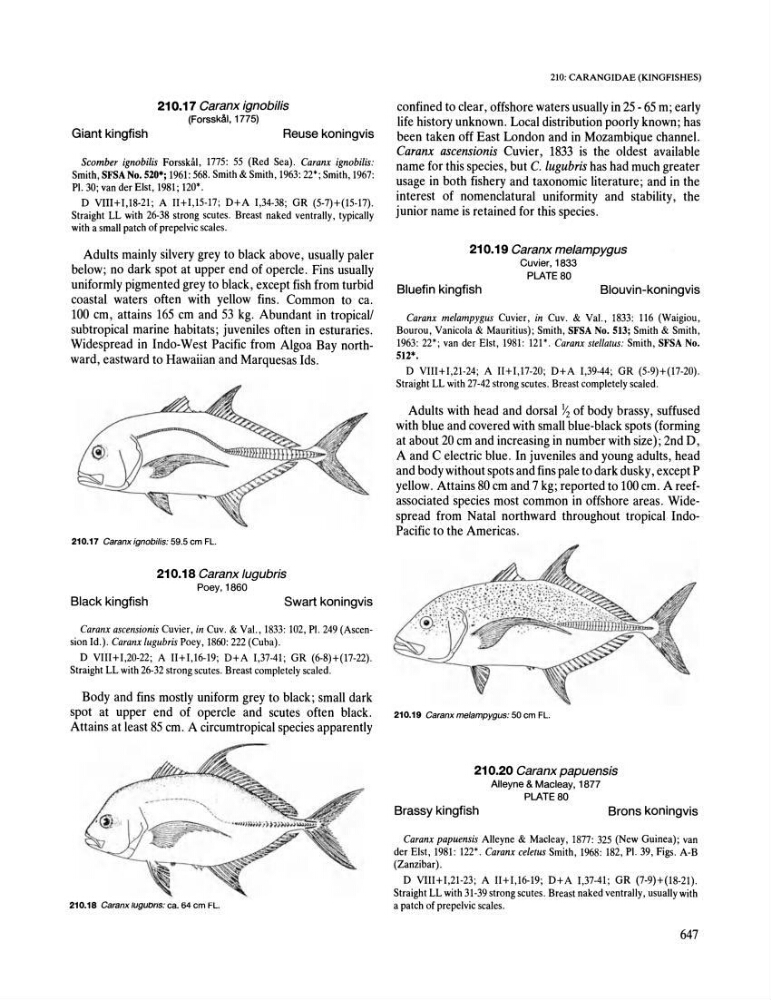
Adults mainly silvery grey to black above, usually paler
below; no dark spot at upper end of opercle. Fins usually
uniformly pigmented grey to black, except fish from turbid
coastal waters often with yellow fins. Common to ca.
100 cm, attains 165 cm and 53 kg. Abundant in tropical!
subtropical marine habitats; juveniles often in esturaries.
Widespread in Indo-West Pacific from Algoa Bay northward, eastward to Hawaiian and Marquesas Ids.
210.17 Caranx ignobilis: 59.5 em FL.
Black kingfish
210.18 Caranx lugubris
Poey, 1860
Swart koningvis
Caranx ascension is Cuvier, in Cuv. & Val., 1833: 102, PI. 249 (Ascension Id.). Caranx lugubris Poey, 1860: 222 (Cuba).
o VIII+I,20-22; A 11+1,16-19; D+A 1,37-41; GR (6-8)+(17-22).
Straight LL with 26-32 strong scutes. Breast completely scaled.
Body and fins mostly uniform grey to black; small dark
spot at upper end of opercle and scutes often black.
Attains at least 85 cm. A circumtropical species apparently
210.18 Caranx lugUOflS: ea. 64 em FL.
210: CARANGIDAE (KINGFISHES)
confined to clear, offshore waters usually in 25 - 65 m; early
life history unknown. Local distribution poorly known; has
been taken off East London and in Mozambique channel.
Caranx ascensionis Cuvier, 1833 is the oldest available
name for this species, but C. lugubris has had much greater
usage in both fishery and taxonomic literature; and in the
interest of nomenclatural uniformity and stability, the
junior name is retained for this species.
210.19 Caranx melampygus
Cuvier, 1833
PLATEBO
Bluefin kingfish
Blouvin-koningvis
Caranx melampygus Cuvier, in Cuv. & Val., 1833: 116 (Waigiou,
Bourou, Vanicola & Mauritius); Smith, SFSA No. 513; Smith & Smith,
1963: 22*; van der Elst, 1981: 121*. Caranx stellatus: Smith, SFSA No.
512*.
D VIII+I,21-24; A 11+1,17-20; D+A 1,39-44; GR (5-9)+(17-20).
Straight LL with 27-42 strong scutes. Breast completely scaled.
Adults with head and dorsal Yz of body brassy, suffused
with blue and covered with small blue-black spots (forming
at about 20 cm and increasing in number with size); 2nd D,
A and C electric blue. In juveniles and young adults, head
and body without spots and fins pale to dark dusky, except P
yellow. Attains 80 cm and 7 kg; reported to 100 cm. A reefassociated species most common in offshore areas. Widespread from Natal northward throughout tropical IndoPacific to the Americas.
210.19 Caranx melampygus: 50 em FL.
210.20 Caranx papuensis
Alleyne & Macleay, 1877
PLATE 80
Brassy kingfish
Brons koningvis
Caranx papuensis Alleyne & Mac1eay, 1877: 325 (New Guinea); van
der Elst, 1981: 122*. Caranx celetus Smith, 1968: 182, PI. 39, Figs. A-B
(Zanzibar) .
o VIII+I,21-23; A 11+1,16-19; D+A 1,37-41; GR (7-9)+(18-21).
Straight LL with 31-39 strong scutes. Breast naked ventrally, usually with
a patch of prepelvic scales.
647
210.17 Caranx ignobilis
(Forsskal, 1775)
Reuse koningvis
Scomber ignobilis Forsskal, 1775: 55 (Red Sea). Caranx ignobilis:
Smith, SFSA No. 520*; 1961: 568. Smith & Smith, 1963: 22*; Smith, 1967:
PI. 30; van der Elst, 1981; 120*.
o VIII+I,18-21; A 11+1,15-17; D+A 1,34-38; GR (5-7)+(15-17).
Straight LL with 26-38 strong scutes. Breast naked ventrally, typically
with a small patch of prepelvic scales.
Adults mainly silvery grey to black above, usually paler
below; no dark spot at upper end of opercle. Fins usually
uniformly pigmented grey to black, except fish from turbid
coastal waters often with yellow fins. Common to ca.
100 cm, attains 165 cm and 53 kg. Abundant in tropical!
subtropical marine habitats; juveniles often in esturaries.
Widespread in Indo-West Pacific from Algoa Bay northward, eastward to Hawaiian and Marquesas Ids.
210.17 Caranx ignobilis: 59.5 em FL.
Black kingfish
210.18 Caranx lugubris
Poey, 1860
Swart koningvis
Caranx ascension is Cuvier, in Cuv. & Val., 1833: 102, PI. 249 (Ascension Id.). Caranx lugubris Poey, 1860: 222 (Cuba).
o VIII+I,20-22; A 11+1,16-19; D+A 1,37-41; GR (6-8)+(17-22).
Straight LL with 26-32 strong scutes. Breast completely scaled.
Body and fins mostly uniform grey to black; small dark
spot at upper end of opercle and scutes often black.
Attains at least 85 cm. A circumtropical species apparently
210.18 Caranx lugUOflS: ea. 64 em FL.
210: CARANGIDAE (KINGFISHES)
confined to clear, offshore waters usually in 25 - 65 m; early
life history unknown. Local distribution poorly known; has
been taken off East London and in Mozambique channel.
Caranx ascensionis Cuvier, 1833 is the oldest available
name for this species, but C. lugubris has had much greater
usage in both fishery and taxonomic literature; and in the
interest of nomenclatural uniformity and stability, the
junior name is retained for this species.
210.19 Caranx melampygus
Cuvier, 1833
PLATEBO
Bluefin kingfish
Blouvin-koningvis
Caranx melampygus Cuvier, in Cuv. & Val., 1833: 116 (Waigiou,
Bourou, Vanicola & Mauritius); Smith, SFSA No. 513; Smith & Smith,
1963: 22*; van der Elst, 1981: 121*. Caranx stellatus: Smith, SFSA No.
512*.
D VIII+I,21-24; A 11+1,17-20; D+A 1,39-44; GR (5-9)+(17-20).
Straight LL with 27-42 strong scutes. Breast completely scaled.
Adults with head and dorsal Yz of body brassy, suffused
with blue and covered with small blue-black spots (forming
at about 20 cm and increasing in number with size); 2nd D,
A and C electric blue. In juveniles and young adults, head
and body without spots and fins pale to dark dusky, except P
yellow. Attains 80 cm and 7 kg; reported to 100 cm. A reefassociated species most common in offshore areas. Widespread from Natal northward throughout tropical IndoPacific to the Americas.
210.19 Caranx melampygus: 50 em FL.
210.20 Caranx papuensis
Alleyne & Macleay, 1877
PLATE 80
Brassy kingfish
Brons koningvis
Caranx papuensis Alleyne & Mac1eay, 1877: 325 (New Guinea); van
der Elst, 1981: 122*. Caranx celetus Smith, 1968: 182, PI. 39, Figs. A-B
(Zanzibar) .
o VIII+I,21-23; A 11+1,16-19; D+A 1,37-41; GR (7-9)+(18-21).
Straight LL with 31-39 strong scutes. Breast naked ventrally, usually with
a patch of prepelvic scales.
647