

210: CARANGIDAE (KINGFISHES)
D VIII + 1,20-22; A II + 1,18-19; GR (7-9)+(17-21). Straight LL with 0-2
scales + 37-45 scutes. Breast naked to V origin, laterally naked area
separated from naked P base by broad band of scales. Curved LL slightly
shorter than straight LL.
Bluish green above, silvery below; small dark blotches on
back between bases of D rays. Attains 46 cm. Durban
northward throughout western Indian Ocean and from
Japan to Australia and eastward to the Fiji Ids.
210.15 Carangoides ob/angus: 28 em FL.
210.16 Carangoides plagiotaenia
Bleeker, 1857
Barcheek kingfish
Balkwang-koningvis
Carangoides plagiotaenia Bleeker, 1857: 59 (Amboina); M.M. Smith,
1972: 231. Caranx vomerinus Playfair , in Playfair & Gunther, 1867: 59, PI.
10, Fig. 1 (Seychelles). Caranx compress us Day, 1878: 221, PI. 50, Fig. 1
(India); Smith, SFSA No. 514*; Smith & Smith, 1963: 20' .
D VIII+I,22-24; A 11+1 ,18-20; GR (8-14)+(19-27) . Straight LL with
20-26 scales + 11-18 scutes. Breast completely scaled. Adults with lower
jaw somewhat enlarged and projecting beyond upper jaw.
Body generally silvery, sometimes with 6-7 dusky, oblique bars; adults with rear margin of preopercle distinctly
dark or black; no opercular spot. Attains 50 cm . Prefers
outer reef areas, usually taken while bottom fishing . IndoWest Pacific south to Durban and eastward to Marshall Ids.
210.16 Carangaides p/agiataenia: 30 em FL.
Genus Caranx Lacepede, 1801
Generic limits of Caranx not well established; as here
defined, 13 species, 7 in southern Africa. Breast squamation
variable in C. sem, which will key out under both sections of
first couplet.
646
KEY TO SPECIES
la Breast completely scaled .. ....... ... ........ .....
. ......... ....... . 2
Ib Breast naked ventrally, frequently with a small patch
of prepelvic scales ........... .... ... .... ... ... .... ....... .... .... .... .. ........ 6
2a Soft D lobe relatively long, 2.3-5.3 in FL; in life,
essentially uniform dark grey to brown; profile of
head relatively steep and angular .............................. C. lugubris
2b Soft D lobe 4.2-8.8 in FL; body coloration not as
above; profile of head not noticeably steep and
angular ... .. ... ..... ............. .......................... ... ....... .... .. ....... 3
3a Small black spots on head and body (forming at
about 16-22 cm FL); snout length 9.2-12.7 in FL;
total GR (including rudiments) 25-29 and total
D + A rays = 39-44 ........ ...... ................. .......... C. melampygus
3b No small black spots on head and body; snout 13.1-18.4
in FL; GR (including rudiments) 22-25 , except 23-27
in C. sem which has 34-38 total D + A rays .... ..... .. ......... ... ... ... 4
4a No small black spot on upper margin of opercle;
upper lobe of C frequently with distal Yz noticeably
dark or black, especially in juveniles; in adults,
adipose eyelid only slightly developed ...... ................ ....... C. sem
4b Small black spot on upper margin of opercle; upper
lobe of C usually uniformly pigmented; in adults,
adipose eyelid well developed, especially posteriorly ...... .... ....... 5
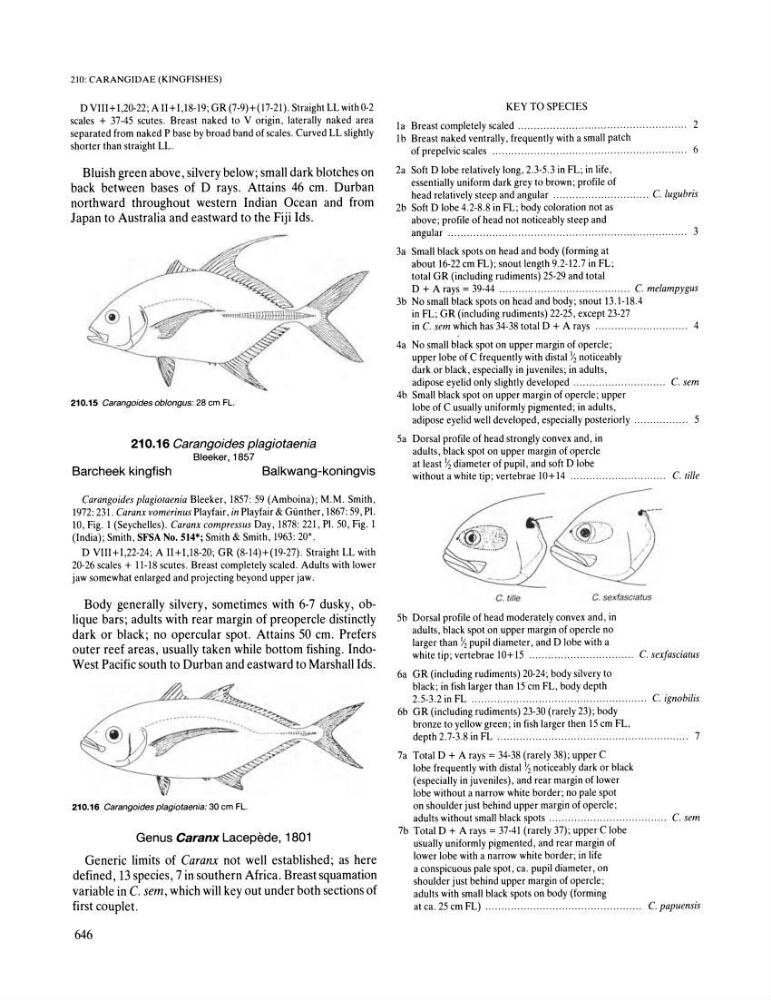
5a Dorsal profile of head strongly convex and, in
adults, black spot on upper margin of opercle
at least Yz diameter of pupil , and soft D lobe
without a white tip ; vertebrae 10+ 14 .............................. C. tille
C.lille
C. sexfascialus
5b Dorsal profile of head moderately convex and, in
adults, black spot on upper margin of opercle no
larger than Yz pupil diameter, and D lobe with a
white tip; vertebrae 10+ 15 ................................. C. sexfasciatus
6a GR (including rudiments) 20-24; body silvery to
black; in fish larger than 15 cm FL, body depth
2.5-3.2 in FL ...... .... ................ ............................. C. ignobilis
6b GR (including rudiments) 23-30 (rarely 23); body
bronze to yellow green; in fish larger then 15 cm FL,
depth 2.7-3.8 in FL ....................................................... .. ... 7
7a Total D + A rays = 34-38 (rarely 38); upper C
lobe frequently with distal Yz noticeably dark or black
(especially in juveniles), and rear margin of lower
lobe without a narrow white border; no pale spot
on shoulder just behind upper margin of opercle;
adults without small black spots ..................................... C. sem
7b Total D + A rays = 37-41 (rarely 37); upper C lobe
usually uniformly pigmented, and rear margin of
lower lobe with a narrow white border; in life
a conspicuous pale spot, ca. pupil diameter, on
shoulder just behind upper margin of opercle;
adults with small black spots on body (forming
at ca. 25 cm FL) ............................................ .... C. papuensis
D VIII + 1,20-22; A II + 1,18-19; GR (7-9)+(17-21). Straight LL with 0-2
scales + 37-45 scutes. Breast naked to V origin, laterally naked area
separated from naked P base by broad band of scales. Curved LL slightly
shorter than straight LL.
Bluish green above, silvery below; small dark blotches on
back between bases of D rays. Attains 46 cm. Durban
northward throughout western Indian Ocean and from
Japan to Australia and eastward to the Fiji Ids.
210.15 Carangoides ob/angus: 28 em FL.
210.16 Carangoides plagiotaenia
Bleeker, 1857
Barcheek kingfish
Balkwang-koningvis
Carangoides plagiotaenia Bleeker, 1857: 59 (Amboina); M.M. Smith,
1972: 231. Caranx vomerinus Playfair , in Playfair & Gunther, 1867: 59, PI.
10, Fig. 1 (Seychelles). Caranx compress us Day, 1878: 221, PI. 50, Fig. 1
(India); Smith, SFSA No. 514*; Smith & Smith, 1963: 20' .
D VIII+I,22-24; A 11+1 ,18-20; GR (8-14)+(19-27) . Straight LL with
20-26 scales + 11-18 scutes. Breast completely scaled. Adults with lower
jaw somewhat enlarged and projecting beyond upper jaw.
Body generally silvery, sometimes with 6-7 dusky, oblique bars; adults with rear margin of preopercle distinctly
dark or black; no opercular spot. Attains 50 cm . Prefers
outer reef areas, usually taken while bottom fishing . IndoWest Pacific south to Durban and eastward to Marshall Ids.
210.16 Carangaides p/agiataenia: 30 em FL.
Genus Caranx Lacepede, 1801
Generic limits of Caranx not well established; as here
defined, 13 species, 7 in southern Africa. Breast squamation
variable in C. sem, which will key out under both sections of
first couplet.
646
KEY TO SPECIES
la Breast completely scaled .. ....... ... ........ .....
. ......... ....... . 2
Ib Breast naked ventrally, frequently with a small patch
of prepelvic scales ........... .... ... .... ... ... .... ....... .... .... .... .. ........ 6
2a Soft D lobe relatively long, 2.3-5.3 in FL; in life,
essentially uniform dark grey to brown; profile of
head relatively steep and angular .............................. C. lugubris
2b Soft D lobe 4.2-8.8 in FL; body coloration not as
above; profile of head not noticeably steep and
angular ... .. ... ..... ............. .......................... ... ....... .... .. ....... 3
3a Small black spots on head and body (forming at
about 16-22 cm FL); snout length 9.2-12.7 in FL;
total GR (including rudiments) 25-29 and total
D + A rays = 39-44 ........ ...... ................. .......... C. melampygus
3b No small black spots on head and body; snout 13.1-18.4
in FL; GR (including rudiments) 22-25 , except 23-27
in C. sem which has 34-38 total D + A rays .... ..... .. ......... ... ... ... 4
4a No small black spot on upper margin of opercle;
upper lobe of C frequently with distal Yz noticeably
dark or black, especially in juveniles; in adults,
adipose eyelid only slightly developed ...... ................ ....... C. sem
4b Small black spot on upper margin of opercle; upper
lobe of C usually uniformly pigmented; in adults,
adipose eyelid well developed, especially posteriorly ...... .... ....... 5
5a Dorsal profile of head strongly convex and, in
adults, black spot on upper margin of opercle
at least Yz diameter of pupil , and soft D lobe
without a white tip ; vertebrae 10+ 14 .............................. C. tille
C.lille
C. sexfascialus
5b Dorsal profile of head moderately convex and, in
adults, black spot on upper margin of opercle no
larger than Yz pupil diameter, and D lobe with a
white tip; vertebrae 10+ 15 ................................. C. sexfasciatus
6a GR (including rudiments) 20-24; body silvery to
black; in fish larger than 15 cm FL, body depth
2.5-3.2 in FL ...... .... ................ ............................. C. ignobilis
6b GR (including rudiments) 23-30 (rarely 23); body
bronze to yellow green; in fish larger then 15 cm FL,
depth 2.7-3.8 in FL ....................................................... .. ... 7
7a Total D + A rays = 34-38 (rarely 38); upper C
lobe frequently with distal Yz noticeably dark or black
(especially in juveniles), and rear margin of lower
lobe without a narrow white border; no pale spot
on shoulder just behind upper margin of opercle;
adults without small black spots ..................................... C. sem
7b Total D + A rays = 37-41 (rarely 37); upper C lobe
usually uniformly pigmented, and rear margin of
lower lobe with a narrow white border; in life
a conspicuous pale spot, ca. pupil diameter, on
shoulder just behind upper margin of opercle;
adults with small black spots on body (forming
at ca. 25 cm FL) ............................................ .... C. papuensis