

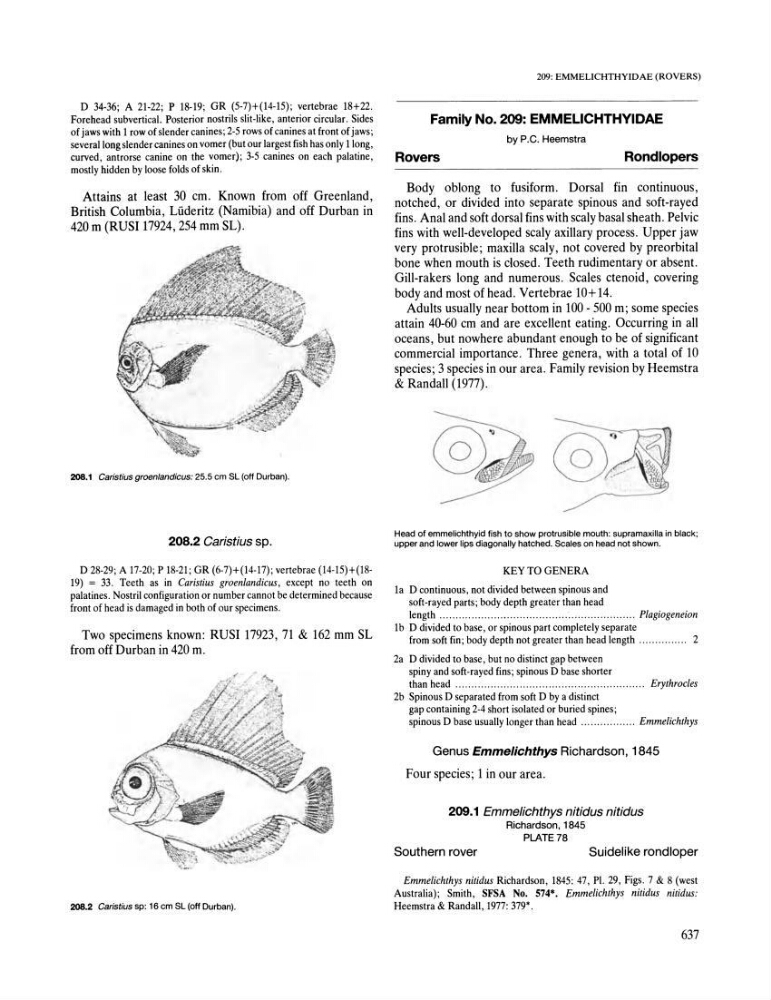
D 34-36; A 21-22; P 18-19; GR (5-7)+(14-15); vertebrae 18+22.
Forehead subvertical. Posterior nostrils slit-like, anterior circular. Sides
of jaws with 1 row of slender canines; 2-5 rows of canines at front of jaws;
several long slender canines on vomer (but our largest fish has only 1 long,
curved, antrorse canine on the vomer); 3-5 canines on each palatine,
mos.tly hidden by loose folds of skin.
Attains at least 30 cm. Known from off Greenland,
British Columbia, Liideritz (Namibia) and off Durban in
420 m (RUSI 17924,254 mm SL).
208.1 Caristius groenlandicus: 25.5 cm SL (off Durban).
208.2 Caristius sp.
D 28-29; A 17-20; P 18-21; GR (6-7)+(14-17); vertebrae (14-15)+(1819) = 33. Teeth as in Caristius groenlandicus, except no teeth on
palatines . Nostril configuration or number cannot be determined because
front of head is damaged in both of our specimens.
Two specimens known: RUSI 17923, 71 & 162 mm SL
from off Durban in 420 m.
208.2 Caristius sp: 16 cm SL (off Durban).
209: EMMELICHTHYIDAE (ROVERS)
Family No. 209: EMMELICHTHYIDAE
by P.C. Heemstra
Rovers
Rondlopers
Body oblong to fusiform. Dorsal fin continuous,
notched, or divided into separate spinous and soft-rayed
fins. Anal and soft dorsal fins with scaly basal sheath. Pelvic
fins with well-developed scaly axillary process. Upper jaw
very protrusible; maxilla scaly, not covered by preorbital
bone when mouth is closed. Teeth rudimentary or absent.
Gill-rakers long and numerous. Scales ctenoid, covering
body and most of head. Vertebrae 10+ 14.
Adults usually near bottom in 100 - 500 m; some species
attain 40-60 cm and are excellent eating. Occurring in all
oceans, but nowhere abundant enough to be of significant
commercial importance. Three genera, with a total of 10
species; 3 species in our area. Family revision by Heemstra
& Randall (1977).
Head of emmelichthyid fish to show protrusible mouth: supramaxilla in black;
upper and lower lips diagonally hatched. Scales on head not shown.
KEY TO GENERA
1a D continuous, not divided between spinous and
soft-rayed parts; body depth greater than head
length .... ............ ........... ......... .. ..... .... .............. Plagiogeneion
1b D divided to base, or spinous part completely separate
from soft fin; body depth not greater than head length..... .... ...... 2
2a D divided to base, but no distinct gap between
spiny and soft-rayed fins; spinous D base shorter
than head ........... ... ... ...... ...... ... .............. ... ... .... ... Erythrocles
2b Spinous D separated from soft D by a distinct
gap containing 2-4 short isolated or buried spines;
spinous D base usually longer than head .... .... ..... ... . Emmelichthys
Genus Emmelichthys Richardson, 1845
Four species; 1 in our area.
209.1 Emme/ichthys nitidus nitidus
Richardson, 1845
PLATE 78
Southern rover
Suidelike rondloper
Emmelichthys nitidus Richardson, 1845: 47, PI. 29, Figs . 7 & 8 (west
Australia) ; Smith , SFSA No. 574*. Emmelichthys nitidus nitidus:
Heemstra & Randall, 1977: 379'.
637
Forehead subvertical. Posterior nostrils slit-like, anterior circular. Sides
of jaws with 1 row of slender canines; 2-5 rows of canines at front of jaws;
several long slender canines on vomer (but our largest fish has only 1 long,
curved, antrorse canine on the vomer); 3-5 canines on each palatine,
mos.tly hidden by loose folds of skin.
Attains at least 30 cm. Known from off Greenland,
British Columbia, Liideritz (Namibia) and off Durban in
420 m (RUSI 17924,254 mm SL).
208.1 Caristius groenlandicus: 25.5 cm SL (off Durban).
208.2 Caristius sp.
D 28-29; A 17-20; P 18-21; GR (6-7)+(14-17); vertebrae (14-15)+(1819) = 33. Teeth as in Caristius groenlandicus, except no teeth on
palatines . Nostril configuration or number cannot be determined because
front of head is damaged in both of our specimens.
Two specimens known: RUSI 17923, 71 & 162 mm SL
from off Durban in 420 m.
208.2 Caristius sp: 16 cm SL (off Durban).
209: EMMELICHTHYIDAE (ROVERS)
Family No. 209: EMMELICHTHYIDAE
by P.C. Heemstra
Rovers
Rondlopers
Body oblong to fusiform. Dorsal fin continuous,
notched, or divided into separate spinous and soft-rayed
fins. Anal and soft dorsal fins with scaly basal sheath. Pelvic
fins with well-developed scaly axillary process. Upper jaw
very protrusible; maxilla scaly, not covered by preorbital
bone when mouth is closed. Teeth rudimentary or absent.
Gill-rakers long and numerous. Scales ctenoid, covering
body and most of head. Vertebrae 10+ 14.
Adults usually near bottom in 100 - 500 m; some species
attain 40-60 cm and are excellent eating. Occurring in all
oceans, but nowhere abundant enough to be of significant
commercial importance. Three genera, with a total of 10
species; 3 species in our area. Family revision by Heemstra
& Randall (1977).
Head of emmelichthyid fish to show protrusible mouth: supramaxilla in black;
upper and lower lips diagonally hatched. Scales on head not shown.
KEY TO GENERA
1a D continuous, not divided between spinous and
soft-rayed parts; body depth greater than head
length .... ............ ........... ......... .. ..... .... .............. Plagiogeneion
1b D divided to base, or spinous part completely separate
from soft fin; body depth not greater than head length..... .... ...... 2
2a D divided to base, but no distinct gap between
spiny and soft-rayed fins; spinous D base shorter
than head ........... ... ... ...... ...... ... .............. ... ... .... ... Erythrocles
2b Spinous D separated from soft D by a distinct
gap containing 2-4 short isolated or buried spines;
spinous D base usually longer than head .... .... ..... ... . Emmelichthys
Genus Emmelichthys Richardson, 1845
Four species; 1 in our area.
209.1 Emme/ichthys nitidus nitidus
Richardson, 1845
PLATE 78
Southern rover
Suidelike rondloper
Emmelichthys nitidus Richardson, 1845: 47, PI. 29, Figs . 7 & 8 (west
Australia) ; Smith , SFSA No. 574*. Emmelichthys nitidus nitidus:
Heemstra & Randall, 1977: 379'.
637