

207: BRAMIDAE (POMFRETS)
disappear after about 40 cm SL, those on C peduncle
antrorse when present, but not enlarged; in adults no LL,
but about 5 series of scales along flank are ridged. Small,
recurved, caniniform teeth in bands on jaws, teeth become
smaller and bands narrow posteriorly to 1-2 series; vomer
with 3 similar teeth, narrow bands on palatines. Two
species, both in our area.
KEY TO SPECIES
la LS, from upper end of gill opening to C base,
39-46 (Atlantic) ................................................ T. /ongipinnis
Ib LS, from upper end of gill opening to C base,
34-38 (Indo-Pacific) ........................................ T. steindachneri
207.7 Taractichthys longipinnis
(Lowe, 1843)
Bigscale pomfret
Grootskub-pomfret
Brama /ongipinnis Lowe, 1843: 82 (Madeira). Taractes longipinnis:
Smith, SFSA No. 860 (in part); Barnard, 1948: 373*; Smith, 1965: 16*;
1966: 71. Taractichthys /ongipinnis: Mead, 1972: 85*.
D 33-38; A 27-30; P 20-22; GR 3+8 with 3 spinule platelets above and
3-4 below; LS 39-46; vertebrae (19-22)+(25-26) = 44-47; P about 1.5
times head length; V hardly exceeds eye diameter.
Grey or silver with coppery reflections. Preserved: black;
P, distal part of V and crescentic border on C whitish; no
pigment inside mouth. Attains over 1 m. Tropical/temperate
Atlantic, south to Walvis Bay (or False Bay?).
207.7 Taractichthys longipinnis: 48 em SL (Walvis Bay).
207.8 Taractichthys steindachneri
(Doderlein, 1883)
Sickle pomfret
Sekel-pomfret
Argo steindachneri DOderlein, in Steindachner & Doderlein, 1883: 34,
PI. 7 (Tokyo, Japan). Taractes longipinnis (non Lowe): Smith, SFSA No.
860 (in part); Day et aI., 1970: 96. Taractichthys steindachneri: Mead,
1972: 91 *.
D 33-37; A 26-28; P 20-22; LS 34-38; vertebrae (19-21 )+(23-26) = 44-46.
636
Attains over 60 cm and 11 kg in weight (estimated from
otoliths to be about 8 years old). Indo-Pacific from California to Zanzibar and south to False Bay. References to T.
/ongipinnis in the Indo-Pacific are considered misidentifications of T. steindachneri. False Bay is therefore a suspect
locality for T. /ongipinnis.
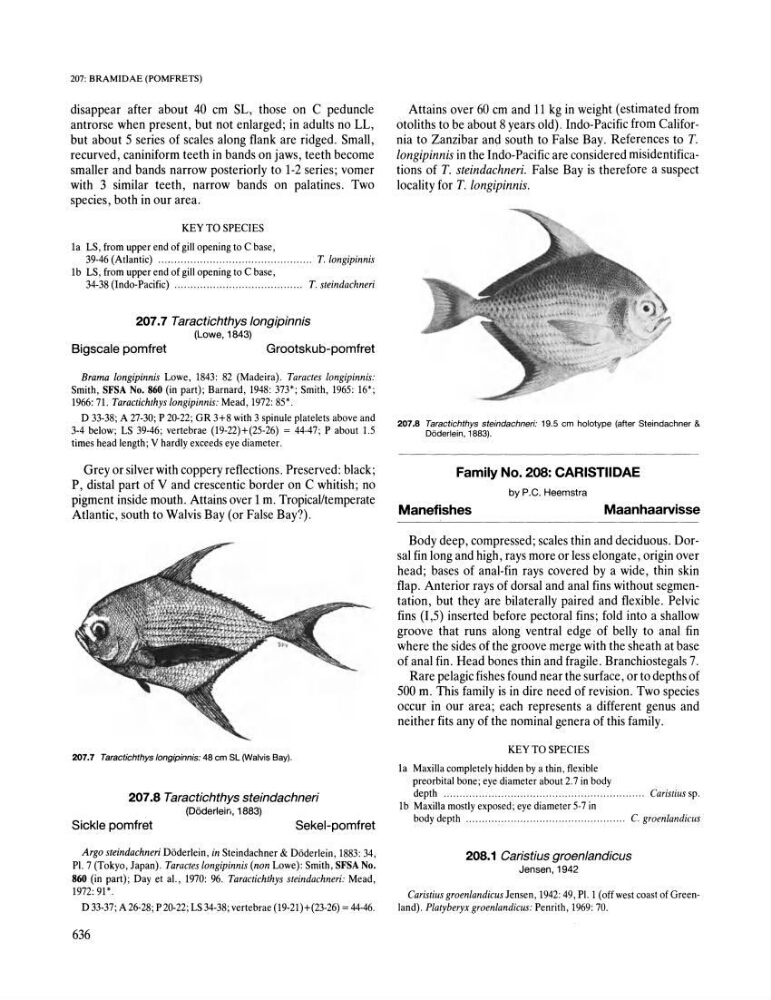
207.8 Taractichthys steindachneri: 19.5 em holotype (after Steindaehner &
Dbderlein, 1883).
Family No. 208: CARISTIIDAE
by P.C. Heemstra
Manefishes
Maanhaarvisse
Body deep, compressed; scales thin and deciduous. Dorsal fin long and high, rays more or less elongate, origin over
head; bases of anal-fin rays covered by a wide, thin skin
flap. Anterior rays of dorsal and anal fins without segmentation, but they are bilaterally paired and flexible. Pelvic
fins (1,5) inserted before pectoral fins; fold into a shallow
groove that runs along ventral edge of belly to anal fin
where the sides of the groove merge with the sheath at base
of anal fin. Head bones thin and fragile. Branchiostegals 7.
Rare pelagic fishes found near the surface, or to depths of
500 m. This family is in dire need of revision. Two species
occur in our area; each represents a different genus and
neither fits any of the nominal genera of this family.
KEY TO SPECIES
la Maxilla completely hidden by a thin, flexible
preorbital bone; eye diameter about 2.7 in body
depth ............................................................... Caristius sp.
Ib Maxilla mostly exposed; eye diameter 5-7 in
body depth .................................................. C. groenlandicus
208.1 Caristius groenlandicus
Jensen, 1942
Caristius groenlandicus Jensen, 1942: 49, PI. 1 (off west coast of Greenland). Platyberyx groenlandicus: Penrith, 1969: 70.
disappear after about 40 cm SL, those on C peduncle
antrorse when present, but not enlarged; in adults no LL,
but about 5 series of scales along flank are ridged. Small,
recurved, caniniform teeth in bands on jaws, teeth become
smaller and bands narrow posteriorly to 1-2 series; vomer
with 3 similar teeth, narrow bands on palatines. Two
species, both in our area.
KEY TO SPECIES
la LS, from upper end of gill opening to C base,
39-46 (Atlantic) ................................................ T. /ongipinnis
Ib LS, from upper end of gill opening to C base,
34-38 (Indo-Pacific) ........................................ T. steindachneri
207.7 Taractichthys longipinnis
(Lowe, 1843)
Bigscale pomfret
Grootskub-pomfret
Brama /ongipinnis Lowe, 1843: 82 (Madeira). Taractes longipinnis:
Smith, SFSA No. 860 (in part); Barnard, 1948: 373*; Smith, 1965: 16*;
1966: 71. Taractichthys /ongipinnis: Mead, 1972: 85*.
D 33-38; A 27-30; P 20-22; GR 3+8 with 3 spinule platelets above and
3-4 below; LS 39-46; vertebrae (19-22)+(25-26) = 44-47; P about 1.5
times head length; V hardly exceeds eye diameter.
Grey or silver with coppery reflections. Preserved: black;
P, distal part of V and crescentic border on C whitish; no
pigment inside mouth. Attains over 1 m. Tropical/temperate
Atlantic, south to Walvis Bay (or False Bay?).
207.7 Taractichthys longipinnis: 48 em SL (Walvis Bay).
207.8 Taractichthys steindachneri
(Doderlein, 1883)
Sickle pomfret
Sekel-pomfret
Argo steindachneri DOderlein, in Steindachner & Doderlein, 1883: 34,
PI. 7 (Tokyo, Japan). Taractes longipinnis (non Lowe): Smith, SFSA No.
860 (in part); Day et aI., 1970: 96. Taractichthys steindachneri: Mead,
1972: 91 *.
D 33-37; A 26-28; P 20-22; LS 34-38; vertebrae (19-21 )+(23-26) = 44-46.
636
Attains over 60 cm and 11 kg in weight (estimated from
otoliths to be about 8 years old). Indo-Pacific from California to Zanzibar and south to False Bay. References to T.
/ongipinnis in the Indo-Pacific are considered misidentifications of T. steindachneri. False Bay is therefore a suspect
locality for T. /ongipinnis.
207.8 Taractichthys steindachneri: 19.5 em holotype (after Steindaehner &
Dbderlein, 1883).
Family No. 208: CARISTIIDAE
by P.C. Heemstra
Manefishes
Maanhaarvisse
Body deep, compressed; scales thin and deciduous. Dorsal fin long and high, rays more or less elongate, origin over
head; bases of anal-fin rays covered by a wide, thin skin
flap. Anterior rays of dorsal and anal fins without segmentation, but they are bilaterally paired and flexible. Pelvic
fins (1,5) inserted before pectoral fins; fold into a shallow
groove that runs along ventral edge of belly to anal fin
where the sides of the groove merge with the sheath at base
of anal fin. Head bones thin and fragile. Branchiostegals 7.
Rare pelagic fishes found near the surface, or to depths of
500 m. This family is in dire need of revision. Two species
occur in our area; each represents a different genus and
neither fits any of the nominal genera of this family.
KEY TO SPECIES
la Maxilla completely hidden by a thin, flexible
preorbital bone; eye diameter about 2.7 in body
depth ............................................................... Caristius sp.
Ib Maxilla mostly exposed; eye diameter 5-7 in
body depth .................................................. C. groenlandicus
208.1 Caristius groenlandicus
Jensen, 1942
Caristius groenlandicus Jensen, 1942: 49, PI. 1 (off west coast of Greenland). Platyberyx groenlandicus: Penrith, 1969: 70.