

give brownish body. D and A blue-black with silver trimmings, as shown in illustration. On long preservation fins
become light buff colour. Attains 50 cm. Off Mozambique,
Durban, East London, Port Elizabeth and St. Helena Bay
(Cape west coast); also New Zealand and Australia.
Genus Pterycombus Fries, 1837
No distinct lobes in D and A; most rays unbranched; V
short, inserted in advance of P base; transverse precaudal
grooves absent; spines on scales persist in large fishes, midlateral scales on C peduncle not modified. Two species: the
North Atlantic P. brama Fries, 1837 overlaps meristically,
but differs from the Indo-Pacific species in D = 51 modally,
vertebrae 48-51 and, in juveniles up to 10 cm, with some
D and A rays longer than half SL and eye about 3.2 in head
length.
207.5 Pterycombus petersii
(Hilgendorf,1878)
Prickly fanfish
Prikkel-waaiervis
Centropholis petersii Hilgendorf, 1878: 1 (Japan). Pterycombus falcatus
Barnard, 1927: 599, Pl. 25 (probably Table Bay); Williams, 1966: 377.
Centropholoides falcatus: Smith, SFSA No. 871. Pterycombus cf. petersii:
Hulley, 1972: 230. Pterycombus petersii: Mead, 1972: 101 *.
D 48-49; A 39-40; P 21-22; GR 1 +(6-7) with spinules on both arms; LS
47-50; pre dorsal scales 10-11; vertebrae 45-58; branchiostegal rays 7; in
juveniles up to 10 em the longest D & A rays are less than half SL, and eye
is about 2.7 in head length; LL distinct in adults (not in P. brama).
Toothed border of massive lower jaw meets upper jaw but is not included
when mouth closed; outer row of irregularly spaced, recurved teeth confined to front of lower jaw; inner row evenly spaced but expanding to
band, with a few larger retrorse teeth, near symphysis; teeth on premaxilla
similar, forming a wider band in front; no teeth on vomer, palatines or
tongue.
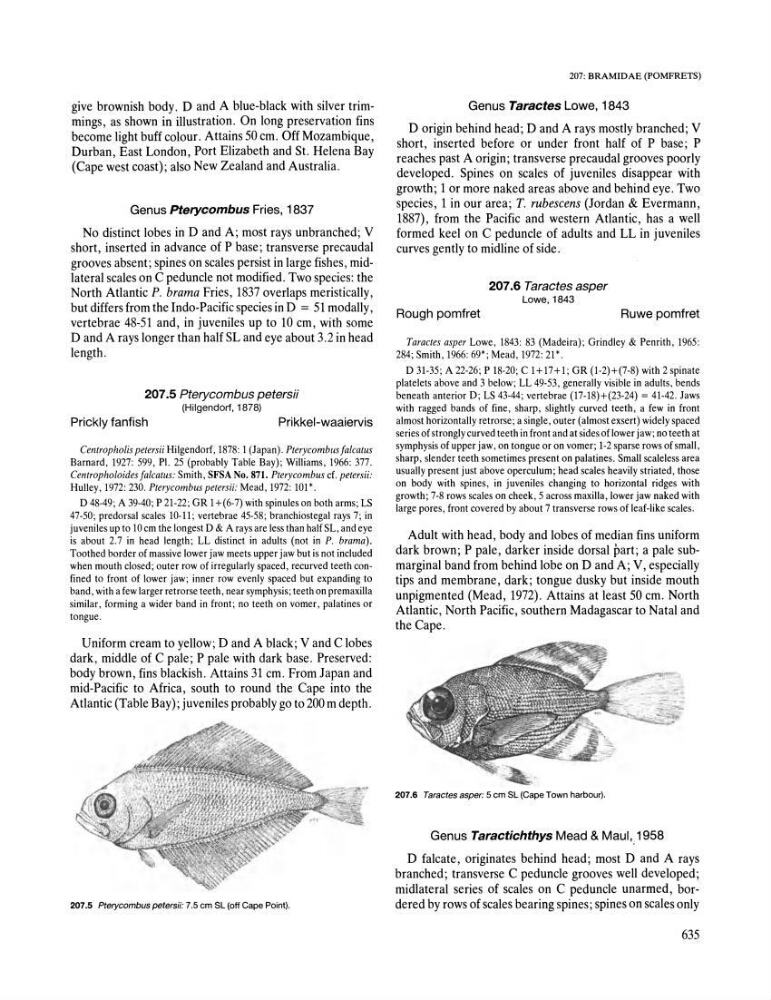
Uniform cream to yellow; D and A black; V and C lobes
dark, middle of C pale; P pale with dark base. Preserved:
body brown, fins blackish. Attains 31 cm. From Japan and
mid-Pacific to Africa, south to round the Cape into the
Atlantic (Table Bay); juveniles probably go to 200 m depth.
207.5 pterycombus peters;;: 7.5 em SL (off Cape Point).
207: BRAMIDAE (POMFRETS)
Genus Taractes Lowe, 1843
D origin behind head; D and A rays mostly branched; V
short, inserted before or under front half of P base; P
reaches past A origin; transverse precaudal grooves poorly
developed. Spines on scales of juveniles disappear with
growth; 1 or more naked areas above and behind eye. Two
species, 1 in our area; T. rubescens (Jordan & Evermann,
1887), from the Pacific and western Atlantic, has a well
formed keel on C peduncle of adults and LL in juveniles
curves gently to midline of side.
Rough pomfret
207.6 Taractes asper
Lowe, 1843
Ruwe pomfret
Taractes asper Lowe, 1843: 83 (Madeira); Grindley & Penrith, 1965:
284; Smith, 1966: 69*; Mead, 1972: 21*.
D 31-35; A 22-26; P 18-20; C 1+ 17+ 1; GR (1-2)+(7-8) with 2 spinate
platelets above and 3 below; LL 49-53, generally visible in adults, bends
beneath anterior D; LS 43-44; vertebrae (17-18)+(23-24) = 41-42. Jaws
with ragged bands of fine, sharp, slightly curved teeth, a few in front
almost horizontally retrorse; a single, outer (almost exsert) widely spaced
series of strongly curved teeth in front and at sides of lower jaw; no teeth at
symphysis of upper jaw, on tongue or on vomer; 1-2 sparse rows of small,
sharp, slender teeth sometimes present on palatines. Small scaleless area
usually present just above operculum; head scales heavily striated, those
on body with spines, in juveniles changing to horizontal ridges with
growth; 7-8 rows scales on cheek, 5 across maxilla, lower jaw naked with
large pores, front covered by about 7 transverse rows of leaf-like scales.
Adult with head, body and lobes of median fins uniform
dark brown; P pale, darker inside dorsal part; a pale submarginal band from behind lobe on D and A; V, especially
tips and membrane, dark; tongue dusky but inside mouth
unpigmented (Mead, 1972). Attains at least 50 cm. North
Atlantic, North Pacific, southern Madagascar to Natal and
the Cape.
207.6 Taractes asper: 5 em SL (Cape Town harbour).
Genus Taractichthys Mead & Maul,;1958
D falcate, originates behind head; most D and A rays
branched; transverse C peduncle grooves well developed;
midlateral series of scales on C peduncle unarmed, bordered by rows of scales bearing spines; spines on scales only
635
become light buff colour. Attains 50 cm. Off Mozambique,
Durban, East London, Port Elizabeth and St. Helena Bay
(Cape west coast); also New Zealand and Australia.
Genus Pterycombus Fries, 1837
No distinct lobes in D and A; most rays unbranched; V
short, inserted in advance of P base; transverse precaudal
grooves absent; spines on scales persist in large fishes, midlateral scales on C peduncle not modified. Two species: the
North Atlantic P. brama Fries, 1837 overlaps meristically,
but differs from the Indo-Pacific species in D = 51 modally,
vertebrae 48-51 and, in juveniles up to 10 cm, with some
D and A rays longer than half SL and eye about 3.2 in head
length.
207.5 Pterycombus petersii
(Hilgendorf,1878)
Prickly fanfish
Prikkel-waaiervis
Centropholis petersii Hilgendorf, 1878: 1 (Japan). Pterycombus falcatus
Barnard, 1927: 599, Pl. 25 (probably Table Bay); Williams, 1966: 377.
Centropholoides falcatus: Smith, SFSA No. 871. Pterycombus cf. petersii:
Hulley, 1972: 230. Pterycombus petersii: Mead, 1972: 101 *.
D 48-49; A 39-40; P 21-22; GR 1 +(6-7) with spinules on both arms; LS
47-50; pre dorsal scales 10-11; vertebrae 45-58; branchiostegal rays 7; in
juveniles up to 10 em the longest D & A rays are less than half SL, and eye
is about 2.7 in head length; LL distinct in adults (not in P. brama).
Toothed border of massive lower jaw meets upper jaw but is not included
when mouth closed; outer row of irregularly spaced, recurved teeth confined to front of lower jaw; inner row evenly spaced but expanding to
band, with a few larger retrorse teeth, near symphysis; teeth on premaxilla
similar, forming a wider band in front; no teeth on vomer, palatines or
tongue.
Uniform cream to yellow; D and A black; V and C lobes
dark, middle of C pale; P pale with dark base. Preserved:
body brown, fins blackish. Attains 31 cm. From Japan and
mid-Pacific to Africa, south to round the Cape into the
Atlantic (Table Bay); juveniles probably go to 200 m depth.
207.5 pterycombus peters;;: 7.5 em SL (off Cape Point).
207: BRAMIDAE (POMFRETS)
Genus Taractes Lowe, 1843
D origin behind head; D and A rays mostly branched; V
short, inserted before or under front half of P base; P
reaches past A origin; transverse precaudal grooves poorly
developed. Spines on scales of juveniles disappear with
growth; 1 or more naked areas above and behind eye. Two
species, 1 in our area; T. rubescens (Jordan & Evermann,
1887), from the Pacific and western Atlantic, has a well
formed keel on C peduncle of adults and LL in juveniles
curves gently to midline of side.
Rough pomfret
207.6 Taractes asper
Lowe, 1843
Ruwe pomfret
Taractes asper Lowe, 1843: 83 (Madeira); Grindley & Penrith, 1965:
284; Smith, 1966: 69*; Mead, 1972: 21*.
D 31-35; A 22-26; P 18-20; C 1+ 17+ 1; GR (1-2)+(7-8) with 2 spinate
platelets above and 3 below; LL 49-53, generally visible in adults, bends
beneath anterior D; LS 43-44; vertebrae (17-18)+(23-24) = 41-42. Jaws
with ragged bands of fine, sharp, slightly curved teeth, a few in front
almost horizontally retrorse; a single, outer (almost exsert) widely spaced
series of strongly curved teeth in front and at sides of lower jaw; no teeth at
symphysis of upper jaw, on tongue or on vomer; 1-2 sparse rows of small,
sharp, slender teeth sometimes present on palatines. Small scaleless area
usually present just above operculum; head scales heavily striated, those
on body with spines, in juveniles changing to horizontal ridges with
growth; 7-8 rows scales on cheek, 5 across maxilla, lower jaw naked with
large pores, front covered by about 7 transverse rows of leaf-like scales.
Adult with head, body and lobes of median fins uniform
dark brown; P pale, darker inside dorsal part; a pale submarginal band from behind lobe on D and A; V, especially
tips and membrane, dark; tongue dusky but inside mouth
unpigmented (Mead, 1972). Attains at least 50 cm. North
Atlantic, North Pacific, southern Madagascar to Natal and
the Cape.
207.6 Taractes asper: 5 em SL (Cape Town harbour).
Genus Taractichthys Mead & Maul,;1958
D falcate, originates behind head; most D and A rays
branched; transverse C peduncle grooves well developed;
midlateral series of scales on C peduncle unarmed, bordered by rows of scales bearing spines; spines on scales only
635