

207: BRAMIDAE (POMFRETS)
Pomfret
207.1 Brama brama
(Bonnaterre, 1788)
PLATE 50
Pomfret
Sparus brama Bonnaterre, 1788: 104, PI. 50, Fig. 192 ("seas of
England"). Brama raii: Smith, SFSA No. 859*; Davies, 1949: 32; Smith &
Smith, 1966: 132*. Brama brama: Grindley & Penrith, 1965: 284; Mead,
1972: 29*.
D 35-38; A 29-32; P 20-23; GR (4-7)+(8-12) = 15-18; LS 70-80; vertebrae (16-17)+(25-27); branchiostegal rays 7.
Colour as illustrated; Mead (1972) gives mottled, metallic silvery-black, with naked tips of fins black; P black
above, lighter below; lining of mouth black. Preserved:
black, with paired fins and tips of central C rays lighter.
Attains at least 70 cm. Trawled between Algoa Bay and
Walvis Bay, from the surface down to about 1 000 m. Plentiful in north Atlantic, known from Australia, New Zealand,
Chile.
Tropical pomfret
207.2 Brama orcini
Cuvier, 1831
Tropiese pomfret
Brama orcini Cuvier, in Cuv. & Val., 1831: 295 (no locality); Mead,
1972: 72*; Smith, 1980: 182. Collybus drachme: Grindley & Penrith,
1965: 284. Bauchot (1970) placed the holotype of B. orcini (from
"Equator") in synonymy of B. raii (i.e. B. brqma). There are slight
differences that Mead recognises, and while B. orcini is considered tropical, B. brama is a temperate form.
D 32-36; A 28-30; P 20-22; GR (3-5)+(9-11); vertebrae (15-17)+(2125) = 37-40; branchiostegal rays 6-8; LS 48-55.
Colour similar to B. brama. Attains 35 cm. Off Natal;
tropical Indo-Pacific down to 100 m, generally near land
masses.
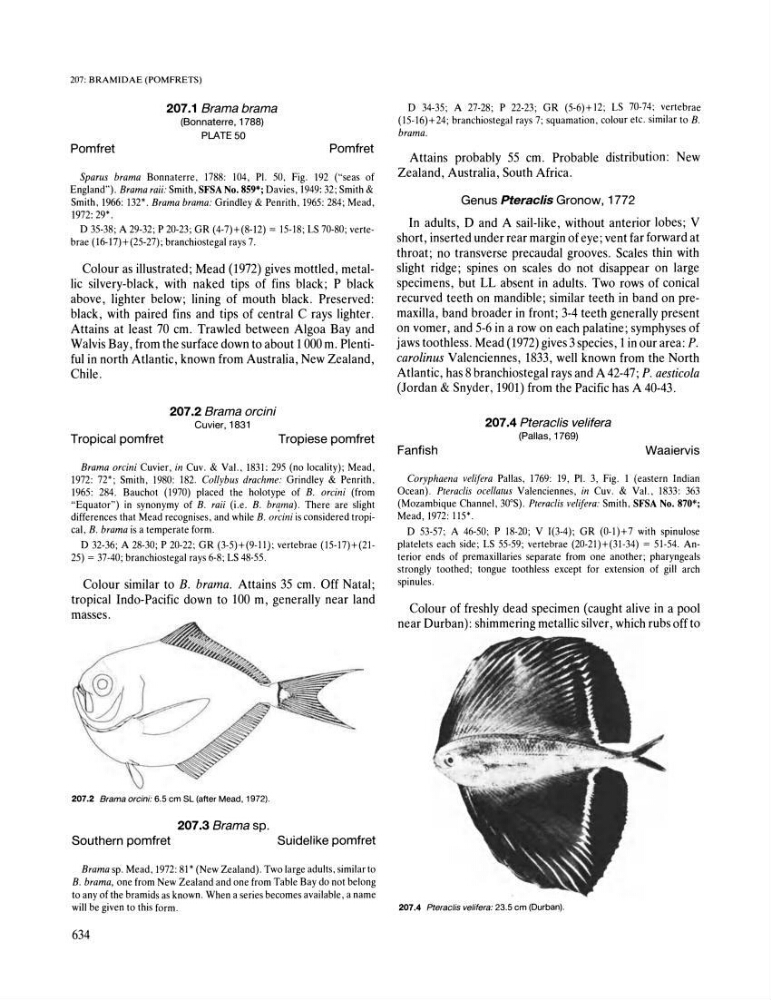
207.2 Brama orcini: 6.5 em SL (after Mead, 1972).
207.3 Brama sp.
Southern pomfret
Suidelike pomfret
Brama sp. Mead, 1972: 81 * (New Zealand). Two large adults, similar to
B. brama, one from New Zealand and one from Table Bay do not belong
to any of the bramids as known. When a series becomes available, a name
will be given to this form.
634
D 34-35; A 27-28; P 22-23; GR (5-6)+ 12; LS 70-74; vertebrae
(15-16)+24; branchiostegal rays 7; squamation, colour etc. similar to B.
brama.
Attains probably 55 cm. Probable distribution: New
Zealand, Australia, South Africa.
Genus Pteraclis Gronow, 1772
In adults, D and A sail-like, without anterior lobes; V
short, inserted under rear margin of eye; vent far forward at
throat; no transverse precaudal grooves. Scales thin with
slight ridge; spines on scales do not disappear on large
specimens, but LL absent in adults. Two rows of conical
recurved teeth on mandible; similar teeth in band on premaxilla, band broader in front; 3-4 teeth generally present
on vomer, and 5-6 in a row on each palatine; symphyses of
jaws toothless. Mead (1972) gives 3 species, 1 in our area: P.
carolinus Valenciennes, 1833, well known from the North
Atlantic, has 8 branchiostegal rays and A 42-47; P. aesticola
(Jordan & Snyder, 1901) from the Pacific has A 40-43.
Fanfish
207.4 Pterac/is velifera
(Pallas, 1769)
Waaiervis
Coryphaena velifera Pallas, 1769: 19, PI. 3, Fig. 1 (eastern Indian
Ocean). Pteraclis ocellatus Valenciennes, in Cuv. & Val., 1833: 363
(Mozambique Channel, 30 0 S). Pteraclis velifera: Smith, SFSA No. 870*;
Mead, 1972: 115*.
D 53-57; A 46-50; P 18-20; V 1(3-4); GR (0-1)+7 with spinulose
platelets each side; LS 55-59; vertebrae (20-21)+(31-34) = 51-54. Anterior ends of premaxillaries separate from one another; pharyngeals
strongly toothed; tongue toothless except for extension of gill arch
spinules.
Colour of freshly dead specimen (caught alive in a pool
near Durban): shimmering metallic silver, which rubs off to
207.4 Pteraclis velifera: 23.5 em (Durban).
Pomfret
207.1 Brama brama
(Bonnaterre, 1788)
PLATE 50
Pomfret
Sparus brama Bonnaterre, 1788: 104, PI. 50, Fig. 192 ("seas of
England"). Brama raii: Smith, SFSA No. 859*; Davies, 1949: 32; Smith &
Smith, 1966: 132*. Brama brama: Grindley & Penrith, 1965: 284; Mead,
1972: 29*.
D 35-38; A 29-32; P 20-23; GR (4-7)+(8-12) = 15-18; LS 70-80; vertebrae (16-17)+(25-27); branchiostegal rays 7.
Colour as illustrated; Mead (1972) gives mottled, metallic silvery-black, with naked tips of fins black; P black
above, lighter below; lining of mouth black. Preserved:
black, with paired fins and tips of central C rays lighter.
Attains at least 70 cm. Trawled between Algoa Bay and
Walvis Bay, from the surface down to about 1 000 m. Plentiful in north Atlantic, known from Australia, New Zealand,
Chile.
Tropical pomfret
207.2 Brama orcini
Cuvier, 1831
Tropiese pomfret
Brama orcini Cuvier, in Cuv. & Val., 1831: 295 (no locality); Mead,
1972: 72*; Smith, 1980: 182. Collybus drachme: Grindley & Penrith,
1965: 284. Bauchot (1970) placed the holotype of B. orcini (from
"Equator") in synonymy of B. raii (i.e. B. brqma). There are slight
differences that Mead recognises, and while B. orcini is considered tropical, B. brama is a temperate form.
D 32-36; A 28-30; P 20-22; GR (3-5)+(9-11); vertebrae (15-17)+(2125) = 37-40; branchiostegal rays 6-8; LS 48-55.
Colour similar to B. brama. Attains 35 cm. Off Natal;
tropical Indo-Pacific down to 100 m, generally near land
masses.
207.2 Brama orcini: 6.5 em SL (after Mead, 1972).
207.3 Brama sp.
Southern pomfret
Suidelike pomfret
Brama sp. Mead, 1972: 81 * (New Zealand). Two large adults, similar to
B. brama, one from New Zealand and one from Table Bay do not belong
to any of the bramids as known. When a series becomes available, a name
will be given to this form.
634
D 34-35; A 27-28; P 22-23; GR (5-6)+ 12; LS 70-74; vertebrae
(15-16)+24; branchiostegal rays 7; squamation, colour etc. similar to B.
brama.
Attains probably 55 cm. Probable distribution: New
Zealand, Australia, South Africa.
Genus Pteraclis Gronow, 1772
In adults, D and A sail-like, without anterior lobes; V
short, inserted under rear margin of eye; vent far forward at
throat; no transverse precaudal grooves. Scales thin with
slight ridge; spines on scales do not disappear on large
specimens, but LL absent in adults. Two rows of conical
recurved teeth on mandible; similar teeth in band on premaxilla, band broader in front; 3-4 teeth generally present
on vomer, and 5-6 in a row on each palatine; symphyses of
jaws toothless. Mead (1972) gives 3 species, 1 in our area: P.
carolinus Valenciennes, 1833, well known from the North
Atlantic, has 8 branchiostegal rays and A 42-47; P. aesticola
(Jordan & Snyder, 1901) from the Pacific has A 40-43.
Fanfish
207.4 Pterac/is velifera
(Pallas, 1769)
Waaiervis
Coryphaena velifera Pallas, 1769: 19, PI. 3, Fig. 1 (eastern Indian
Ocean). Pteraclis ocellatus Valenciennes, in Cuv. & Val., 1833: 363
(Mozambique Channel, 30 0 S). Pteraclis velifera: Smith, SFSA No. 870*;
Mead, 1972: 115*.
D 53-57; A 46-50; P 18-20; V 1(3-4); GR (0-1)+7 with spinulose
platelets each side; LS 55-59; vertebrae (20-21)+(31-34) = 51-54. Anterior ends of premaxillaries separate from one another; pharyngeals
strongly toothed; tongue toothless except for extension of gill arch
spinules.
Colour of freshly dead specimen (caught alive in a pool
near Durban): shimmering metallic silver, which rubs off to
207.4 Pteraclis velifera: 23.5 em (Durban).