

Adults dark bronzy brown; juveniles unknown. Attains
70 cm. Large fishes with a bony bump between the eyes.
Delagoa Bay northwards.
206.3 Oplegnathus robinsoni
Regan, 1916
PLATE 78
' "
Natal knifejaw
Natalse kraaibek
Hoplegnathus robinsoni Regan, 1916: 168 (Natal); Barnard, 1927: 506;
Smith, 1935: 191. Oplegnathus robinsoni: Fowler, 1935: 392; Smith, 1946:
797; Smith, SFSA No. 462*.
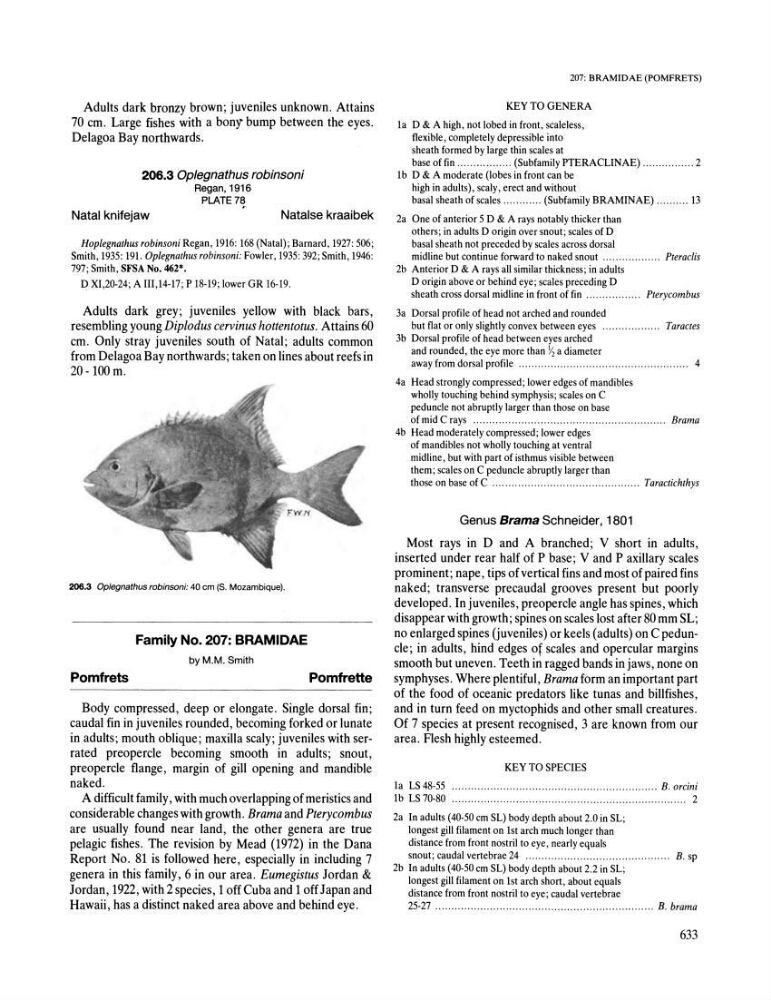
D XI,20-24; A III,14-17; P 18-19; lower GR 16-19.
Adults dark grey; juveniles yellow with black bars,
resembling young Diplodus cervinus hottentotus. Attains 60
cm. Only stray juveniles south of Natal; adults common
from Delagoa Bay northwards; taken on lines about reefs in
20 -100 m.
206.3 Oplegnathus robinsoni: 40 em (5. Mozambique).
Pomfrets
Family No. 207: BRAMIDAE
by M.M . Smith
Pomfrette
Body compressed, deep or elongate. Single dorsal fin;
caudal fin in juveniles rounded, becoming forked or lunate
in adults; mouth oblique; maxilla scaly; juveniles with serrated preopercle becoming smooth in adults; snout,
preopercle flange, margin of gill opening and mandible
naked.
A difficult family, with much overlapping of meristics and
considerable changes with growth. Brama and Pterycombus
are usually found near land, the other genera are true
pelagic fishes. The revision by Mead (1972) in the Dana
Report No. 81 is folJowed here, especially in including 7
genera in this family, 6 in our area. Eumegistus Jordan &
Jordan, 1922, with 2 species, 1 off Cuba and 1 off Japan and
Hawaii, has a distinct naked area above and behind eye.
207: BRAMIDAE (POMFRETS)
KEY TO GENERA
1a D & A high, not lobed in front, scaleless,
flexible, completely depressible into
sheath formed by large thin scales at
base offin ................. (Subfamily PTERACLINAE) ................ 2
1 b D & A moderate (lobes in front can be
high in adults), scaly, erect and without
basal sheath of scales ............ (Subfamily BRAMINAE) .......... 13
2a One of anterior 5 D & A rays notably thicker than
others; in adults D origin over snout; scales of D
basal sheath not preceded by scales across dorsal
midline but continue forward to naked snout .................. Pteraclis
2b Anterior D & A rays all similar thickness; in adults
D origin above or behind eye; scales preceding D
sheath cross dorsal midline in front of fin ... .............. Pterycombus
3a Dorsal profile of head not arched and rounded
but flat or only slightly convex between eyes .................. Taractes
3b Dorsal profile of head between eyes arched
and rounded, the eye more than Yz a diameter
away from dorsal profile ..................................................... 4
4a Head strongly compressed; lower edges of mandibles
wholly touching behind symphysis; scales on C
peduncle not abruptly larger than those on base
of mid Crays .. ....... .. .. ..... ..... .......... ... ............. ........... Brama
4b Head moderately compressed; lower edges
of mandibles not wholly touching at ventral
midline, but with part of isthmus visible between
them; scales on C peduncle abruptly larger than
those on base of C .............................................. Taractichth ys
Genus Brama Schneider, 1801
Most rays in D and A branched; V short in adults,
inserted under rear half of P base; V and P axillary scales
prominent; nape, tips of vertical fins and most of paired fins
naked; transverse precaudal grooves present but poorly
developed. In juveniles, preopercle angle has spines, which
disappear with growth; spines on scales lost after 80 mm SL;
no enlarged spines (juveniles) or keels (adults) on C peduncle; in adults, hind edges of scales and opercular margins
smooth but uneven. Teeth in ragged bands in jaws, none on
symphyses. Where plentiful, Brama form an important part
of the food of oceanic predators like tunas and billfishes,
and in turn feed on myctophids and other small creatures.
Of 7 species at present recognised, 3 are known from our
area. Flesh highly esteemed.
KEY TO SPECIES
la LS 48-55 ................................................. .. ....... .. .... B. orcini
Ib LS 70-80 .... ...................... ........ ...... ... ............... .. ........ .. ... 2
2a In adults (40-50 cm SL) body depth about 2.0 in SL;
longest gill filament on 1st arch much longer than
distance from front nostril to eye, nearly equals
snout; caudal vertebrae 24 ............................................. B. sp
2b In adults (40-50 em SL) body depth about 2.2 in SL;
longest gill filament on 1st arch short, about equals
distance from front nostril to eye; caudal vertebrae
25-27 ....................................... ... ......... ................. B. brama
633
70 cm. Large fishes with a bony bump between the eyes.
Delagoa Bay northwards.
206.3 Oplegnathus robinsoni
Regan, 1916
PLATE 78
' "
Natal knifejaw
Natalse kraaibek
Hoplegnathus robinsoni Regan, 1916: 168 (Natal); Barnard, 1927: 506;
Smith, 1935: 191. Oplegnathus robinsoni: Fowler, 1935: 392; Smith, 1946:
797; Smith, SFSA No. 462*.
D XI,20-24; A III,14-17; P 18-19; lower GR 16-19.
Adults dark grey; juveniles yellow with black bars,
resembling young Diplodus cervinus hottentotus. Attains 60
cm. Only stray juveniles south of Natal; adults common
from Delagoa Bay northwards; taken on lines about reefs in
20 -100 m.
206.3 Oplegnathus robinsoni: 40 em (5. Mozambique).
Pomfrets
Family No. 207: BRAMIDAE
by M.M . Smith
Pomfrette
Body compressed, deep or elongate. Single dorsal fin;
caudal fin in juveniles rounded, becoming forked or lunate
in adults; mouth oblique; maxilla scaly; juveniles with serrated preopercle becoming smooth in adults; snout,
preopercle flange, margin of gill opening and mandible
naked.
A difficult family, with much overlapping of meristics and
considerable changes with growth. Brama and Pterycombus
are usually found near land, the other genera are true
pelagic fishes. The revision by Mead (1972) in the Dana
Report No. 81 is folJowed here, especially in including 7
genera in this family, 6 in our area. Eumegistus Jordan &
Jordan, 1922, with 2 species, 1 off Cuba and 1 off Japan and
Hawaii, has a distinct naked area above and behind eye.
207: BRAMIDAE (POMFRETS)
KEY TO GENERA
1a D & A high, not lobed in front, scaleless,
flexible, completely depressible into
sheath formed by large thin scales at
base offin ................. (Subfamily PTERACLINAE) ................ 2
1 b D & A moderate (lobes in front can be
high in adults), scaly, erect and without
basal sheath of scales ............ (Subfamily BRAMINAE) .......... 13
2a One of anterior 5 D & A rays notably thicker than
others; in adults D origin over snout; scales of D
basal sheath not preceded by scales across dorsal
midline but continue forward to naked snout .................. Pteraclis
2b Anterior D & A rays all similar thickness; in adults
D origin above or behind eye; scales preceding D
sheath cross dorsal midline in front of fin ... .............. Pterycombus
3a Dorsal profile of head not arched and rounded
but flat or only slightly convex between eyes .................. Taractes
3b Dorsal profile of head between eyes arched
and rounded, the eye more than Yz a diameter
away from dorsal profile ..................................................... 4
4a Head strongly compressed; lower edges of mandibles
wholly touching behind symphysis; scales on C
peduncle not abruptly larger than those on base
of mid Crays .. ....... .. .. ..... ..... .......... ... ............. ........... Brama
4b Head moderately compressed; lower edges
of mandibles not wholly touching at ventral
midline, but with part of isthmus visible between
them; scales on C peduncle abruptly larger than
those on base of C .............................................. Taractichth ys
Genus Brama Schneider, 1801
Most rays in D and A branched; V short in adults,
inserted under rear half of P base; V and P axillary scales
prominent; nape, tips of vertical fins and most of paired fins
naked; transverse precaudal grooves present but poorly
developed. In juveniles, preopercle angle has spines, which
disappear with growth; spines on scales lost after 80 mm SL;
no enlarged spines (juveniles) or keels (adults) on C peduncle; in adults, hind edges of scales and opercular margins
smooth but uneven. Teeth in ragged bands in jaws, none on
symphyses. Where plentiful, Brama form an important part
of the food of oceanic predators like tunas and billfishes,
and in turn feed on myctophids and other small creatures.
Of 7 species at present recognised, 3 are known from our
area. Flesh highly esteemed.
KEY TO SPECIES
la LS 48-55 ................................................. .. ....... .. .... B. orcini
Ib LS 70-80 .... ...................... ........ ...... ... ............... .. ........ .. ... 2
2a In adults (40-50 cm SL) body depth about 2.0 in SL;
longest gill filament on 1st arch much longer than
distance from front nostril to eye, nearly equals
snout; caudal vertebrae 24 ............................................. B. sp
2b In adults (40-50 em SL) body depth about 2.2 in SL;
longest gill filament on 1st arch short, about equals
distance from front nostril to eye; caudal vertebrae
25-27 ....................................... ... ......... ................. B. brama
633