

209: EMMELICHTHYIDAE (ROVERS)
D X+I+I+I,9-11; A III,IO; P 20-23; LL 87-98; GR (10-12)+(27-31).
Depth 4.1-5.2; head 3.3-3.9. Two protuberances on rear margin of gill
chamber.
Generally reddish, darker (bluish grey) dorsally and
silvery white below. Attains 50 cm. Occasionally taken by
trawl in 100 - 500 m off western Cape coast. Also occurs at
Australia, New Zealand, St. Paul and Amsterdam Ids.
Emmeliehthys nitidus eyaneseens (Guichenot), with LL
100-105, is the eastern Pacific subspecies.
Genus Erythrocles Jordan, 1919
Four species; 1 in our area.
209.2 Erythrocles schlege/ii
(Richardson, 1846)
PLATE 78
Japanese rubyfish
Japanse robyn vis
Emmelichthys schlegelii Richardson, 1846: 272 (Nagasaki, Japan).
Erythrocles schlegelii: Heemstra & Randall, 1977: 372*
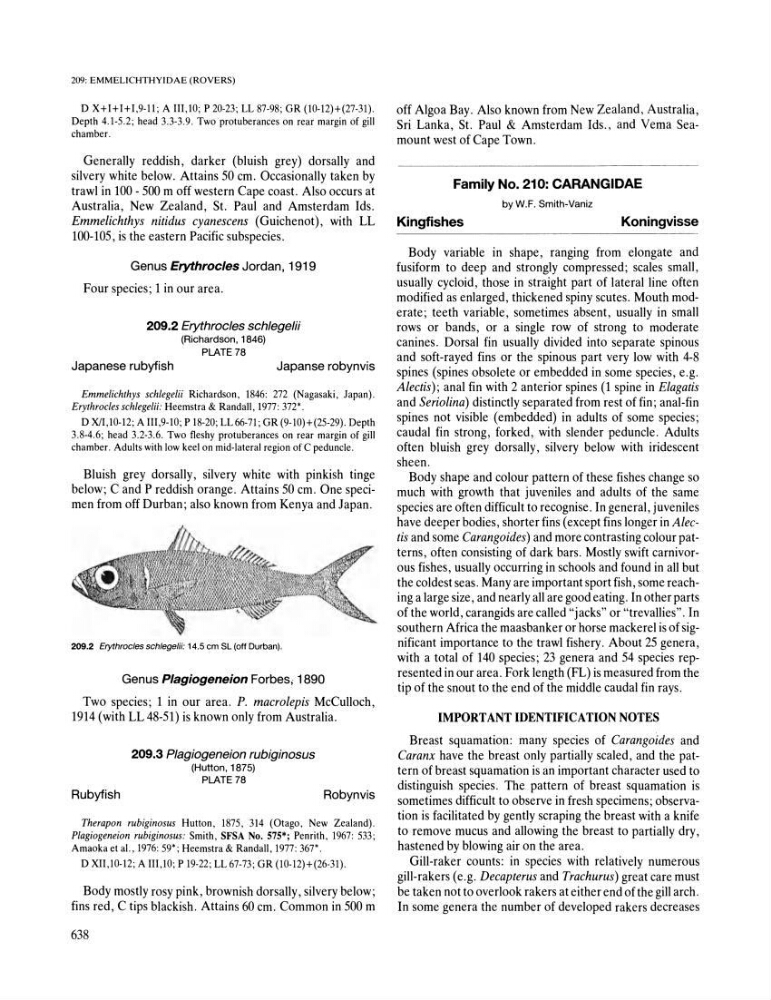
D XlI,IO-12; A III,9-1O; P 18-20; LL 66-71; GR (9-10)+(25-29). Depth
3.8-4.6; head 3.2-3.6. Two fleshy protuberances on rear margin of gill
chamber. Adults with low keel on mid-lateral region of C peduncle.
Bluish grey dorsally, silvery white with pinkish tinge
below; C and P reddish orange. Attains 50 cm. One specimen from off Durban; also known from Kenya and Japan.
209.2 Erythroc/es sch/egelii: 14.5 em SL (off Durban).
Genus Plagiogeneion Forbes; 1890
Two species; 1 in our area. P. maerolepis McCulloch,
1914 (with LL 48-51) is known only from Australia.
Rubyfish
209.3 Plagiogeneion rubiginosus
(Hutton, 1875)
PLATE 78
Robynvis
Therapon rubiginosus Hutton, 1875, 314 (Otago, New Zealand).
Plagiogeneion rubiginosus: Smith, SFSA No. 575*; Penrith, 1967: 533;
Amaoka et al., 1976: 59*; Heemstra & Randall, 1977: 367*.
D XII,IO-12; A III,lO; P 19-22; LL 67-73; GR (10-12)+(26-31).
Body mostly rosy pink, brownish dorsally, silvery below;
fins red, C tips blackish. Attains 60 cm. Common in 500 m
638
off Algoa Bay. Also known from New Zealand, Australia,
Sri Lanka, St. Paul & Amsterdam Ids., and Vema Seamount west of Cape Town.
Family No. 210: CARANGIDAE
by W.F. Smith-Vaniz
Kingfishes
Koningvisse
Body variable in shape, ranging from elongate and
fusiform to deep and strongly compressed; scales small,
usually cycloid, those in straight part of lateral line often
modified as enlarged, thickened spiny scutes. Mouth moderate; teeth variable, sometimes absent, usually in small
rows or bands, or a single row of strong to moderate
canines. Dorsal fin usually divided into separate spinous
and soft-rayed fins or the spinous part very low with 4-8
spines (spines obsolete or embedded in some species, e.g.
Aleetis); anal fin with 2 anterior spines (1 spine in Elagatis
and Seriolina) distinctly separated from rest of fin; anal-fin
spines not visible (embedded) in adults of some species;
caudal fin strong, forked, with slender peduncle. Adults
often bluish grey dorsally, silvery below with iridescent
sheen.
Body shape and colour pattern of these fishes change so
much with growth that juveniles and adults of the same
species are often difficult to recognise. In general, juveniles
have deeper bodies, shorter fins (except fins longer in Aleetis and some Carangoides) and more contrasting colour patterns, often consisting of dark bars. Mostly swift carnivorous fishes, usually occurring in schools and found in all but
the coldest seas. Many are important sport fish, some reaching a large size, and nearly all are good eating. In other parts
of the world, carangids are called "jacks" or "trevallies". In
southern Africa the maasbanker or horse mackerel is of significant importance to the trawl fishery. About 25 genera,
with a total of 140 species; 23 genera and 54 species represented in our area. Fork length (FL) is measured from the
tip of the snout to the end of the middle caudal fin rays.
IMPORTANT IDENTIFICATION NOTES
Breast squamation: many species of Carangoides and
Caranx have the breast only partially scaled, and the pattern of breast squamation is an important character used to
distinguish species. The pattern of breast squamation is
sometimes difficult to observe in fresh specimens; observation is facilitated by gently scraping the breast with a knife
to remove mucus and allowing the breast to partially dry,
hastened by blowing air on the area.
Gill-raker counts: in species with relatively numerous
gill-rakers (e.g. Deeapterus and Traehurus) great care must
be taken not to overlook rakers at either end of the gill arch.
In some genera the number of developed rakers decreases
D X+I+I+I,9-11; A III,IO; P 20-23; LL 87-98; GR (10-12)+(27-31).
Depth 4.1-5.2; head 3.3-3.9. Two protuberances on rear margin of gill
chamber.
Generally reddish, darker (bluish grey) dorsally and
silvery white below. Attains 50 cm. Occasionally taken by
trawl in 100 - 500 m off western Cape coast. Also occurs at
Australia, New Zealand, St. Paul and Amsterdam Ids.
Emmeliehthys nitidus eyaneseens (Guichenot), with LL
100-105, is the eastern Pacific subspecies.
Genus Erythrocles Jordan, 1919
Four species; 1 in our area.
209.2 Erythrocles schlege/ii
(Richardson, 1846)
PLATE 78
Japanese rubyfish
Japanse robyn vis
Emmelichthys schlegelii Richardson, 1846: 272 (Nagasaki, Japan).
Erythrocles schlegelii: Heemstra & Randall, 1977: 372*
D XlI,IO-12; A III,9-1O; P 18-20; LL 66-71; GR (9-10)+(25-29). Depth
3.8-4.6; head 3.2-3.6. Two fleshy protuberances on rear margin of gill
chamber. Adults with low keel on mid-lateral region of C peduncle.
Bluish grey dorsally, silvery white with pinkish tinge
below; C and P reddish orange. Attains 50 cm. One specimen from off Durban; also known from Kenya and Japan.
209.2 Erythroc/es sch/egelii: 14.5 em SL (off Durban).
Genus Plagiogeneion Forbes; 1890
Two species; 1 in our area. P. maerolepis McCulloch,
1914 (with LL 48-51) is known only from Australia.
Rubyfish
209.3 Plagiogeneion rubiginosus
(Hutton, 1875)
PLATE 78
Robynvis
Therapon rubiginosus Hutton, 1875, 314 (Otago, New Zealand).
Plagiogeneion rubiginosus: Smith, SFSA No. 575*; Penrith, 1967: 533;
Amaoka et al., 1976: 59*; Heemstra & Randall, 1977: 367*.
D XII,IO-12; A III,lO; P 19-22; LL 67-73; GR (10-12)+(26-31).
Body mostly rosy pink, brownish dorsally, silvery below;
fins red, C tips blackish. Attains 60 cm. Common in 500 m
638
off Algoa Bay. Also known from New Zealand, Australia,
Sri Lanka, St. Paul & Amsterdam Ids., and Vema Seamount west of Cape Town.
Family No. 210: CARANGIDAE
by W.F. Smith-Vaniz
Kingfishes
Koningvisse
Body variable in shape, ranging from elongate and
fusiform to deep and strongly compressed; scales small,
usually cycloid, those in straight part of lateral line often
modified as enlarged, thickened spiny scutes. Mouth moderate; teeth variable, sometimes absent, usually in small
rows or bands, or a single row of strong to moderate
canines. Dorsal fin usually divided into separate spinous
and soft-rayed fins or the spinous part very low with 4-8
spines (spines obsolete or embedded in some species, e.g.
Aleetis); anal fin with 2 anterior spines (1 spine in Elagatis
and Seriolina) distinctly separated from rest of fin; anal-fin
spines not visible (embedded) in adults of some species;
caudal fin strong, forked, with slender peduncle. Adults
often bluish grey dorsally, silvery below with iridescent
sheen.
Body shape and colour pattern of these fishes change so
much with growth that juveniles and adults of the same
species are often difficult to recognise. In general, juveniles
have deeper bodies, shorter fins (except fins longer in Aleetis and some Carangoides) and more contrasting colour patterns, often consisting of dark bars. Mostly swift carnivorous fishes, usually occurring in schools and found in all but
the coldest seas. Many are important sport fish, some reaching a large size, and nearly all are good eating. In other parts
of the world, carangids are called "jacks" or "trevallies". In
southern Africa the maasbanker or horse mackerel is of significant importance to the trawl fishery. About 25 genera,
with a total of 140 species; 23 genera and 54 species represented in our area. Fork length (FL) is measured from the
tip of the snout to the end of the middle caudal fin rays.
IMPORTANT IDENTIFICATION NOTES
Breast squamation: many species of Carangoides and
Caranx have the breast only partially scaled, and the pattern of breast squamation is an important character used to
distinguish species. The pattern of breast squamation is
sometimes difficult to observe in fresh specimens; observation is facilitated by gently scraping the breast with a knife
to remove mucus and allowing the breast to partially dry,
hastened by blowing air on the area.
Gill-raker counts: in species with relatively numerous
gill-rakers (e.g. Deeapterus and Traehurus) great care must
be taken not to overlook rakers at either end of the gill arch.
In some genera the number of developed rakers decreases