

200: MENIDAE (MOONFISH)
sometimes enters estuaries. Readily dries in air without
salt; used in India and other Asian countries for food.
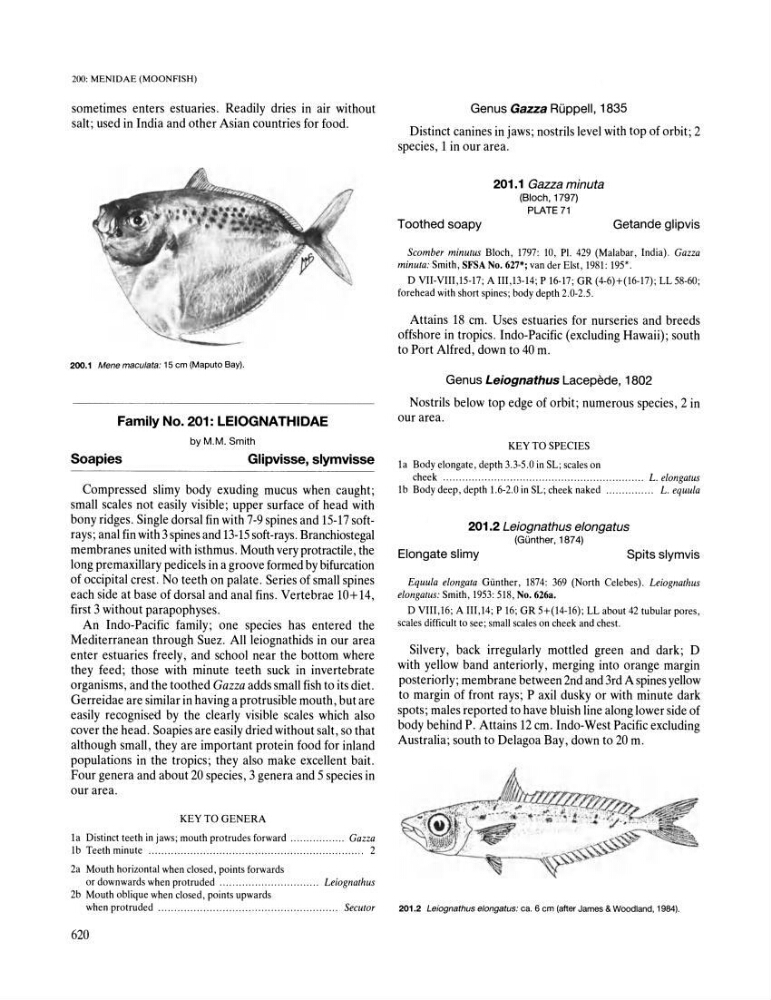
200.1 Mene maculata: 15 em (Maputo Bay).
Family No. 201: LEIOGNATHIDAE
by M.M. Smith
Soapies
Glipvisse, slymvisse
Compressed slimy body exuding mucus when caught;
small scales not easily visible; upper surface of head with
bony ridges. Single dorsal fin with 7-9 spines and 15-17 softrays; anal fin with 3 spines and 13-15 soft-rays. Branchiostegal
membranes united with isthmus. Mouth very protractile, the
long premaxillary pedicels in a groove formed by bifurcation
of occipital crest. No teeth on palate . Series of small spines
each side at base of dorsal and anal fins. Vertebrae 10+ 14,
first 3 without parapophyses.
An Indo-Pacific family; one species has entered the
Mediterranean through Suez. All leiognathids in our area
enter estuaries freely, and school near the bottom where
they feed; those with minute teeth suck in invertebrate
organisms, and the toothed Gazza adds small fish to its diet.
Gerreidae are similar in having a protrusible mouth, but are
easily recognised by the clearly visible scales which also
cover the head. Soapies are easily dried without salt, so that
although small, they are important protein food for inland
populations in the tropics; they also make excellent bait.
Four genera and about 20 species, 3 genera and 5 species in
our area.
KEY TO GENERA
1a Distinct teeth in jaws; mouth protrudes forward .... ... ... ....... Gazza
1 b Teeth minute ................................................................... 2
2a Mouth horizontal when closed, points forwards
or downwards when protruded .......................... ..... Leiognathus
2b Mouth oblique when closed, points upwards
when protruded ............................................... ... ...... SecUlor
620
Genus Gazza Ruppell, 1835
Distinct canines in jaws; nostrils level with top of orbit; 2
species, 1 in our area.
Toothed soapy
201.1 Gazza minuta
(Bloch, 1797)
PLATE 71
Getande glipvis
Scomber minutus Bloch, 1797: 10, PI. 429 (Malabar, India). Gazza
minuta: Smith, SFSA No. 627*; van der Elst, 1981: 195*.
D VII-VIII,1S-17; A III,13-14; P 16-17; GR (4-6)+(16-17); LL 58-60;
forehead with short spines; body depth 2.0-2.5.
Attains 18 cm. Uses estuaries for nurseries and breeds
offshore in tropics. Indo-Pacific (excluding Hawaii); south
to Port Alfred, down to 40 m.
Genus Leiognathus Lacepede, 1802
Nostrils below top edge of orbit; numerous species, 2 in
our area.
KEY TO SPECIES
la Body elongate, depth 3.3-5.0 in SL; scales on
cheek ................ .. ............................................. L. efongatus
Ib Body deep, depth 1.6-2.0 in SL; cheek naked ........... .. .. L. equula
201.2 Leiognathus elongatus
(Gunther, 1874)
Elongate slimy
Spits slymvis
Equula elongata Giinther, 1874: 369 (North Celebes). Leiognathus
elongatus: Smith, 1953: 518, No. 626a.
D VIII,16; A III,14; P 16; GR 5+(14-16); LL about 42 tubular pores,
scales difficult to see; small scales on cheek and chest.
Silvery, back irregularly mottled green and dark; D
with yellow band anteriorly, merging into orange margin
posteriorly; membrane between 2nd and 3rd A spines yellow
to margin of front rays; P axil dusky or with minute dark
spots; males reported to have bluish line along lower side of
body behind P. Attains 12 cm. Indo-West Pacific excluding
Australia; south to Delagoa Bay, down to 20 m.
201.2 Leiognathus elongatus: ea. 6 em (after James & Woodland , 1984).
sometimes enters estuaries. Readily dries in air without
salt; used in India and other Asian countries for food.
200.1 Mene maculata: 15 em (Maputo Bay).
Family No. 201: LEIOGNATHIDAE
by M.M. Smith
Soapies
Glipvisse, slymvisse
Compressed slimy body exuding mucus when caught;
small scales not easily visible; upper surface of head with
bony ridges. Single dorsal fin with 7-9 spines and 15-17 softrays; anal fin with 3 spines and 13-15 soft-rays. Branchiostegal
membranes united with isthmus. Mouth very protractile, the
long premaxillary pedicels in a groove formed by bifurcation
of occipital crest. No teeth on palate . Series of small spines
each side at base of dorsal and anal fins. Vertebrae 10+ 14,
first 3 without parapophyses.
An Indo-Pacific family; one species has entered the
Mediterranean through Suez. All leiognathids in our area
enter estuaries freely, and school near the bottom where
they feed; those with minute teeth suck in invertebrate
organisms, and the toothed Gazza adds small fish to its diet.
Gerreidae are similar in having a protrusible mouth, but are
easily recognised by the clearly visible scales which also
cover the head. Soapies are easily dried without salt, so that
although small, they are important protein food for inland
populations in the tropics; they also make excellent bait.
Four genera and about 20 species, 3 genera and 5 species in
our area.
KEY TO GENERA
1a Distinct teeth in jaws; mouth protrudes forward .... ... ... ....... Gazza
1 b Teeth minute ................................................................... 2
2a Mouth horizontal when closed, points forwards
or downwards when protruded .......................... ..... Leiognathus
2b Mouth oblique when closed, points upwards
when protruded ............................................... ... ...... SecUlor
620
Genus Gazza Ruppell, 1835
Distinct canines in jaws; nostrils level with top of orbit; 2
species, 1 in our area.
Toothed soapy
201.1 Gazza minuta
(Bloch, 1797)
PLATE 71
Getande glipvis
Scomber minutus Bloch, 1797: 10, PI. 429 (Malabar, India). Gazza
minuta: Smith, SFSA No. 627*; van der Elst, 1981: 195*.
D VII-VIII,1S-17; A III,13-14; P 16-17; GR (4-6)+(16-17); LL 58-60;
forehead with short spines; body depth 2.0-2.5.
Attains 18 cm. Uses estuaries for nurseries and breeds
offshore in tropics. Indo-Pacific (excluding Hawaii); south
to Port Alfred, down to 40 m.
Genus Leiognathus Lacepede, 1802
Nostrils below top edge of orbit; numerous species, 2 in
our area.
KEY TO SPECIES
la Body elongate, depth 3.3-5.0 in SL; scales on
cheek ................ .. ............................................. L. efongatus
Ib Body deep, depth 1.6-2.0 in SL; cheek naked ........... .. .. L. equula
201.2 Leiognathus elongatus
(Gunther, 1874)
Elongate slimy
Spits slymvis
Equula elongata Giinther, 1874: 369 (North Celebes). Leiognathus
elongatus: Smith, 1953: 518, No. 626a.
D VIII,16; A III,14; P 16; GR 5+(14-16); LL about 42 tubular pores,
scales difficult to see; small scales on cheek and chest.
Silvery, back irregularly mottled green and dark; D
with yellow band anteriorly, merging into orange margin
posteriorly; membrane between 2nd and 3rd A spines yellow
to margin of front rays; P axil dusky or with minute dark
spots; males reported to have bluish line along lower side of
body behind P. Attains 12 cm. Indo-West Pacific excluding
Australia; south to Delagoa Bay, down to 20 m.
201.2 Leiognathus elongatus: ea. 6 em (after James & Woodland , 1984).