

Slimy
201.3 Leiognathus equula
(Forsskal, 1775)
Slymvis
Scomber equula Forsskal, 1775: 58 (Red Sea). Leiognathus equula:
Smith, SFSA No. 626*. Leiognathus equulus: van der Elst, 1981: 196*.
D VIII,15-16; A III,14-15; P 18-20; GR (5-6)+(15-16); LL 54-63 difficult to count, scales almost invisible especially on breast which appears
naked; lower edge of preopercIe serrate; mouth protrudes downwards. D
spines 2, 3 and 4 and A spines 2 and 3 can lock in upright position.
Silvery, sometimes with faint narrow bars on back and
dark saddle on C peduncle; D transparent; P axil dusky; A
yellowish. The largest leiognathid, attains 25 cm. IndoPacific; common in Natal, reaches East London, down to
40 m. Important food-fish in the tropics.
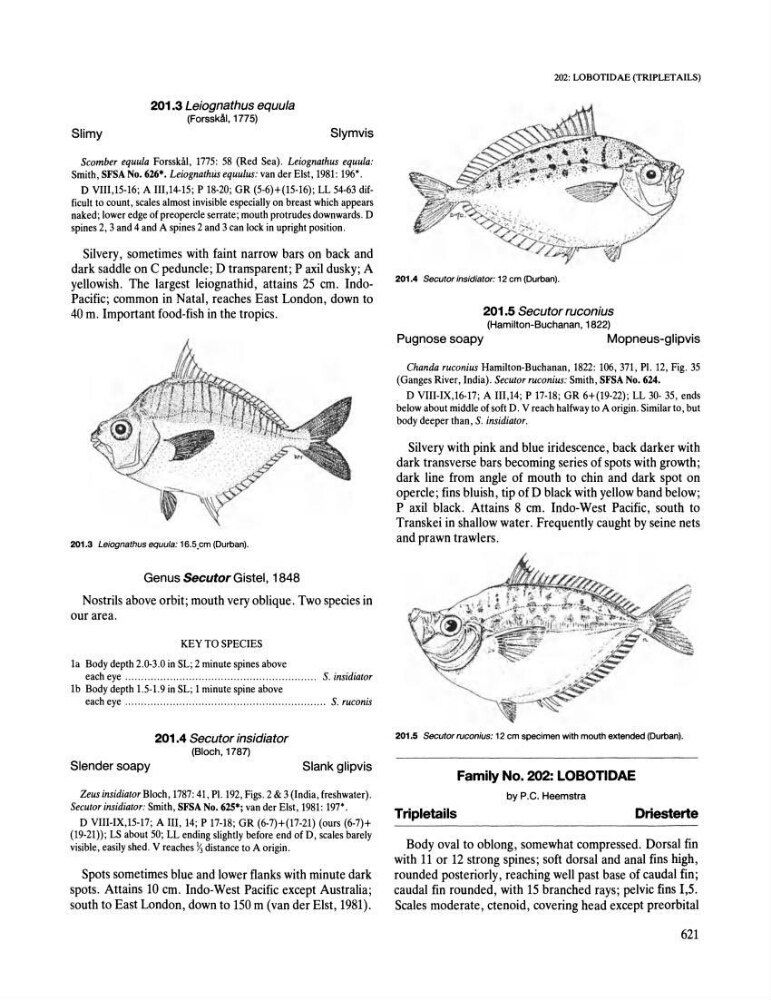
201.3 Leiognathusequula: 16.5.cm (Durban).
Genus Secutor Gistel, 1848
Nostrils above orbit; mouth very oblique. Two species in
our area.
KEY TO SPECIES
1a Body depth 2.0-3.0 in SL; 2 minute spines above
each eye............................................................ S. insidiator
1b Body depth 1.5-1.9 in SL; 1 minute spine above
each eye ............................................................... S. ruconis
Slender soapy
201.4 Secutor insidiator
(Bloch, 1787)
Siank glipvis
Zeus insidiator Bloch, 1787: 41, PI. 192, Figs. 2 & 3 (India, freshwater).
Secutor insidiator: Smith, SFSA No. 625*; van der Elst, 1981: 197'.
D VIII-IX,15-17; A III, 14; P 17-18; GR (6-7)+(17-21) (ours (6-7)+
(19-21)); LS about 50; LL ending slightly before end of D, scales barely
visible, easily shed. V reaches l) distance to A origin.
Spots sometimes blue and lower flanks with minute dark
spots. Attains 10 cm. Indo-West Pacific except Australia;
south to East London, down to 150 m (van der Elst, 1981).
202: LOBOTIDAE (TRIPLETAILS)
201.4 Secutor insidiator: 12 cm (Durban).
201.5 Secutor ruconius
(Hamilton-Buchanan, 1822)
Pugnose soapy
Mopneus-glipvis
Chanda ruconius Hamilton-Buchanan, 1822: 106,371, PI. 12, Fig. 35
(Ganges River, India). Secutor ruconius: Smith, SFSA No. 624.
D VIII-IX,16-17; A III,14; P 17-18; GR 6+(19-22); LL 30- 35, ends
below about middle of soft D. V reach halfway to A origin. Similar to, but
body deeper than, S. insidiator.
Silvery with pink and blue iridescence, back darker with
dark transverse bars becoming series of spots with growth;
dark line from angle of mouth to chin and dark spot on
opercle; fins bluish, tip of D black with yellow band below;
P axil black. Attains 8 cm. Indo-West Pacific, south to
Transkei in shallow water. Frequently caught by seine nets
and prawn trawlers.
201.5 Secutor ruconius: 12 cm specimen with mouth extended (Durban).
Family No. 202: LOBOTIDAE
by P.C. Heemstra
Tripletails
Driesterte
Body oval to oblong, somewhat compressed. Dorsal fin
with 11 or 12 strong spines; soft dorsal and anal fins high,
rounded posteriorly, reaching well past base of caudal fin;
caudal fin rounded, with 15 branched rays; pelvic fins 1,5.
Scales moderate, ctenoid, covering head except preorbital
621
201.3 Leiognathus equula
(Forsskal, 1775)
Slymvis
Scomber equula Forsskal, 1775: 58 (Red Sea). Leiognathus equula:
Smith, SFSA No. 626*. Leiognathus equulus: van der Elst, 1981: 196*.
D VIII,15-16; A III,14-15; P 18-20; GR (5-6)+(15-16); LL 54-63 difficult to count, scales almost invisible especially on breast which appears
naked; lower edge of preopercIe serrate; mouth protrudes downwards. D
spines 2, 3 and 4 and A spines 2 and 3 can lock in upright position.
Silvery, sometimes with faint narrow bars on back and
dark saddle on C peduncle; D transparent; P axil dusky; A
yellowish. The largest leiognathid, attains 25 cm. IndoPacific; common in Natal, reaches East London, down to
40 m. Important food-fish in the tropics.
201.3 Leiognathusequula: 16.5.cm (Durban).
Genus Secutor Gistel, 1848
Nostrils above orbit; mouth very oblique. Two species in
our area.
KEY TO SPECIES
1a Body depth 2.0-3.0 in SL; 2 minute spines above
each eye............................................................ S. insidiator
1b Body depth 1.5-1.9 in SL; 1 minute spine above
each eye ............................................................... S. ruconis
Slender soapy
201.4 Secutor insidiator
(Bloch, 1787)
Siank glipvis
Zeus insidiator Bloch, 1787: 41, PI. 192, Figs. 2 & 3 (India, freshwater).
Secutor insidiator: Smith, SFSA No. 625*; van der Elst, 1981: 197'.
D VIII-IX,15-17; A III, 14; P 17-18; GR (6-7)+(17-21) (ours (6-7)+
(19-21)); LS about 50; LL ending slightly before end of D, scales barely
visible, easily shed. V reaches l) distance to A origin.
Spots sometimes blue and lower flanks with minute dark
spots. Attains 10 cm. Indo-West Pacific except Australia;
south to East London, down to 150 m (van der Elst, 1981).
202: LOBOTIDAE (TRIPLETAILS)
201.4 Secutor insidiator: 12 cm (Durban).
201.5 Secutor ruconius
(Hamilton-Buchanan, 1822)
Pugnose soapy
Mopneus-glipvis
Chanda ruconius Hamilton-Buchanan, 1822: 106,371, PI. 12, Fig. 35
(Ganges River, India). Secutor ruconius: Smith, SFSA No. 624.
D VIII-IX,16-17; A III,14; P 17-18; GR 6+(19-22); LL 30- 35, ends
below about middle of soft D. V reach halfway to A origin. Similar to, but
body deeper than, S. insidiator.
Silvery with pink and blue iridescence, back darker with
dark transverse bars becoming series of spots with growth;
dark line from angle of mouth to chin and dark spot on
opercle; fins bluish, tip of D black with yellow band below;
P axil black. Attains 8 cm. Indo-West Pacific, south to
Transkei in shallow water. Frequently caught by seine nets
and prawn trawlers.
201.5 Secutor ruconius: 12 cm specimen with mouth extended (Durban).
Family No. 202: LOBOTIDAE
by P.C. Heemstra
Tripletails
Driesterte
Body oval to oblong, somewhat compressed. Dorsal fin
with 11 or 12 strong spines; soft dorsal and anal fins high,
rounded posteriorly, reaching well past base of caudal fin;
caudal fin rounded, with 15 branched rays; pelvic fins 1,5.
Scales moderate, ctenoid, covering head except preorbital
621