

195: DREPANIDAE (SICKLEFISHES)
specimens in our collection have bars or are uniformly
coloured, we use the name Drepane longimanus for those
fishes in our ~rea.
195.1 Drepane /ongimanus
(Bloch & Schneider, 1801)
Concertina-fish
Konsertinavis
Chaetodon longimanus Bloch & Schneider, 1801: 229 (Tranquebar,
India). Drepane punctata (non Linnaeus): Smith, SFSA No. 576*; van der
Elst, 1981: 168*.
D VIII-IX,19-22; A III,17-19; P 16-18 reaches beyond A base; GR
(6-8)+(10-12); LL 45-55.
Silvery with purple and yellow reflections, uniform or
with 4-9 vertical bars dorsally, some reach midline of body,
others stop at LL. Attains 40 cm. Eats small invertebrates
extracted from the mud. Breeds close inshore during
spring. Often enters estuaries in Natal. Tropical Indo-West
Pacific south to East London. Taken in nets, stated that the
flesh is of good quality but not generally esteemed as food.
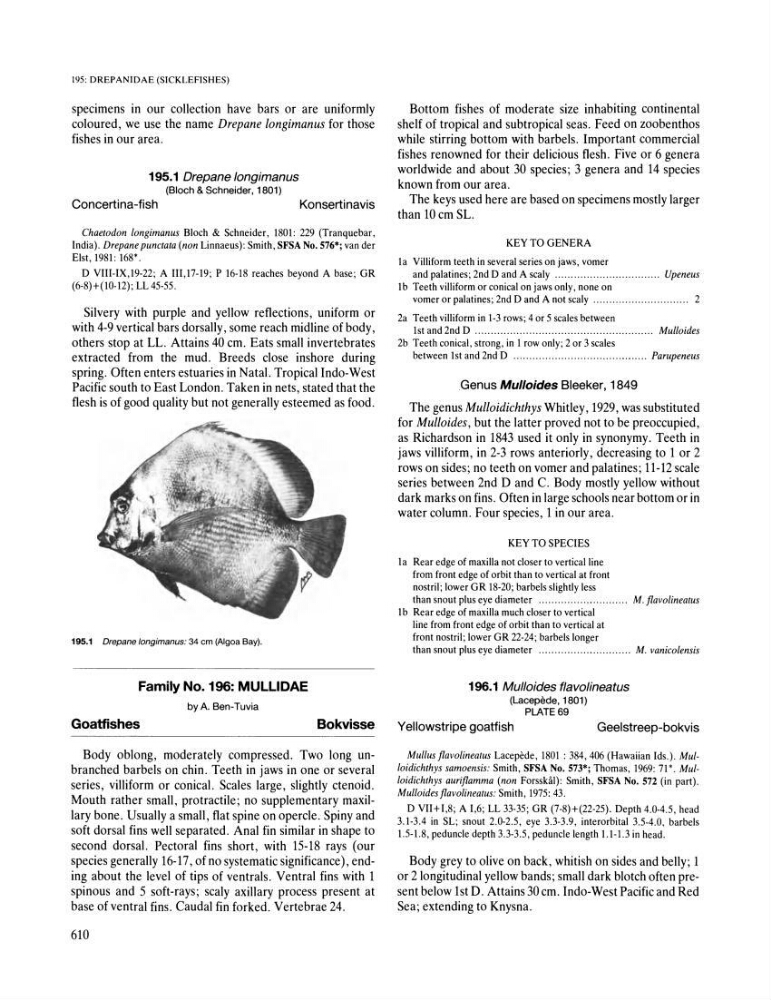
195.1 Drepane longimanus: 34 em (Algoa Bay).
Family No. 196: MULLIDAE
by A. Ben-Tuvia
Goatfishes
Bokvisse
Body oblong, moderately compressed. Two long unbranched barbels on chin. Teeth in jaws in one or several
series, villiform or conical. Scales large, slightly ctenoid.
Mouth rather small, protractile; no supplementary maxillary bone. Usually a small, flat spine on opercle. Spiny and
soft dorsal fins well separated. Anal fin similar in shape to
second dorsal. Pectoral fins short, with 15-18 rays (our
species generally 16-17, of no systematic significance), ending about the level of tips of ventrals. Ventral fins with 1
spinous and 5 soft-rays; scaly axillary process present at
base of ventral fins. Caudal fin forked. Vertebrae 24.
610
Bottom fishes of moderate size inhabiting continental
shelf of tropical and subtropical seas. Feed on zoobenthos
while stirring bottom with barbels. Important commercial
fishes renowned for their delicious flesh. Five or 6 genera
worldwide and about 30 species; 3 genera and 14 species
known from our area.
The keys used here are based on specimens mostly larger
than 10 cm SL.
KEY TO GENERA
1 a Villi form teeth in several series on jaws, vomer
and palatines; 2nd D and A scaly ................................. Upeneus
Ib Teeth villiform or conical on jaws only, none on
vomer or palatines; 2nd D and A not scaly .............................. 2
2a Teeth villiform in 1-3 rows; 4 or 5 scales between
1 st and 2nd D ........................................................ M ulloides
2b Teeth conical, strong, in 1 row only; 2 or 3 scales
between 1st and 2nd D .......................................... Parupeneus
Genus Mulloides Bleeker, 1849
The genus Mulloidichthys Whitley, 1929, was substituted
for Mulloides, but the latter proved not to be preoccupied,
as Richardson in 1843 used it only in synonymy. Teeth in
jaws villiform, in 2-3 rows anteriorly, decreasing to 1 or 2
rows on sides; no teeth on vomer and palatines; 11-12 scale
series between 2nd 0 and C. Body mostly yellow without
dark marks on fins. Often in large schools near bottom or in
water column. Four species, 1 in our area.
KEY TO SPECIES
1 a Rear edge of maxilla not closer to vertical line
from front edge of orbit than to vertical at front
nostril; lower GR 18-20; barbels slightly less
than snout plus eye diameter ............................ M. [Iavolineatus
1 b Rear edge of maxilla much closer to vertical
line from front edge of orbit than to vertical at
front nostril; lower GR 22-24; barbels longer
than snout plus eye diameter ............................. M. vanicolensis
196.1 Mulloides f1avolineatus
(Lacepede, 1801)
PLATE 69
Yeliowstripe goatfish
Geelstreep-bokvis
Mullus [Iavolineatus Lacepede, 1801 : 384, 406 (Hawaiian Ids.). Mulloidichthys samoensis: Smith, SFSA No. 573*; Thomas, 1969: 71 *. Mulloidichthys auri[lamma (non Forsskill): Smith, SFSA No. 572 (in part).
Mulloides [Iavolineatus: Smith, 1975: 43.
D VII + 1,8; A 1,6; LL 33-35; GR (7-8)+(22-25). Depth 4.0-4.5, head
3.1-3.4 in SL; snout 2.0-2.5, eye 3.3-3.9, interorbital 3.5-4.0, barbels
1.5-1.8, peduncle depth 3.3-3.5, peduncle length 1.1-1.3 in head.
Body grey to olive on back, whitish on sides and belly; 1
or 2 longitudinal yellow bands; small dark blotch often present below 1st D. Attains 30 cm. Indo-West Pacific and Red
Sea; extending to Knysna.
specimens in our collection have bars or are uniformly
coloured, we use the name Drepane longimanus for those
fishes in our ~rea.
195.1 Drepane /ongimanus
(Bloch & Schneider, 1801)
Concertina-fish
Konsertinavis
Chaetodon longimanus Bloch & Schneider, 1801: 229 (Tranquebar,
India). Drepane punctata (non Linnaeus): Smith, SFSA No. 576*; van der
Elst, 1981: 168*.
D VIII-IX,19-22; A III,17-19; P 16-18 reaches beyond A base; GR
(6-8)+(10-12); LL 45-55.
Silvery with purple and yellow reflections, uniform or
with 4-9 vertical bars dorsally, some reach midline of body,
others stop at LL. Attains 40 cm. Eats small invertebrates
extracted from the mud. Breeds close inshore during
spring. Often enters estuaries in Natal. Tropical Indo-West
Pacific south to East London. Taken in nets, stated that the
flesh is of good quality but not generally esteemed as food.
195.1 Drepane longimanus: 34 em (Algoa Bay).
Family No. 196: MULLIDAE
by A. Ben-Tuvia
Goatfishes
Bokvisse
Body oblong, moderately compressed. Two long unbranched barbels on chin. Teeth in jaws in one or several
series, villiform or conical. Scales large, slightly ctenoid.
Mouth rather small, protractile; no supplementary maxillary bone. Usually a small, flat spine on opercle. Spiny and
soft dorsal fins well separated. Anal fin similar in shape to
second dorsal. Pectoral fins short, with 15-18 rays (our
species generally 16-17, of no systematic significance), ending about the level of tips of ventrals. Ventral fins with 1
spinous and 5 soft-rays; scaly axillary process present at
base of ventral fins. Caudal fin forked. Vertebrae 24.
610
Bottom fishes of moderate size inhabiting continental
shelf of tropical and subtropical seas. Feed on zoobenthos
while stirring bottom with barbels. Important commercial
fishes renowned for their delicious flesh. Five or 6 genera
worldwide and about 30 species; 3 genera and 14 species
known from our area.
The keys used here are based on specimens mostly larger
than 10 cm SL.
KEY TO GENERA
1 a Villi form teeth in several series on jaws, vomer
and palatines; 2nd D and A scaly ................................. Upeneus
Ib Teeth villiform or conical on jaws only, none on
vomer or palatines; 2nd D and A not scaly .............................. 2
2a Teeth villiform in 1-3 rows; 4 or 5 scales between
1 st and 2nd D ........................................................ M ulloides
2b Teeth conical, strong, in 1 row only; 2 or 3 scales
between 1st and 2nd D .......................................... Parupeneus
Genus Mulloides Bleeker, 1849
The genus Mulloidichthys Whitley, 1929, was substituted
for Mulloides, but the latter proved not to be preoccupied,
as Richardson in 1843 used it only in synonymy. Teeth in
jaws villiform, in 2-3 rows anteriorly, decreasing to 1 or 2
rows on sides; no teeth on vomer and palatines; 11-12 scale
series between 2nd 0 and C. Body mostly yellow without
dark marks on fins. Often in large schools near bottom or in
water column. Four species, 1 in our area.
KEY TO SPECIES
1 a Rear edge of maxilla not closer to vertical line
from front edge of orbit than to vertical at front
nostril; lower GR 18-20; barbels slightly less
than snout plus eye diameter ............................ M. [Iavolineatus
1 b Rear edge of maxilla much closer to vertical
line from front edge of orbit than to vertical at
front nostril; lower GR 22-24; barbels longer
than snout plus eye diameter ............................. M. vanicolensis
196.1 Mulloides f1avolineatus
(Lacepede, 1801)
PLATE 69
Yeliowstripe goatfish
Geelstreep-bokvis
Mullus [Iavolineatus Lacepede, 1801 : 384, 406 (Hawaiian Ids.). Mulloidichthys samoensis: Smith, SFSA No. 573*; Thomas, 1969: 71 *. Mulloidichthys auri[lamma (non Forsskill): Smith, SFSA No. 572 (in part).
Mulloides [Iavolineatus: Smith, 1975: 43.
D VII + 1,8; A 1,6; LL 33-35; GR (7-8)+(22-25). Depth 4.0-4.5, head
3.1-3.4 in SL; snout 2.0-2.5, eye 3.3-3.9, interorbital 3.5-4.0, barbels
1.5-1.8, peduncle depth 3.3-3.5, peduncle length 1.1-1.3 in head.
Body grey to olive on back, whitish on sides and belly; 1
or 2 longitudinal yellow bands; small dark blotch often present below 1st D. Attains 30 cm. Indo-West Pacific and Red
Sea; extending to Knysna.