

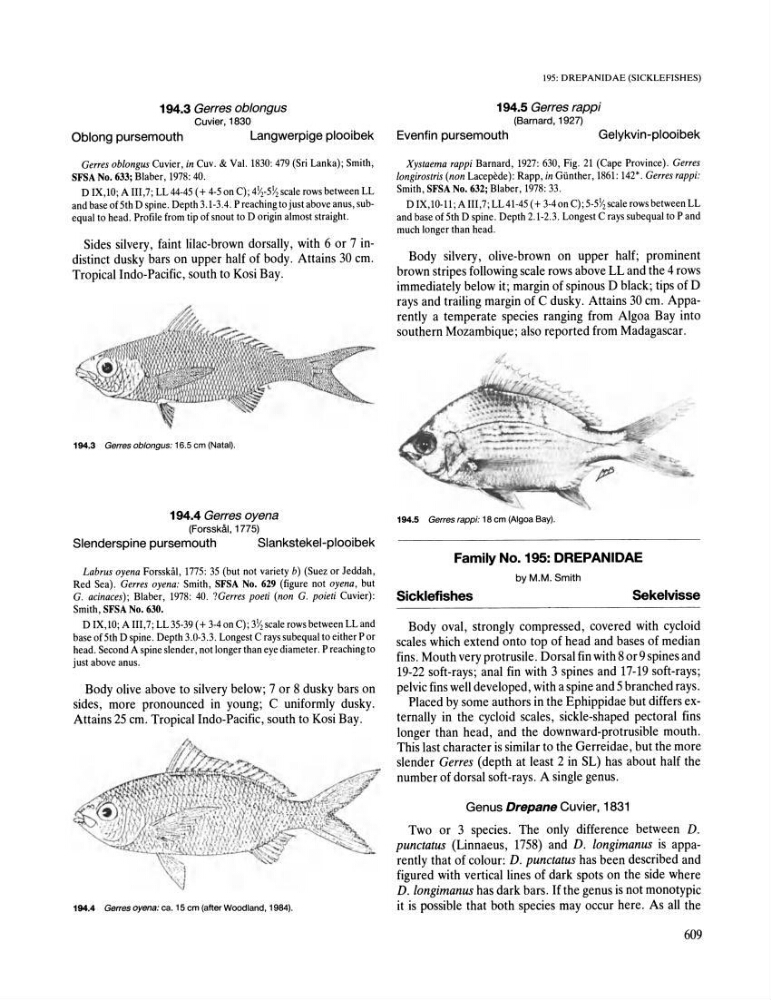
194.3 Gerres ab/angus
Cuvier, 1830
Oblong pursemouth
Langwerpige plooibek
Gerres oblongus Cuvier, in Cuv. & Val. 1830: 479 (Sri Lanka); Smith,
SFSA No. 633; Blaber, 1978: 40.
D IX,lO; A 1II,7; LL 44-45 (+ 4-5 on C); 4\'2-51z scale rows between LL
and base of 5th D spine. Depth 3.1-3.4. P reaching to just above anus, subequal to head. Profile from tip of snout to D origin almost straight.
Sides silvery, faint lilac-brown dorsally, with 6 or 7 indistinct dusky bars on upper half of body. Attains 30 cm.
Tropical Indo-Pacific, south to Kosi Bay.
194.3 Gerres ob/ongus: 16.5 cm (Natal).
194.4 Gerres ayena
(Forsskal,1775)
Slenderspine pursemouth
Siankstekel-plooibek
Labrus oyena Forsskill, 1775: 35 (but not variety b) (Suez or Jeddah,
Red Sea). Gerres oyena: Smith, SFSA No. 629 (figure not oyena, but
G. acinaces); Blaber, 1978: 40. ?Gerres poeti (non G. poieti Cuvier):
Smith, SFSA No. 630.
D IX,lO; A 1II,7; LL 35-39 (+ 3-4 on C); 31z scale rows between LL and
base of 5th D spine. Depth 3.0-3.3. Longest Crays subequal to either P or
head. Second A spine slender, not longer than eye diameter. P reaching to
just above anus.
Body olive above to silvery below; 7 or 8 dusky bars on
sides, more pronounced in young; C uniformly dusky.
Attains 25 cm. Tropical Indo-Pacific, south to Kosi Bay.
194.4 Gerres ayena: ea. 15 em (after Woodland, 1984).
195: DREPANIDAE (SICKLEFISHES)
194.5 Gerres rappi
(Barnard, 1927)
Evenfin pursemouth
Gelykvin-plooibek
Xystaema rappi Barnard, 1927: 630, Fig. 21 (Cape Province). Gerres
longirostris (non Lacepede): Rapp, in Gunther, 1861: 142*. Gerres rappi:
Smith, SFSA No. 632; Blaber, 1978: 33.
D IX,10-11; A III,7; LL41-45 (+ 3-40n C); 5-5\'2 scale rows between LL
and base of 5th D spine. Depth 2.1-2.3. Longest Crays subequal to P and
much longer than head.
Body silvery, olive-brown on upper half; prominent
brown stripes following scale rows above LL and the 4 rows
immediately below it; margin of spinous D black; tips of D
rays and trailing margin of C dusky. Attains 30 cm. Apparently a temperate species ranging from Algoa Bay into
southern Mozambique; also reported from Madagascar.
194.5 Gerres rappi: 18 em (Algoa Bay).
Family No. 195: DREPANIDAE
by M.M. Smith
Sicklefishes
Sekelvisse
Body oval, strongly compressed, covered with cycloid
scales which extend onto top of head and bases of median
fins. Mouth very protrusile. Dorsal fin with 8 or 9 spines and
19-22 soft-rays; anal fin with 3 spines and 17-19 soft-rays;
pelvic fins well developed, with a spine and 5 branched rays.
Placed by some authors in the Ephippidae but differs externally in the cycloid scales, sickle-shaped pectoral fins
longer than head, and the downward-protrusible mouth.
This last character is similar to the Gerreidae, but the more
slender Gerres (depth at least 2 in SL) has about half the
number of dorsal soft-rays. A single genus.
Genus Drepane Cuvier, 1831
Two or 3 species. The only difference between D.
punctatus (Linnaeus, 1758) and D. longimanus is apparently that of colour: D. punctatus has been described and
figured with vertical lines of dark spots on the side where
D. longimanus has dark bars. If the genus is not monotypic
it is possible that both species may occur here. As all the
609
Cuvier, 1830
Oblong pursemouth
Langwerpige plooibek
Gerres oblongus Cuvier, in Cuv. & Val. 1830: 479 (Sri Lanka); Smith,
SFSA No. 633; Blaber, 1978: 40.
D IX,lO; A 1II,7; LL 44-45 (+ 4-5 on C); 4\'2-51z scale rows between LL
and base of 5th D spine. Depth 3.1-3.4. P reaching to just above anus, subequal to head. Profile from tip of snout to D origin almost straight.
Sides silvery, faint lilac-brown dorsally, with 6 or 7 indistinct dusky bars on upper half of body. Attains 30 cm.
Tropical Indo-Pacific, south to Kosi Bay.
194.3 Gerres ob/ongus: 16.5 cm (Natal).
194.4 Gerres ayena
(Forsskal,1775)
Slenderspine pursemouth
Siankstekel-plooibek
Labrus oyena Forsskill, 1775: 35 (but not variety b) (Suez or Jeddah,
Red Sea). Gerres oyena: Smith, SFSA No. 629 (figure not oyena, but
G. acinaces); Blaber, 1978: 40. ?Gerres poeti (non G. poieti Cuvier):
Smith, SFSA No. 630.
D IX,lO; A 1II,7; LL 35-39 (+ 3-4 on C); 31z scale rows between LL and
base of 5th D spine. Depth 3.0-3.3. Longest Crays subequal to either P or
head. Second A spine slender, not longer than eye diameter. P reaching to
just above anus.
Body olive above to silvery below; 7 or 8 dusky bars on
sides, more pronounced in young; C uniformly dusky.
Attains 25 cm. Tropical Indo-Pacific, south to Kosi Bay.
194.4 Gerres ayena: ea. 15 em (after Woodland, 1984).
195: DREPANIDAE (SICKLEFISHES)
194.5 Gerres rappi
(Barnard, 1927)
Evenfin pursemouth
Gelykvin-plooibek
Xystaema rappi Barnard, 1927: 630, Fig. 21 (Cape Province). Gerres
longirostris (non Lacepede): Rapp, in Gunther, 1861: 142*. Gerres rappi:
Smith, SFSA No. 632; Blaber, 1978: 33.
D IX,10-11; A III,7; LL41-45 (+ 3-40n C); 5-5\'2 scale rows between LL
and base of 5th D spine. Depth 2.1-2.3. Longest Crays subequal to P and
much longer than head.
Body silvery, olive-brown on upper half; prominent
brown stripes following scale rows above LL and the 4 rows
immediately below it; margin of spinous D black; tips of D
rays and trailing margin of C dusky. Attains 30 cm. Apparently a temperate species ranging from Algoa Bay into
southern Mozambique; also reported from Madagascar.
194.5 Gerres rappi: 18 em (Algoa Bay).
Family No. 195: DREPANIDAE
by M.M. Smith
Sicklefishes
Sekelvisse
Body oval, strongly compressed, covered with cycloid
scales which extend onto top of head and bases of median
fins. Mouth very protrusile. Dorsal fin with 8 or 9 spines and
19-22 soft-rays; anal fin with 3 spines and 17-19 soft-rays;
pelvic fins well developed, with a spine and 5 branched rays.
Placed by some authors in the Ephippidae but differs externally in the cycloid scales, sickle-shaped pectoral fins
longer than head, and the downward-protrusible mouth.
This last character is similar to the Gerreidae, but the more
slender Gerres (depth at least 2 in SL) has about half the
number of dorsal soft-rays. A single genus.
Genus Drepane Cuvier, 1831
Two or 3 species. The only difference between D.
punctatus (Linnaeus, 1758) and D. longimanus is apparently that of colour: D. punctatus has been described and
figured with vertical lines of dark spots on the side where
D. longimanus has dark bars. If the genus is not monotypic
it is possible that both species may occur here. As all the
609