

183: SPARIDAE (SEABREAMS)
D XI,12-13; A 111,10-11; P 15-17; LL 60-65; GR (8-10)+(15-17); depth
2.75. Fine pointed teeth externally, with 2 or 3 series of small molars
within; lips thin.
Smaller than our other species of Lithognathus, attaining
55 cm. Mediterranean to the Cape and round our coast to
Mozambique; recorded from Red Sea, but none found in
tropical east Africa. Not abundant; caught by anglers using
small hooks mainly in sandy areas of estuaries and down to
30 m; flesh excellent. Spawns in the sea during summer.
183.21 Lithognathus mormyrus: upper and lower jaws (after Bauehot & Smith,
1984).
Genus Pachymetopon Gunther, 1859
About 5 rows of incisors round each jaw, no molars.
Interorbital naked; soft D and A scaly basally. Three rather
plump-bodied fishes found only in South Africa (one
reported to reach Madagascar).
KEY TO SPECIES
la P about as long as head; lower GR 13-14; LL 60-65 ........ P. blochii
Ib P distinctly longer than head; LL 80-86 .................................. 2
2a Scales on inner margin of preopercle flange; lower
GR 15-18 ............................................................ P. aeneum
2b Entire preopercle flange naked; lower GR 10-13 ........... P. grande
183.22 Pachymetopon aeneum
(Gilchrist & Thompson, 1908)
PLATE 60
Blue hottentot
Blou hottentot
Cantharus aeneus Gilchrist & Thompson, 1908: 166 (Natal). Cantharus
natalensis Gilchrist & Thompson, 1908: 167 (Natal). Cantharus simus
Gilchrist & Thompson, 1909: 231 (Durban). Pachymetopon aeneum:
Smith, 1938: 286; SFSA No. 737*; Smith & Smith, 1966: 55*; Smith, 1981:
180; van der Elst, 1981: 320*.
D X-XI,l1-13; A 111,10; P 17; LL 80-86; Tr. 10/22; GR (6-8)+(15-18);
depth 2.2-2.5. Pug-like snout, with characteristic bulge between eyes.
Fresh from the water, this species is of great beauty, with
cobalt blue head and blue-streaked bronzy-yellow body. No
588
artist may hope to portray these colours in their natural
brilliance. Attains 50 cm. Known only from the Cape to
Sodwana Bay. Not often taken by shore anglers, then as a
rule only on rocky banks in rather deep water, chiefly on
redbait. Flesh excellent.
Hottentot
183.23 Pachymetopon blochii
(Valenciennes, 1830)
PLATE 60
Hottentot
Cantharus Blochii Valenciennes, in Cuv. & Val., 1830: 339 (Cape of
Good Hope). Cantharus castelnau Bleeker, 1860: 59 (Cape of Good
Hope). Pachymetopon blochii: Smith, 1938: 285; SFSA No. 736*; van der
Elst, 1981: 321 *. Pachymetopon canescens Norman, 1935: 14, PI. 2 (False
Bay).
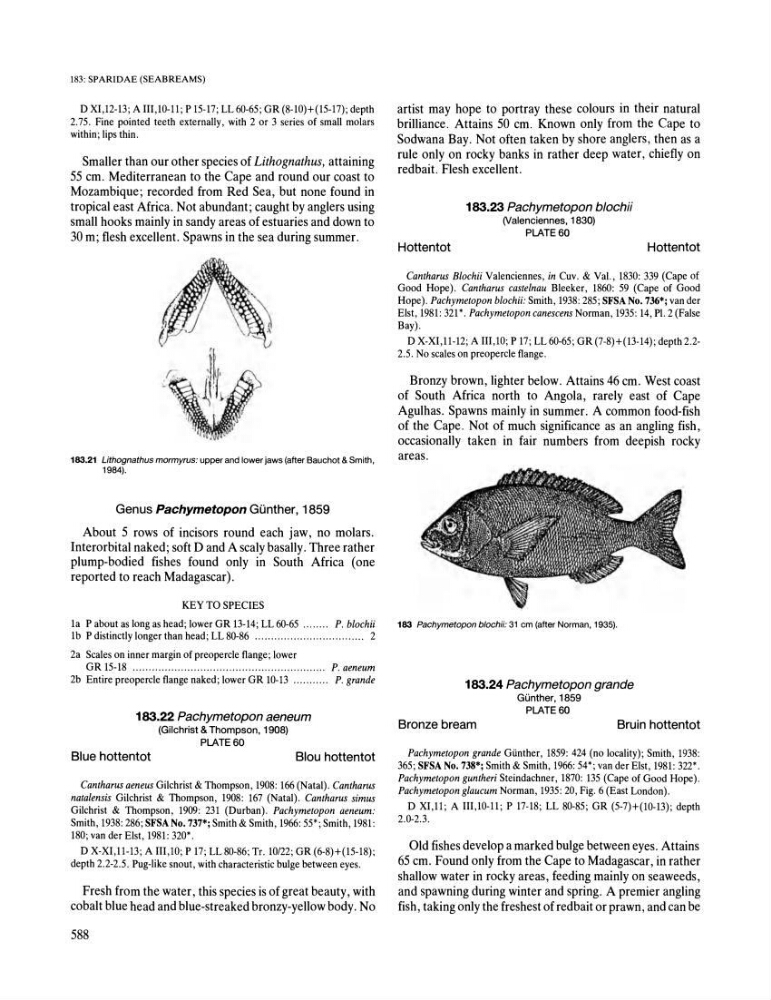
D X-XI,11-12; A 111,10; P 17; LL 60-65; GR (7-8)+(13-14); depth 2.22.5. No scales on preopercle flange.
Bronzy brown, lighter below. Attains 46 cm. West coast
of South Africa north to Angola, rarely east of Cape
Agulhas. Spawns mainly in summer. A common food-fish
of the Cape. Not of much significance as an angling fish,
occasionally taken in fair numbers from deepish rocky
areas.
183 Pachymetopon blochii: 31 em (after Norman, 1935).
183.24 Pachymetopon grande
Gunther, 1859
PLATE 60
Bronze bream
Bruin hottentot
Pachymetopon grande Giinther, 1859: 424 (no locality); Smith, 1938:
365; SFSA No. 738*; Smith & Smith, 1966: 54*; van der Elst, 1981: 322*.
Pachymetopon guntheri Steindachner, 1870: 135 (Cape of Good Hope).
Pachymetopon glaucum Norman, 1935: 20, Fig. 6 (East London).
D XI,l1; A 111,10-11; P 17-18; LL 80-85; GR (5-7)+(10-13); depth
2.0-2.3.
Old fishes develop a marked bulge between eyes. Attains
65 cm. Found only from the Cape to Madagascar, in rather
shallow water in rocky areas, feeding mainly on seaweeds,
and spawning during winter and spring. A premier angling
fish, taking only the freshest of redbait or prawn, and can be
D XI,12-13; A 111,10-11; P 15-17; LL 60-65; GR (8-10)+(15-17); depth
2.75. Fine pointed teeth externally, with 2 or 3 series of small molars
within; lips thin.
Smaller than our other species of Lithognathus, attaining
55 cm. Mediterranean to the Cape and round our coast to
Mozambique; recorded from Red Sea, but none found in
tropical east Africa. Not abundant; caught by anglers using
small hooks mainly in sandy areas of estuaries and down to
30 m; flesh excellent. Spawns in the sea during summer.
183.21 Lithognathus mormyrus: upper and lower jaws (after Bauehot & Smith,
1984).
Genus Pachymetopon Gunther, 1859
About 5 rows of incisors round each jaw, no molars.
Interorbital naked; soft D and A scaly basally. Three rather
plump-bodied fishes found only in South Africa (one
reported to reach Madagascar).
KEY TO SPECIES
la P about as long as head; lower GR 13-14; LL 60-65 ........ P. blochii
Ib P distinctly longer than head; LL 80-86 .................................. 2
2a Scales on inner margin of preopercle flange; lower
GR 15-18 ............................................................ P. aeneum
2b Entire preopercle flange naked; lower GR 10-13 ........... P. grande
183.22 Pachymetopon aeneum
(Gilchrist & Thompson, 1908)
PLATE 60
Blue hottentot
Blou hottentot
Cantharus aeneus Gilchrist & Thompson, 1908: 166 (Natal). Cantharus
natalensis Gilchrist & Thompson, 1908: 167 (Natal). Cantharus simus
Gilchrist & Thompson, 1909: 231 (Durban). Pachymetopon aeneum:
Smith, 1938: 286; SFSA No. 737*; Smith & Smith, 1966: 55*; Smith, 1981:
180; van der Elst, 1981: 320*.
D X-XI,l1-13; A 111,10; P 17; LL 80-86; Tr. 10/22; GR (6-8)+(15-18);
depth 2.2-2.5. Pug-like snout, with characteristic bulge between eyes.
Fresh from the water, this species is of great beauty, with
cobalt blue head and blue-streaked bronzy-yellow body. No
588
artist may hope to portray these colours in their natural
brilliance. Attains 50 cm. Known only from the Cape to
Sodwana Bay. Not often taken by shore anglers, then as a
rule only on rocky banks in rather deep water, chiefly on
redbait. Flesh excellent.
Hottentot
183.23 Pachymetopon blochii
(Valenciennes, 1830)
PLATE 60
Hottentot
Cantharus Blochii Valenciennes, in Cuv. & Val., 1830: 339 (Cape of
Good Hope). Cantharus castelnau Bleeker, 1860: 59 (Cape of Good
Hope). Pachymetopon blochii: Smith, 1938: 285; SFSA No. 736*; van der
Elst, 1981: 321 *. Pachymetopon canescens Norman, 1935: 14, PI. 2 (False
Bay).
D X-XI,11-12; A 111,10; P 17; LL 60-65; GR (7-8)+(13-14); depth 2.22.5. No scales on preopercle flange.
Bronzy brown, lighter below. Attains 46 cm. West coast
of South Africa north to Angola, rarely east of Cape
Agulhas. Spawns mainly in summer. A common food-fish
of the Cape. Not of much significance as an angling fish,
occasionally taken in fair numbers from deepish rocky
areas.
183 Pachymetopon blochii: 31 em (after Norman, 1935).
183.24 Pachymetopon grande
Gunther, 1859
PLATE 60
Bronze bream
Bruin hottentot
Pachymetopon grande Giinther, 1859: 424 (no locality); Smith, 1938:
365; SFSA No. 738*; Smith & Smith, 1966: 54*; van der Elst, 1981: 322*.
Pachymetopon guntheri Steindachner, 1870: 135 (Cape of Good Hope).
Pachymetopon glaucum Norman, 1935: 20, Fig. 6 (East London).
D XI,l1; A 111,10-11; P 17-18; LL 80-85; GR (5-7)+(10-13); depth
2.0-2.3.
Old fishes develop a marked bulge between eyes. Attains
65 cm. Found only from the Cape to Madagascar, in rather
shallow water in rocky areas, feeding mainly on seaweeds,
and spawning during winter and spring. A premier angling
fish, taking only the freshest of redbait or prawn, and can be