

most difficult to hook, but at times bites fiercely and fights
gamely. J.L.B. Smith (SFSA) records 14 different common
names for this fish! A beautiful fish: in the water, the head
side-on is iridescent blue and sharply differentiated from
the bronzy body. Highly esteemed as a food-fish, sometimes taken in fair numbers by rock anglers, but not sufficiently abundant to be of commercial significance. Numbers are often thrown ashore, numbed or dead, when cold
water upwelling occurs at Knysna. Preyed on by larger
fishes, a strip of its flesh is excellent bait. Once at Knysna a
specimen of about 1.5 kg jumped onto a rocky ledge at the
water's edge to escape from a large pursuing red steenbras
which, with head out of the water, snapped at it and then
made off; the bronze bream slipped away with the next
wave.
Genus Pagel/us Cuvier, 1829
Body mainly pink; only one subspecies of P. bel/ottii
Steindachner, 1882 from the Atlantic in our area (M.L.
Bauchot, personal communication) .
183.25 Pagel/us bel/ottN natalensis
Steindachner, 1902
PLATE 60
Red tjor-tjor
Rooi tjortjor
Pagellus natalensis Steindachner, 1902: 134 (Durban); Smith, 1938:
374*; SFSA No. 728*; Smith & Smith , 1966: 91*; van der E1st, 1981 : 323*.
D XII,lO-11; A III,lO; P 16; LL 60-67; GR (5-6)+(10-13); depth
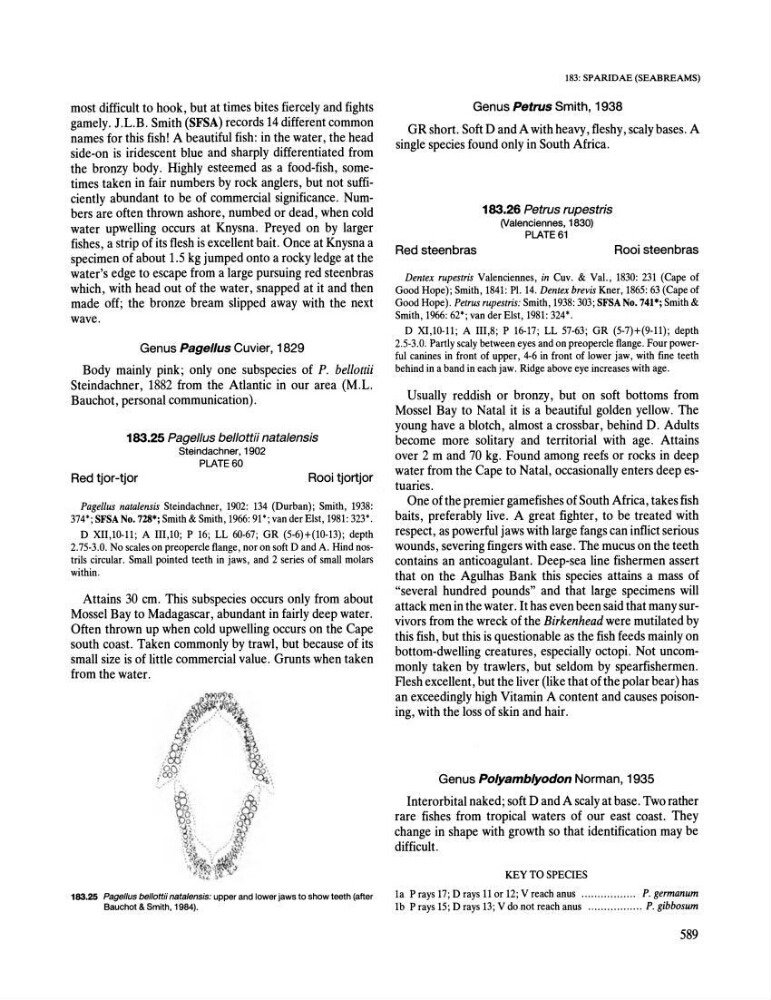
2.75-3.0. No scales on preopercIe flange, nor on soft D and A. Hind nostrils circular. Small pointed teeth in jaws, and 2 series of small molars
within.
Attains 30 cm. This subspecies occurs only from about
Mossel Bay to Madagascar, abundant in fairly deep water.
Often thrown up when cold upwelling occurs on the Cape
south coast. Taken commonly by trawl, but because of its
small size is of little commercial value. Grunts when taken
from the water.
183.25 Pagel/us bel/attii natalensis: upper and lower jaws to show teeth (after
Bauchot & Smith, 1984).
183: SPARIDAE (SEABREAMS)
Genus Petrus Smith, 1938
GR short. Soft D and A with heavy, fleshy, scaly bases. A
single species found only in South Africa.
Red steen bras
183.26 Petrus rupestris
(Valenciennes, 1830)
PLATE 61
Rooi steen bras
Dentex rupestris Valenciennes, in Cuv. & Val., 1830: 231 (Cape of
Good Hope) ; Smith, 1841: PI. 14. Dentex brevis Kner, 1865: 63 (Cape of
Good Hope). Petrus rupestris: Smith, 1938: 303; SFSA No. 741*; Smith &
Smith, 1966: 62*; van der Elst, 1981: 324*.
D XI,lO-11 ; A III,8 ; P 16-17; LL 57-63; GR (5-7)+(9-11) ; depth
2.5-3.0. Partly scaly between eyes and on preopercIe flange. Four powerful canines in front of upper, 4-6 in front of lower jaw, with fine teeth
behind in a band in each jaw. Ridge above eye increases with age .
Usually reddish or bronzy, but on soft bottoms from
Mossel Bay to Natal it is a beautiful golden yellow. The
young have a blotch, almost a crossbar, behind D. Adults
become more solitary and territorial with age. Attains
over 2 m and 70 kg. Found among reefs or rocks in deep
water from the Cape to Natal, occasionally enters deep estuaries.
One of the premier gamefishes of South Africa, takes fish
baits, preferably live. A great fighter, to be treated with
respect, as powerful jaws with large fangs can inflict serious
wounds, severing fingers with ease. The mucus on the teeth
contains an anticoagulant. Deep-sea line fishermen assert
that on the Agulhas Bank this species attains a mass of
"several hundred pounds" and that large specimens will
attack men in the water. It has even been said that many survivors from the wreck of the Birkenhead were mutilated by
this fish, but this is questionable as the fish feeds mainly on
bottom-dwelling creatures, especially octopi. Not uncommonly taken by trawlers, but seldom by spearfishermen.
Flesh excellent, but the liver (like that of the polar bear) has
an exceedingly high Vitamin A content and causes poisoning, with the loss of skin and hair.
Genus Polyamblyodon Norman, 1935
Interorbital naked; soft D and A scaly at base. Two rather
rare fishes from tropical waters of our east coast. They
change in shape with growth so that identification may be
difficult.
KEY TO SPECIES
la Prays 17; Drays 11 or 12; V reach anus ....... .. .. ... ... P. germanum
Ib Prays 15 ; Drays 13; V do not reach anus .. .. ..... ....... . P. gibbosum
589
gamely. J.L.B. Smith (SFSA) records 14 different common
names for this fish! A beautiful fish: in the water, the head
side-on is iridescent blue and sharply differentiated from
the bronzy body. Highly esteemed as a food-fish, sometimes taken in fair numbers by rock anglers, but not sufficiently abundant to be of commercial significance. Numbers are often thrown ashore, numbed or dead, when cold
water upwelling occurs at Knysna. Preyed on by larger
fishes, a strip of its flesh is excellent bait. Once at Knysna a
specimen of about 1.5 kg jumped onto a rocky ledge at the
water's edge to escape from a large pursuing red steenbras
which, with head out of the water, snapped at it and then
made off; the bronze bream slipped away with the next
wave.
Genus Pagel/us Cuvier, 1829
Body mainly pink; only one subspecies of P. bel/ottii
Steindachner, 1882 from the Atlantic in our area (M.L.
Bauchot, personal communication) .
183.25 Pagel/us bel/ottN natalensis
Steindachner, 1902
PLATE 60
Red tjor-tjor
Rooi tjortjor
Pagellus natalensis Steindachner, 1902: 134 (Durban); Smith, 1938:
374*; SFSA No. 728*; Smith & Smith , 1966: 91*; van der E1st, 1981 : 323*.
D XII,lO-11; A III,lO; P 16; LL 60-67; GR (5-6)+(10-13); depth
2.75-3.0. No scales on preopercIe flange, nor on soft D and A. Hind nostrils circular. Small pointed teeth in jaws, and 2 series of small molars
within.
Attains 30 cm. This subspecies occurs only from about
Mossel Bay to Madagascar, abundant in fairly deep water.
Often thrown up when cold upwelling occurs on the Cape
south coast. Taken commonly by trawl, but because of its
small size is of little commercial value. Grunts when taken
from the water.
183.25 Pagel/us bel/attii natalensis: upper and lower jaws to show teeth (after
Bauchot & Smith, 1984).
183: SPARIDAE (SEABREAMS)
Genus Petrus Smith, 1938
GR short. Soft D and A with heavy, fleshy, scaly bases. A
single species found only in South Africa.
Red steen bras
183.26 Petrus rupestris
(Valenciennes, 1830)
PLATE 61
Rooi steen bras
Dentex rupestris Valenciennes, in Cuv. & Val., 1830: 231 (Cape of
Good Hope) ; Smith, 1841: PI. 14. Dentex brevis Kner, 1865: 63 (Cape of
Good Hope). Petrus rupestris: Smith, 1938: 303; SFSA No. 741*; Smith &
Smith, 1966: 62*; van der Elst, 1981: 324*.
D XI,lO-11 ; A III,8 ; P 16-17; LL 57-63; GR (5-7)+(9-11) ; depth
2.5-3.0. Partly scaly between eyes and on preopercIe flange. Four powerful canines in front of upper, 4-6 in front of lower jaw, with fine teeth
behind in a band in each jaw. Ridge above eye increases with age .
Usually reddish or bronzy, but on soft bottoms from
Mossel Bay to Natal it is a beautiful golden yellow. The
young have a blotch, almost a crossbar, behind D. Adults
become more solitary and territorial with age. Attains
over 2 m and 70 kg. Found among reefs or rocks in deep
water from the Cape to Natal, occasionally enters deep estuaries.
One of the premier gamefishes of South Africa, takes fish
baits, preferably live. A great fighter, to be treated with
respect, as powerful jaws with large fangs can inflict serious
wounds, severing fingers with ease. The mucus on the teeth
contains an anticoagulant. Deep-sea line fishermen assert
that on the Agulhas Bank this species attains a mass of
"several hundred pounds" and that large specimens will
attack men in the water. It has even been said that many survivors from the wreck of the Birkenhead were mutilated by
this fish, but this is questionable as the fish feeds mainly on
bottom-dwelling creatures, especially octopi. Not uncommonly taken by trawlers, but seldom by spearfishermen.
Flesh excellent, but the liver (like that of the polar bear) has
an exceedingly high Vitamin A content and causes poisoning, with the loss of skin and hair.
Genus Polyamblyodon Norman, 1935
Interorbital naked; soft D and A scaly at base. Two rather
rare fishes from tropical waters of our east coast. They
change in shape with growth so that identification may be
difficult.
KEY TO SPECIES
la Prays 17; Drays 11 or 12; V reach anus ....... .. .. ... ... P. germanum
Ib Prays 15 ; Drays 13; V do not reach anus .. .. ..... ....... . P. gibbosum
589