

rocky areas, but also found down to 80 m; nowhere abundant. Usually taken from rocks on redbait, rare for more
than 2 to be caught in one spot. A shapely fish. Flesh excellent.
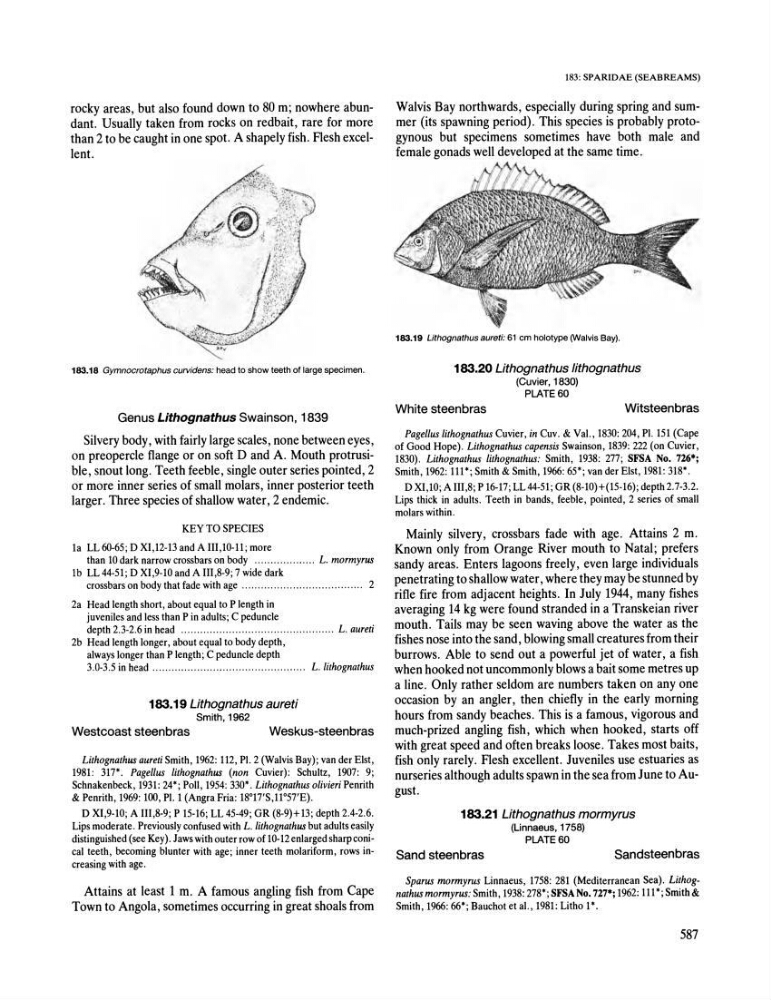
183.18 Gymnocrotaphus curvidens: head to show teeth of large specimen.
Genus Lithognathus Swainson, 1839
Silvery body, with fairly large scales, none between eyes,
on preopercle flange or on soft 0 and A. Mouth protrusible, snout long. Teeth feeble, single outer series pointed, 2
or more inner series of small molars, inner posterior teeth
larger. Three species of shallow water, 2 endemic.
KEY TO SPECIES
la LL 60-65; D XI,12-13 and A III,IO-11; more
than 10 dark narrow crossbars on body ................... L. mormyrus
Ib LL 44-51; D XI,9-1O and A III,8-9; 7 wide dark
crossbars on body that fade with age ....................... ............... 2
2a Head length short, about equal to P length in
juveniles and less than P in adults; C peduncle
depth 2.3-2.6 in head ................................................ L. aureti
2b Head length longer, about equal to body depth,
always longer than P length; C peduncle depth
3.0-3.5 in head .................................. .............. L. lithognathus
183.19 Uthognathus aureti
Smith,1962
Westcoast steenbras
Weskus-steenbras
Lithognathus aureti Smith, 1962: 112, PI. 2 (Walvis Bay); van der Elst,
1981: 317*. Pagel/us lithognathus (non Cuvier): Schultz, 1907: 9;
Schnakenbeck, 1931: 24*; Poll, 1954: 330* . Lithognathus olivieri Penrith
& Penrith, 1969: 100, PI. 1 (Angra Fria: 18°17'S,11°57'E).
D XI,9-1O; A III,8-9; P 15-16; LL 45-49; GR (8-9)+ 13; depth 2.4-2.6.
Lips moderate . Previously confused with L. lithognathus but adults easily
distinguished (see Key). Jaws with outer row of 10-12 enlarged sharp conical teeth, becoming blunter with age; inner teeth molariform, rows increasing with age.
Attains at least 1 m. A famous angling fish from Cape
Town to Angola, sometimes occurring in great shoals from
183: SPARIDAE (SEABREAMS)
Walvis Bay northwards, especially during spring and summer (its spawning period). This species is probably protogynous but specimens sometimes have both male and
female gonads well developed at the same time.
183.19 Lithognathus aureti: 61 cm holotype (Walvis Bay).
183.20 Lithognathus lithognathus
(Cuvier, 1830)
PLATE 60
White steen bras
Witsteenbras
Pagel/us lithognathus Cuvier, in Cuv. & Val., 1830: 204, PI. 151 (Cape
of Good Hope). Lithognathus capensis Swainson, 1839: 222 (on Cuvier,
1830). Lithognathus lithognathus: Smith, 1938: 277; SFSA No. 726*;
Smith, 1962: 111*; Smith & Smith, 1966: 65*; van der Elst, 1981: 318*.
D XI,IO; A III,8; P 16-17; LL 44-51; GR (8-10)+(15-16); depth 2.7-3.2.
Lips thick in adults. Teeth in bands, feeble, pointed, 2 series of small
molars within .
Mainly silvery, crossbars fade with age. Attains 2 m.
Known only from Orange River mouth to Natal; prefers
sandy areas. Enters lagoons freely, even large individuals
penetrating to shallow water, where they may be stunned by
rifle fire from adjacent heights. In July 1944, many fishes
averaging 14 kg were found stranded in a Transkeian river
mouth. Tails may be seen waving above the water as the
fishes nose into the sand, blowing small creatures from their
burrows. Able to send out a powerful jet of water, a fish
when hooked not uncommonly blows a bait some metres up
a line. Only rather seldom are numbers taken on anyone
occasion by an angler, then chiefly in the early morning
hours from sandy beaches. This is a famous, vigorous and
much-prized angling fish, which when hooked, starts off
with great speed and often breaks loose. Takes most baits,
fish only rarely. Flesh excellent. Juveniles use estuaries as
nurseries although adults spawn in the sea from June to August.
183.21 Uthognathus mormyrus
(Linnaeus, 1758)
PLATE 60
Sand steenbras
Sandsteenbras
Sparus mormyrus Linnaeus, 1758: 281 (Mediterranean Sea). Lithognathus mormyrus: Smith, 1938: 278*; SFSANo. 727*; 1962: 111*; Smith &
Smith, 1966: 66*; Bauchot et aI., 1981: Litho 1*.
587
than 2 to be caught in one spot. A shapely fish. Flesh excellent.
183.18 Gymnocrotaphus curvidens: head to show teeth of large specimen.
Genus Lithognathus Swainson, 1839
Silvery body, with fairly large scales, none between eyes,
on preopercle flange or on soft 0 and A. Mouth protrusible, snout long. Teeth feeble, single outer series pointed, 2
or more inner series of small molars, inner posterior teeth
larger. Three species of shallow water, 2 endemic.
KEY TO SPECIES
la LL 60-65; D XI,12-13 and A III,IO-11; more
than 10 dark narrow crossbars on body ................... L. mormyrus
Ib LL 44-51; D XI,9-1O and A III,8-9; 7 wide dark
crossbars on body that fade with age ....................... ............... 2
2a Head length short, about equal to P length in
juveniles and less than P in adults; C peduncle
depth 2.3-2.6 in head ................................................ L. aureti
2b Head length longer, about equal to body depth,
always longer than P length; C peduncle depth
3.0-3.5 in head .................................. .............. L. lithognathus
183.19 Uthognathus aureti
Smith,1962
Westcoast steenbras
Weskus-steenbras
Lithognathus aureti Smith, 1962: 112, PI. 2 (Walvis Bay); van der Elst,
1981: 317*. Pagel/us lithognathus (non Cuvier): Schultz, 1907: 9;
Schnakenbeck, 1931: 24*; Poll, 1954: 330* . Lithognathus olivieri Penrith
& Penrith, 1969: 100, PI. 1 (Angra Fria: 18°17'S,11°57'E).
D XI,9-1O; A III,8-9; P 15-16; LL 45-49; GR (8-9)+ 13; depth 2.4-2.6.
Lips moderate . Previously confused with L. lithognathus but adults easily
distinguished (see Key). Jaws with outer row of 10-12 enlarged sharp conical teeth, becoming blunter with age; inner teeth molariform, rows increasing with age.
Attains at least 1 m. A famous angling fish from Cape
Town to Angola, sometimes occurring in great shoals from
183: SPARIDAE (SEABREAMS)
Walvis Bay northwards, especially during spring and summer (its spawning period). This species is probably protogynous but specimens sometimes have both male and
female gonads well developed at the same time.
183.19 Lithognathus aureti: 61 cm holotype (Walvis Bay).
183.20 Lithognathus lithognathus
(Cuvier, 1830)
PLATE 60
White steen bras
Witsteenbras
Pagel/us lithognathus Cuvier, in Cuv. & Val., 1830: 204, PI. 151 (Cape
of Good Hope). Lithognathus capensis Swainson, 1839: 222 (on Cuvier,
1830). Lithognathus lithognathus: Smith, 1938: 277; SFSA No. 726*;
Smith, 1962: 111*; Smith & Smith, 1966: 65*; van der Elst, 1981: 318*.
D XI,IO; A III,8; P 16-17; LL 44-51; GR (8-10)+(15-16); depth 2.7-3.2.
Lips thick in adults. Teeth in bands, feeble, pointed, 2 series of small
molars within .
Mainly silvery, crossbars fade with age. Attains 2 m.
Known only from Orange River mouth to Natal; prefers
sandy areas. Enters lagoons freely, even large individuals
penetrating to shallow water, where they may be stunned by
rifle fire from adjacent heights. In July 1944, many fishes
averaging 14 kg were found stranded in a Transkeian river
mouth. Tails may be seen waving above the water as the
fishes nose into the sand, blowing small creatures from their
burrows. Able to send out a powerful jet of water, a fish
when hooked not uncommonly blows a bait some metres up
a line. Only rather seldom are numbers taken on anyone
occasion by an angler, then chiefly in the early morning
hours from sandy beaches. This is a famous, vigorous and
much-prized angling fish, which when hooked, starts off
with great speed and often breaks loose. Takes most baits,
fish only rarely. Flesh excellent. Juveniles use estuaries as
nurseries although adults spawn in the sea from June to August.
183.21 Uthognathus mormyrus
(Linnaeus, 1758)
PLATE 60
Sand steenbras
Sandsteenbras
Sparus mormyrus Linnaeus, 1758: 281 (Mediterranean Sea). Lithognathus mormyrus: Smith, 1938: 278*; SFSANo. 727*; 1962: 111*; Smith &
Smith, 1966: 66*; Bauchot et aI., 1981: Litho 1*.
587