

183: SPARIDAE (SEABREAMS)
KEY TO SPECIES
la Body yellowish, with 5 broad black crossbars
dorsally, between which are small bars up
from belly; A m,l1 ............................... D. cervinus hottentotus
Ib Body uniform silver, with large black saddle
on C peduncle; Am, 13-14 ............................ D. sargus capensis
Zebra
183.16 Dip/odus cervinus hottentotus
(Smith, 1844)
PLATE 60
Wildeperd
Sargus hottentotus Smith, 1844, PI. 23, Fig. 1 (South Africa). Diplodus
trifasciatus: Smith, 1938: 254*; SFSA No. 714*; Smith & Smith, 1966: 41 *.
Diplodus cervinus: Bauchot & Daget, 1971: 322; Smith, 1975: 53; van der
Elst, 1981: 315*. Diplodus cervinus hottentotus: Smith, 1981: 180.
D XI,12-13; A m,l1; PIS; LL60-67; GR (7-9)+(9-10); depth 2.0-2.25;
12 inclined incisors in front of upper jaw. Lips rather thick.
Young are often bright yellow between the crossbars. D.
cervinus hottentotus differs from the Mediterranean! Atlantic subspecies D. cervinus cervinus Valenciennes, 1843 in
having more LL scales and small black bars up from belly
between first 3 body bars. Spawns along our south coast
during summer. Attains 60 cm. From the Cape to Sodwana
Bay down to 60 m. Rather like Diplodus sargus capensis in
habits, but even more wary and difficult to hook. Fights
gamely on light tackle; large specimens, while being played
on a line, resemble a disc of gold, especially when catching
the oblique rays of the setting sun. Flesh good, but a freshly
landed zebra emits a powerful, rather nauseating odour.
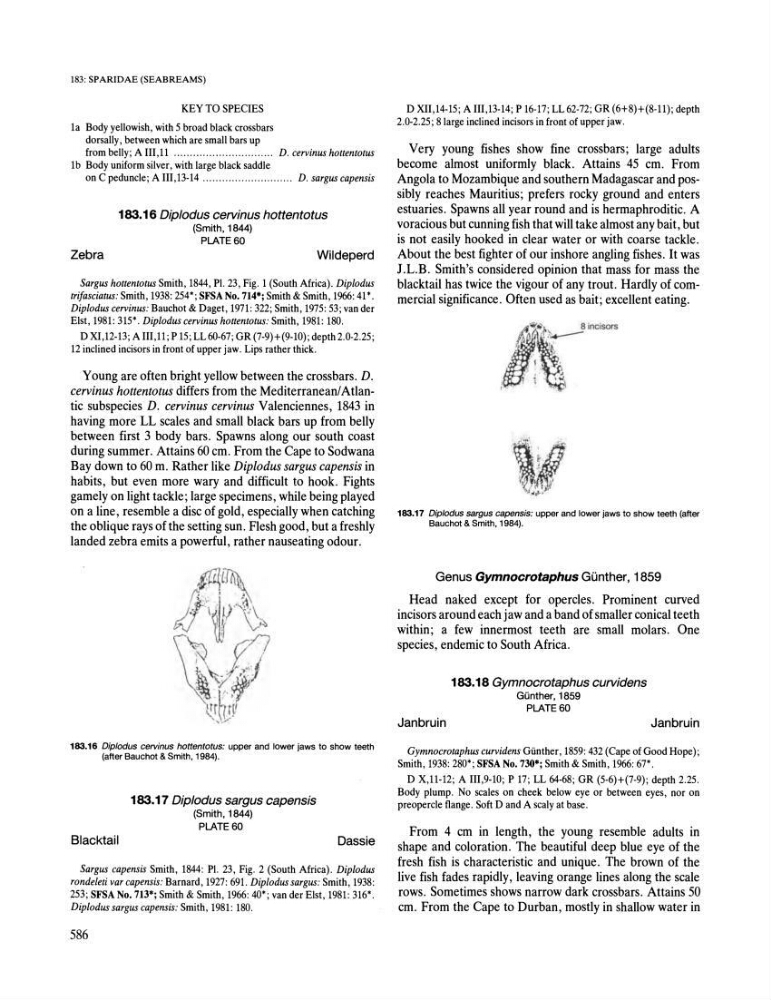
183.16 Dip/odus cervinus hottentotus: upper and lower jaws to show teeth
(after Bauchot & Smith, 1984).
Blacktail
183.17 Dip/odus sargus capensis
(Smith, 1844)
PLATE 60
Dassie
Sargus capensis Smith, 1844: PI. 23, Fig. 2 (South Africa). Diplodus
rondeleti var capensis: Barnard, 1927: 691. Diplodus sargus: Smith, 1938:
253; SFSA No. 713*; Smith & Smith, 1966: 40*; van der Elst, 1981: 316*.
Diplodus sargus capensis: Smith, 1981: 180.
586
D XII,14-15; A m,13-14; P 16-17; LL 62-72; GR (6+8)+(8-11); depth
2.0-2.25; 8 large inclined incisors in front of upper jaw.
Very young fishes show fine crossbars; large adults
become almost uniformly black. Attains 45 cm. From
Angola to Mozambique and southern Madagascar and possibly reaches Mauritius; prefers rocky ground and enters
estuaries. Spawns all year round and is hermaphroditic. A
voracious but cunning fish that will take almost any bait, but
is not easily hooked in clear water or with coarse tackle.
About the best fighter of our inshore angling fishes. It was
J.L.B. Smith's considered opinion that mass for mass the
blacktail has twice the vigour of any trout. Hardly of commercial significance. Often used as bait; excellent eating.
183.17 Diplodus sargus capensis: upper and lower jaws to show teeth (after
Bauchot & Smith, 1984).
Genus Gymnocrotaphus Gunther, 1859
Head naked except for opercles. Prominent curved
incisors around each jaw and a band of smaller conical teeth
within; a few innermost teeth are small molars. One
species, endemic to South Africa.
Janbruin
183.18 Gymnocrotaphus curvidens
Gunther, 1859
PLATE 60
Janbruin
Gymnocrotaphus curvidens Gunther, 1859: 432 (Cape of Good Hope);
Smith, 1938: 280*; SFSA No. 730*; Smith & Smith, 1966: 67*.
D X,11-12; A m,9-1O; P 17; LL 64-68; GR (5-6)+(7-9); depth 2.25.
Body plump. No scales on cheek below eye or between eyes, nor on
preopercle flange. Soft D and A scaly at base.
From 4 cm in length, the young resemble adults in
shape and coloration. The beautiful deep blue eye of the
fresh fish is characteristic and unique. The brown of the
live fish fades rapidly, leaving orange lines along the scale
rows. Sometimes shows narrow dark crossbars. Attains 50
cm. From the Cape to Durban, mostly in shallow water in
KEY TO SPECIES
la Body yellowish, with 5 broad black crossbars
dorsally, between which are small bars up
from belly; A m,l1 ............................... D. cervinus hottentotus
Ib Body uniform silver, with large black saddle
on C peduncle; Am, 13-14 ............................ D. sargus capensis
Zebra
183.16 Dip/odus cervinus hottentotus
(Smith, 1844)
PLATE 60
Wildeperd
Sargus hottentotus Smith, 1844, PI. 23, Fig. 1 (South Africa). Diplodus
trifasciatus: Smith, 1938: 254*; SFSA No. 714*; Smith & Smith, 1966: 41 *.
Diplodus cervinus: Bauchot & Daget, 1971: 322; Smith, 1975: 53; van der
Elst, 1981: 315*. Diplodus cervinus hottentotus: Smith, 1981: 180.
D XI,12-13; A m,l1; PIS; LL60-67; GR (7-9)+(9-10); depth 2.0-2.25;
12 inclined incisors in front of upper jaw. Lips rather thick.
Young are often bright yellow between the crossbars. D.
cervinus hottentotus differs from the Mediterranean! Atlantic subspecies D. cervinus cervinus Valenciennes, 1843 in
having more LL scales and small black bars up from belly
between first 3 body bars. Spawns along our south coast
during summer. Attains 60 cm. From the Cape to Sodwana
Bay down to 60 m. Rather like Diplodus sargus capensis in
habits, but even more wary and difficult to hook. Fights
gamely on light tackle; large specimens, while being played
on a line, resemble a disc of gold, especially when catching
the oblique rays of the setting sun. Flesh good, but a freshly
landed zebra emits a powerful, rather nauseating odour.
183.16 Dip/odus cervinus hottentotus: upper and lower jaws to show teeth
(after Bauchot & Smith, 1984).
Blacktail
183.17 Dip/odus sargus capensis
(Smith, 1844)
PLATE 60
Dassie
Sargus capensis Smith, 1844: PI. 23, Fig. 2 (South Africa). Diplodus
rondeleti var capensis: Barnard, 1927: 691. Diplodus sargus: Smith, 1938:
253; SFSA No. 713*; Smith & Smith, 1966: 40*; van der Elst, 1981: 316*.
Diplodus sargus capensis: Smith, 1981: 180.
586
D XII,14-15; A m,13-14; P 16-17; LL 62-72; GR (6+8)+(8-11); depth
2.0-2.25; 8 large inclined incisors in front of upper jaw.
Very young fishes show fine crossbars; large adults
become almost uniformly black. Attains 45 cm. From
Angola to Mozambique and southern Madagascar and possibly reaches Mauritius; prefers rocky ground and enters
estuaries. Spawns all year round and is hermaphroditic. A
voracious but cunning fish that will take almost any bait, but
is not easily hooked in clear water or with coarse tackle.
About the best fighter of our inshore angling fishes. It was
J.L.B. Smith's considered opinion that mass for mass the
blacktail has twice the vigour of any trout. Hardly of commercial significance. Often used as bait; excellent eating.
183.17 Diplodus sargus capensis: upper and lower jaws to show teeth (after
Bauchot & Smith, 1984).
Genus Gymnocrotaphus Gunther, 1859
Head naked except for opercles. Prominent curved
incisors around each jaw and a band of smaller conical teeth
within; a few innermost teeth are small molars. One
species, endemic to South Africa.
Janbruin
183.18 Gymnocrotaphus curvidens
Gunther, 1859
PLATE 60
Janbruin
Gymnocrotaphus curvidens Gunther, 1859: 432 (Cape of Good Hope);
Smith, 1938: 280*; SFSA No. 730*; Smith & Smith, 1966: 67*.
D X,11-12; A m,9-1O; P 17; LL 64-68; GR (5-6)+(7-9); depth 2.25.
Body plump. No scales on cheek below eye or between eyes, nor on
preopercle flange. Soft D and A scaly at base.
From 4 cm in length, the young resemble adults in
shape and coloration. The beautiful deep blue eye of the
fresh fish is characteristic and unique. The brown of the
live fish fades rapidly, leaving orange lines along the scale
rows. Sometimes shows narrow dark crossbars. Attains 50
cm. From the Cape to Durban, mostly in shallow water in