

points distinct. Outer teeth movable, with brown edges;
several rows of small molars within. One species.
Karanteen
183.14 Crenidens crenidens
(Forsskal, 1775)
PLATE 59
Karanteen
Sparus crenidens ForssUI, 1775: xv, 15 (Djedda, Red Sea and Suez).
Crenidens crenidens: Smith, 1938: 361* ; SFSA No. 732*; van der Elst,
1981: 313*.
D XI,l1 ; A m,lO; P 13-14; LLSO-60; GR (6-8)+(9-11); depth 2.5. No
scales between eyes, on preopercle flange , or on soft D or A, butthese fins
with marked basal sheath . Cheeks scaly.
Attains 30 cm. A small shoaling species known from Red
Sea and Persian Gulf to Durban , rarely as far as East London; spawns in tropical waters. Caught on shrimp or prawn
with a small hook. Excellent bait. May always be recognised
by the generally dull colouring and the brown crenulate tips
of outer teeth. Quite good eating.
183.14 Crenidens crenidens: upper and lower teeth (after Bauehot & Smith,
1984).
Genus Cymatoceps Smith, 1938
Head between eyes scaly, also bases of soft D and A.
Preopercle flange partly scaly. One large species, found
only in South Africa.
183.15 Cymatoceps nasutus
(Castelnau, 1861)
PLATE 59
Black musselcracker
Poenskop
Chrysophrys nasutus Castelnau, 1861: 24 (Table Bay) . Pagrus nigripinnis Boulenger, 1903: 67, PI. 7 (Natal). Cymatoceps nasutus: Smith, 1938:
260*; SFSA No. 719*; Smith & Smith, 1966: 51*; van der Elst, 1981: 314".
D XII,lO; A I1I,8; P 16-17; LL61-65; GR (6-8)+(10-11); depth 2.3-2.5.
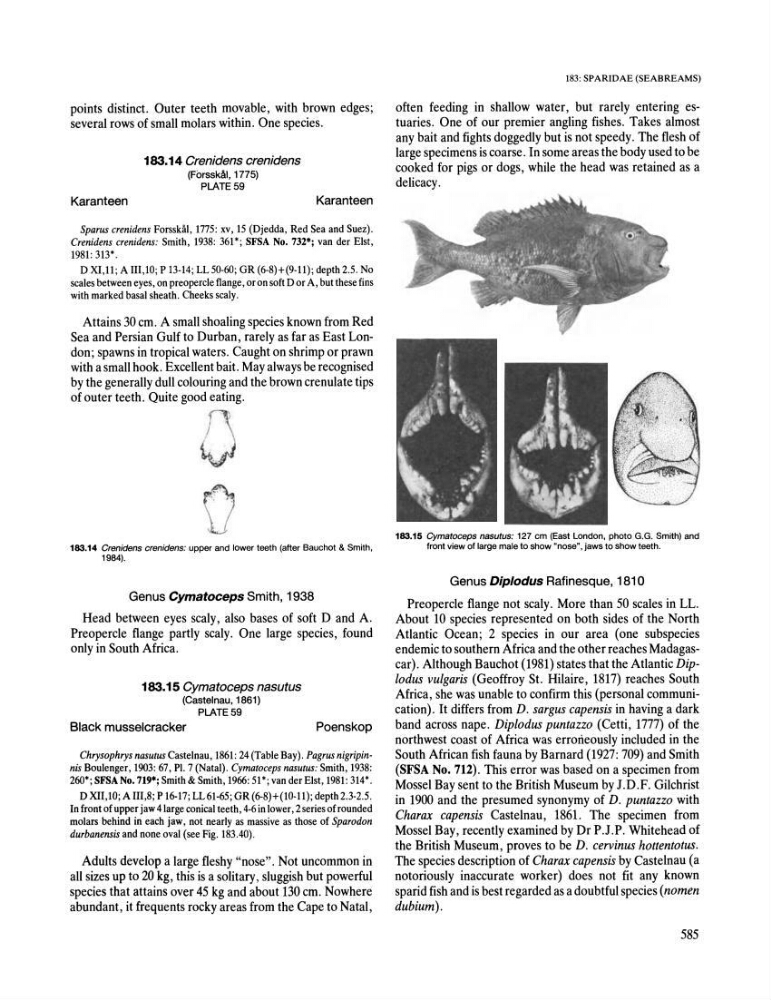
In front of upper jaw41arge conical teeth, 4-6 in lower, 2 series of rounded
molars behind in each jaw, not nearly as massive as those of Sparodon
durbanensis and none oval (see Fig. 183.40).
Adults develop a large fleshy "nose". Not uncommon in
all sizes up to 20 kg, this is a solitary, sluggish but powerful
species that attains over 45 kg and about 130 cm. Nowhere
abundant, it frequents rocky areas from the Cape to Natal,
183: SPARIDAE (SEABREAMS)
often feeding in shallow water, but rarely entering estuaries. One of our premier angling fishes. Takes almost
any bait and fights doggedly but is not speedy. The flesh of
large specimens is coarse. In some areas the body used to be
cooked for pigs or dogs, while the head was retained as a
delicacy.
183.15 Cymatoceps nasutus: 127 em (East london, photo G.G. Smith) and
front view of large male to show "nose", jaws to show teeth.
Genus Dip/odus Rafinesque, 1810
Preopercle flange not scaly. More than 50 scales in LL.
About 10 species represented on both sides of the North
Atlantic Ocean; 2 species in our area (one subspecies
endemic to southern Africa and the other reaches Madagascar). Although Bauchot (1981) states that the Atlantic Diplodus vulgaris (Geoffroy St. Hilaire, 1817) reaches South
Africa, she was unable to confirm this (personal communication). It differs from D. sargus capensis in having a dark
band across nape. Diplodus puntazzo (Cetti, 1777) of the
northwest coast of Africa was erroneously included in the
South African fish fauna by Barnard (1927: 709) and Smith
(SFSA No. 712). This error was based on a specimen from
Mossel Bay sent to the British Museum by J.D.F. Gilchrist
in 1900 and the presumed synonymy of D. puntazzo with
Charax capensis Castelnau, 1861. The specimen from
Mossel Bay, recently examined by Dr P.J.P. Whitehead of
the British Museum, proves to be D. cervinus hottentotus.
The species description of Charax capensis by Castelnau (a
notoriously inaccurate worker) does not fit any known
spa rid fish and is best regarded as a doubtful species (nomen
dubium).
585
several rows of small molars within. One species.
Karanteen
183.14 Crenidens crenidens
(Forsskal, 1775)
PLATE 59
Karanteen
Sparus crenidens ForssUI, 1775: xv, 15 (Djedda, Red Sea and Suez).
Crenidens crenidens: Smith, 1938: 361* ; SFSA No. 732*; van der Elst,
1981: 313*.
D XI,l1 ; A m,lO; P 13-14; LLSO-60; GR (6-8)+(9-11); depth 2.5. No
scales between eyes, on preopercle flange , or on soft D or A, butthese fins
with marked basal sheath . Cheeks scaly.
Attains 30 cm. A small shoaling species known from Red
Sea and Persian Gulf to Durban , rarely as far as East London; spawns in tropical waters. Caught on shrimp or prawn
with a small hook. Excellent bait. May always be recognised
by the generally dull colouring and the brown crenulate tips
of outer teeth. Quite good eating.
183.14 Crenidens crenidens: upper and lower teeth (after Bauehot & Smith,
1984).
Genus Cymatoceps Smith, 1938
Head between eyes scaly, also bases of soft D and A.
Preopercle flange partly scaly. One large species, found
only in South Africa.
183.15 Cymatoceps nasutus
(Castelnau, 1861)
PLATE 59
Black musselcracker
Poenskop
Chrysophrys nasutus Castelnau, 1861: 24 (Table Bay) . Pagrus nigripinnis Boulenger, 1903: 67, PI. 7 (Natal). Cymatoceps nasutus: Smith, 1938:
260*; SFSA No. 719*; Smith & Smith, 1966: 51*; van der Elst, 1981: 314".
D XII,lO; A I1I,8; P 16-17; LL61-65; GR (6-8)+(10-11); depth 2.3-2.5.
In front of upper jaw41arge conical teeth, 4-6 in lower, 2 series of rounded
molars behind in each jaw, not nearly as massive as those of Sparodon
durbanensis and none oval (see Fig. 183.40).
Adults develop a large fleshy "nose". Not uncommon in
all sizes up to 20 kg, this is a solitary, sluggish but powerful
species that attains over 45 kg and about 130 cm. Nowhere
abundant, it frequents rocky areas from the Cape to Natal,
183: SPARIDAE (SEABREAMS)
often feeding in shallow water, but rarely entering estuaries. One of our premier angling fishes. Takes almost
any bait and fights doggedly but is not speedy. The flesh of
large specimens is coarse. In some areas the body used to be
cooked for pigs or dogs, while the head was retained as a
delicacy.
183.15 Cymatoceps nasutus: 127 em (East london, photo G.G. Smith) and
front view of large male to show "nose", jaws to show teeth.
Genus Dip/odus Rafinesque, 1810
Preopercle flange not scaly. More than 50 scales in LL.
About 10 species represented on both sides of the North
Atlantic Ocean; 2 species in our area (one subspecies
endemic to southern Africa and the other reaches Madagascar). Although Bauchot (1981) states that the Atlantic Diplodus vulgaris (Geoffroy St. Hilaire, 1817) reaches South
Africa, she was unable to confirm this (personal communication). It differs from D. sargus capensis in having a dark
band across nape. Diplodus puntazzo (Cetti, 1777) of the
northwest coast of Africa was erroneously included in the
South African fish fauna by Barnard (1927: 709) and Smith
(SFSA No. 712). This error was based on a specimen from
Mossel Bay sent to the British Museum by J.D.F. Gilchrist
in 1900 and the presumed synonymy of D. puntazzo with
Charax capensis Castelnau, 1861. The specimen from
Mossel Bay, recently examined by Dr P.J.P. Whitehead of
the British Museum, proves to be D. cervinus hottentotus.
The species description of Charax capensis by Castelnau (a
notoriously inaccurate worker) does not fit any known
spa rid fish and is best regarded as a doubtful species (nomen
dubium).
585