

183: SPARIDAE (SEABREAMS)
Marked change in colour and markings from juvenile to
adult (see Plate). Adults at death one of the most beautiful
of all creatures as waves of different colours pass over the
body, hence the early Dutch name of "dageraad", dawn.
Attains 75 cm. Found only from the Cape to Natal. Taken in
fair numbers by line boats on almost any bait; most abundant on the Cape south coast, where it shoals in deepish
water (down to 100 m) over rocky banks. Not often caught
from the shore. Flesh good.
183.10 Chrysoblephus gibbiceps
(Valenciennes, 1830)
PLATE 59
Red stumpnose
Rooistompneus
Chrysophrys gibbiceps Valenciennes, in Cuv. & Val. ,21830: 127, PI.
147 (Cape of Good Hope). Chrysoblephus gibbiceps: Smith, 1938: 267;
SFSA No. 725*; Smith & Smith, 1966: 60*; van der Elst, 1981: 309*.
D XI-XII,lO-11; A III,7-9; P 17; LL 52-55; GR (6-7)+(10-12); depth
2.0-2.4.
Sometimes darker crossbars. Attains 75 cm. Adult males
develop a big hump on forehead. A rather untidy-looking
fish. Found only from the Cape to Natal, rarely in Natal
waters, mostly in deepish water. Spawning period spring to
summer. Of considerable commercial significance about
the Cape. Flesh good. Said to occur in Australian waters,
but this needs confirmation.
Roman
183.11 Chrysoblephus laticeps
(Valenciennes, 1830)
PLATE 59
Roman
Chrysophrys laticeps Valenciennes, in Cuv. & VaL, 1830: 122 (Cape of
Good Hope). Chrysoblephus algoensis Castelnau, 1861: 22 (Algoa Bay).
Chrysophrys pugicephalus Gilchrist & Thompson, 1909: 234 (off
Durban). Chrysoblephus laticeps: Smith, 1938: 263, SFSA No. 721*;
Smith & Smith, 1966: 57*; Penrith, 1972: 135*; van der Elst, 1981: 310*.
D XI-XII, 10-11 ; A 111,7-9; P 17-18; LL 58-64; GR (6-7)+(10-12); depth
2.3-2.5.
Usually reddish orange, but a blue colour variety is
known and shows the white patch on the side. Attains at
least 50 cm. These fishes are first gregarious females, then
with growth they change sex and become solitary, territorial
males, each living in its own particular cave (van der Elst,
1981). Spawns during summer. Occurs from the Cape to
Mauritius. Favours rocky ground in deepish water (to 100
m) but often taken from shore. Voracious but sluggish;
takes any bait. Flesh good. Fresh from the water or even in
an aquarium it is a gorgeous creature.
584
183.12 Chrysoblephus lophus
(Fowler, 1925)
PLATE 59
False Englishman
Vals Engelsman
Sparus lophus Fowler, 1925: 234, Fig. 3 (Natal). Chrysoblephus lophus:
Smith, 1938: 268; SFSA No. 723*; van der Elst, 1981: 311*.
D XI,lO; A 111,9; P 16-17; LL 55-58; GR (7-9)+(10-13); depth 2.0-2.25;
3rd D spine about as long as or longer than head, probably reduces with
age.
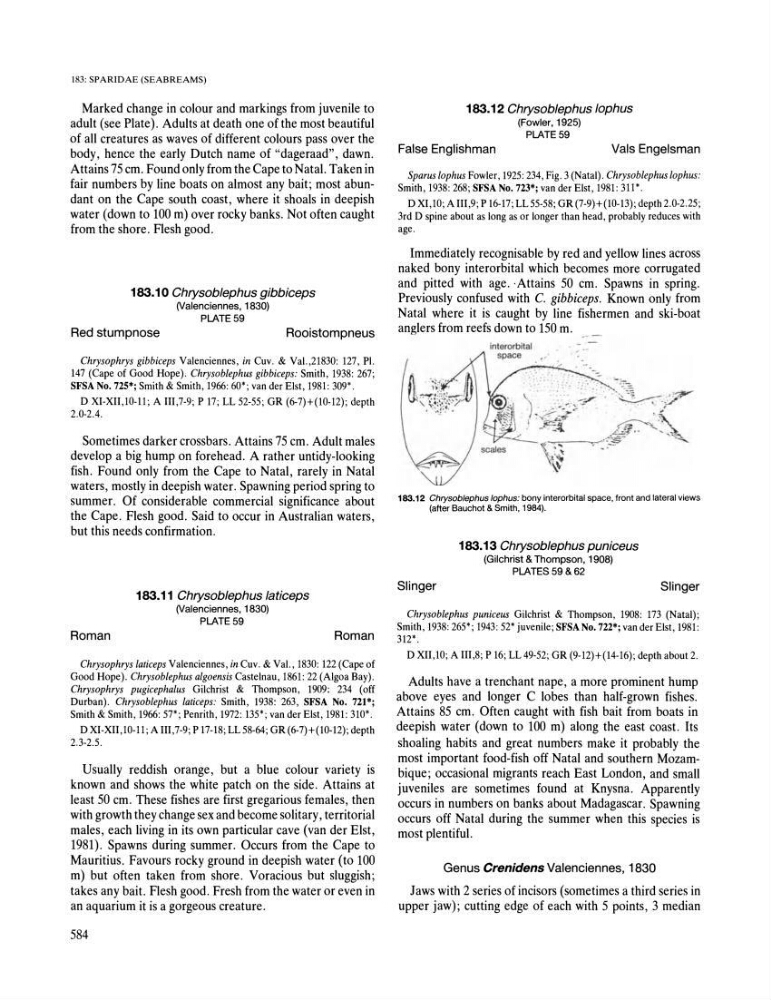
Immediately recognisable by red and yellow lines across
naked bony interorbital which becomes more corrugated
and pitted with age .. Attains 50 cm. Spawns in spring.
Previously confused with C. gibbiceps. Known only from
Natal where it is caught by line fishermen and ski-boat
anglers from reefs down to 150 m.
interorbital
183.12 Chrysobtephus tophus: bony interorbital space. front and lateral views
(after Bauchot & Smith, 1984).
Slinger
183.13 Chrysoblephus puniceus
(Gilchrist & Thompson, 1908)
PLATES 59 & 62
Slinger
Chrysoblephus puniceus Gilchrist & Thompson, 1908: 173 (Natal);
Smith, 1938: 265*; 1943: 52* juvenile; SFSA No. 722*; van der Elst, 1981:
312* .
D XII,lO; A 111,8; P 16; LL 49-52; GR (9-12)+(14-16); depth about 2.
Adults have a trenchant nape, a more prominent hump
above eyes and longer C lobes than half-grown fishes.
Attains 85 cm. Often caught with fish bait from boats in
deepish water (down to 100 m) along the east coast. Its
shoaling habits and great numbers make it probably the
most important food-fish off Natal and southern Mozambique; occasional migrants reach East London, and small
juveniles are sometimes found at Knysna. Apparently
occurs in numbers on banks about Madagascar. Spawning
occurs off Natal during the summer when this species is
most plentiful.
Genus Crenidens Valenciennes, 1830
Jaws with 2 series of incisors (sometimes a third series in
upper jaw); cutting edge of each with 5 points, 3 median
Marked change in colour and markings from juvenile to
adult (see Plate). Adults at death one of the most beautiful
of all creatures as waves of different colours pass over the
body, hence the early Dutch name of "dageraad", dawn.
Attains 75 cm. Found only from the Cape to Natal. Taken in
fair numbers by line boats on almost any bait; most abundant on the Cape south coast, where it shoals in deepish
water (down to 100 m) over rocky banks. Not often caught
from the shore. Flesh good.
183.10 Chrysoblephus gibbiceps
(Valenciennes, 1830)
PLATE 59
Red stumpnose
Rooistompneus
Chrysophrys gibbiceps Valenciennes, in Cuv. & Val. ,21830: 127, PI.
147 (Cape of Good Hope). Chrysoblephus gibbiceps: Smith, 1938: 267;
SFSA No. 725*; Smith & Smith, 1966: 60*; van der Elst, 1981: 309*.
D XI-XII,lO-11; A III,7-9; P 17; LL 52-55; GR (6-7)+(10-12); depth
2.0-2.4.
Sometimes darker crossbars. Attains 75 cm. Adult males
develop a big hump on forehead. A rather untidy-looking
fish. Found only from the Cape to Natal, rarely in Natal
waters, mostly in deepish water. Spawning period spring to
summer. Of considerable commercial significance about
the Cape. Flesh good. Said to occur in Australian waters,
but this needs confirmation.
Roman
183.11 Chrysoblephus laticeps
(Valenciennes, 1830)
PLATE 59
Roman
Chrysophrys laticeps Valenciennes, in Cuv. & VaL, 1830: 122 (Cape of
Good Hope). Chrysoblephus algoensis Castelnau, 1861: 22 (Algoa Bay).
Chrysophrys pugicephalus Gilchrist & Thompson, 1909: 234 (off
Durban). Chrysoblephus laticeps: Smith, 1938: 263, SFSA No. 721*;
Smith & Smith, 1966: 57*; Penrith, 1972: 135*; van der Elst, 1981: 310*.
D XI-XII, 10-11 ; A 111,7-9; P 17-18; LL 58-64; GR (6-7)+(10-12); depth
2.3-2.5.
Usually reddish orange, but a blue colour variety is
known and shows the white patch on the side. Attains at
least 50 cm. These fishes are first gregarious females, then
with growth they change sex and become solitary, territorial
males, each living in its own particular cave (van der Elst,
1981). Spawns during summer. Occurs from the Cape to
Mauritius. Favours rocky ground in deepish water (to 100
m) but often taken from shore. Voracious but sluggish;
takes any bait. Flesh good. Fresh from the water or even in
an aquarium it is a gorgeous creature.
584
183.12 Chrysoblephus lophus
(Fowler, 1925)
PLATE 59
False Englishman
Vals Engelsman
Sparus lophus Fowler, 1925: 234, Fig. 3 (Natal). Chrysoblephus lophus:
Smith, 1938: 268; SFSA No. 723*; van der Elst, 1981: 311*.
D XI,lO; A 111,9; P 16-17; LL 55-58; GR (7-9)+(10-13); depth 2.0-2.25;
3rd D spine about as long as or longer than head, probably reduces with
age.
Immediately recognisable by red and yellow lines across
naked bony interorbital which becomes more corrugated
and pitted with age .. Attains 50 cm. Spawns in spring.
Previously confused with C. gibbiceps. Known only from
Natal where it is caught by line fishermen and ski-boat
anglers from reefs down to 150 m.
interorbital
183.12 Chrysobtephus tophus: bony interorbital space. front and lateral views
(after Bauchot & Smith, 1984).
Slinger
183.13 Chrysoblephus puniceus
(Gilchrist & Thompson, 1908)
PLATES 59 & 62
Slinger
Chrysoblephus puniceus Gilchrist & Thompson, 1908: 173 (Natal);
Smith, 1938: 265*; 1943: 52* juvenile; SFSA No. 722*; van der Elst, 1981:
312* .
D XII,lO; A 111,8; P 16; LL 49-52; GR (9-12)+(14-16); depth about 2.
Adults have a trenchant nape, a more prominent hump
above eyes and longer C lobes than half-grown fishes.
Attains 85 cm. Often caught with fish bait from boats in
deepish water (down to 100 m) along the east coast. Its
shoaling habits and great numbers make it probably the
most important food-fish off Natal and southern Mozambique; occasional migrants reach East London, and small
juveniles are sometimes found at Knysna. Apparently
occurs in numbers on banks about Madagascar. Spawning
occurs off Natal during the summer when this species is
most plentiful.
Genus Crenidens Valenciennes, 1830
Jaws with 2 series of incisors (sometimes a third series in
upper jaw); cutting edge of each with 5 points, 3 median