

1810) have been reported (Poll, 1971) from southern
Angola, and occasional strays may reach our area. They can
be distinguished as follows:
la GR (6-8)+(8-10) = 15-18; small black spot at rear
end of Dbase ... .. ......... .... ....... .......... ... .......... ... ... C. gibbosus
Ib GR (8-11)+(14-16) = 23-27; dark red blotch at
base oflast 3-5 Drays .... .... ....... ..... .... ... .... ....... ..... C. barnardi
Santer
183.7 Cheimerius nufar
(Ehrenberg, 1830)
PLATE 58
Santer
Dentex nufar Ehrenberg, in Cuv. & Val. , 1830: 240 (Egypt, Red Sea) .
Dentex miles Gilchrist & Thompson, 1908: 155 (Natal). Dentex albus
Gilchrist & Thompson, 1914: 128* (Natal) . Cheimerius nufar: Smith,
1938: 292*; SFSA No. 740*; Smith & Smith, 1966: 58* ; van der Elst , 1981:
306*.
D XI-XII ,1O-11 ; A III ,8; P 16; LL 59-63 ; GR (8-11)+(13-16) = 22-25 ;
depth 2.2-2.5 . A few small scales on margin of preoperc1e, interorbital
partly scaly; no scales on soft D or A. Outer V ray usually elongate.
When alive, bright silvery with faint red crossbars; after
death, usually fades to almost white, but some specimens
darken to almost purple. Attains 75 cm; spawns in summer. Widespread in tropical Indo-Pacific down to at least
80 m. Extends to the Cape. Poll (1971) reported C. nufar
from the west coast of Africa between lOON and lOoS ; but
his specimens have fewer GR (6-9)+(11-13) = 18-21, and
they were redetermined as C. canariensis by Bauchot
et al. (1981) . A variable species with numerous synonyms.
The shape of the body and fins varies with age, the 3rd D
spine being shorter in large specimens. Taken by line and
trawl in deepish water; not very abundant in our area. Large
specimens are rarely caught from shore, and then only with
stormy weather at sea. The young shelter in estuaries when
stormy weather approaches ; Cheimerius means "sign of
storm". A common food-fish in Mozambique; flesh excellent.
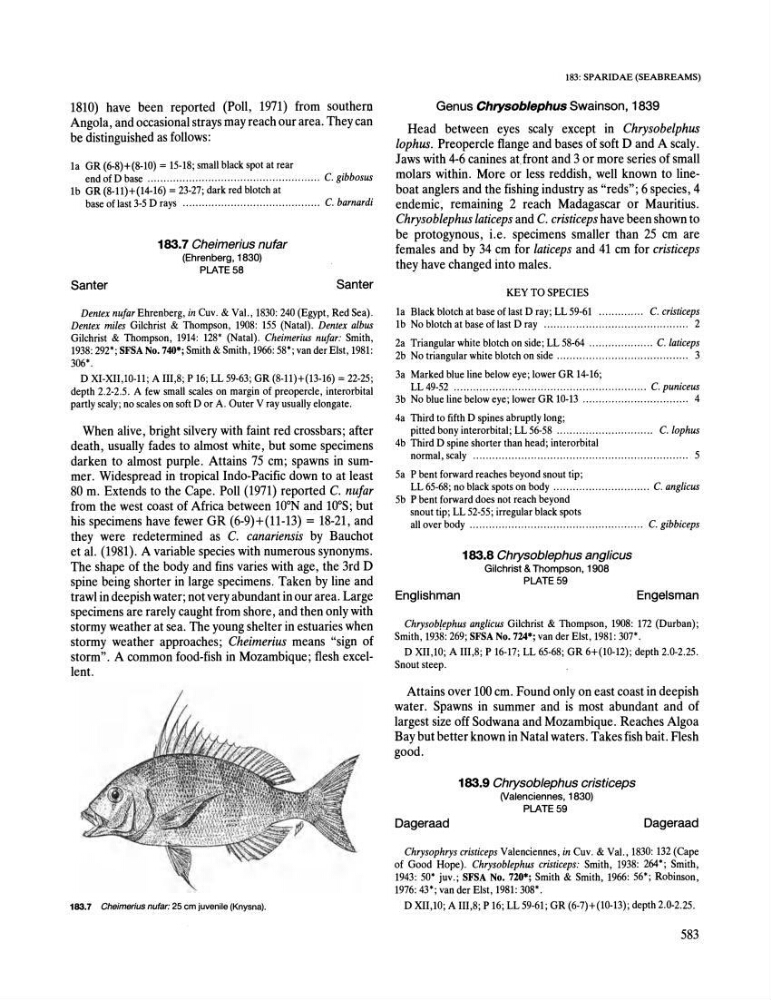
183.7 Cheimerius nutar: 25 em juvenile (Knysna).
183: SPARIDAE (SEABREAMS)
Genus Chrysob/ephus Swainson, 1839
Head between eyes scaly except in Chrysobelphus
lophus. Preopercle flange and bases of soft D and A scaly.
Jaws with 4-6 canines at.front and 3 or more series of small
molars within. More or less reddish, well known to lineboat anglers and the fishing industry as "reds"; 6 species, 4
endemic, remaining 2 reach Madagascar or Mauritius.
Chrysoblephus laticeps and C. cristiceps have been shown to
be protogynous, i.e. specimens smaller than 25 cm are
females and by 34 cm for laticeps and 41 cm for cristiceps
they have changed into males.
KEY TO SPECIES
l a Black blotch at base of last Dray; LL 59-61 .... ....... ... C. cristieeps
Ib No blotch at base of last Dray ............. ................. ........... .. .. 2
2a Triangular white blotch on side ; LL 58-64 ..... ..... .... ... ... C. latieeps
2b No triangular white blotch on side .............. .. ......................... 3
3a Marked blue line below eye ; lower GR 14-16;
LL 49-52 ....... ............... .. ... ........... ............ .... .... .. C. punieeus
3b No blue line below eye ; lower GR 10-13 ............................ .. ... 4
4a Third to fifth D spines abruptly long;
pitted bony interorbital ; LL 56-58 .......... ...... .... .. ... ..... C. lophus
4b Third D spine shorter than head; interorbital
normal , scaly ... .. ... .... ... .... ... ... ... .... ..... ..... .. ....................... 5
5a P bent forward reaches beyond snout tip;
LL 65-68 ; no black spots on body .. .. .. .. .......... ........ .. .. C. anglieus
5b P bent forward does not reach beyond
snout tip; LL 52-55 ; irregular black spots
all over body .. ........ ......... ... .. ... ........ .... ... .. ... ....... C. gibbieeps
Englishman
183.8 Chrysoblephus ang/icus
Gilchrist & Thompson. 1908
PLATE 59
Engelsman
Chrysob[ephus anglieus Gilchrist & Thompson, 1908: 172 (Durban);
Smith, 1938: 269; SFSA No. 724*; van der Elst, 1981 : 307*.
D XII ,1O; A III ,8; P 16-17; LL 65-68; GR 6+(10-12) ; depth 2.0-2.25.
Snout steep.
Attains over 100 cm. Found only on east coast in deepish
water. Spawns in summer and is most abundant and of
largest size off Sodwana and Mozambique. Reaches Algoa
Bay but better known in Natal waters. Takes fish bait. Flesh
good.
Oageraad
183.9 Chrysoblephus cristiceps
(Valenciennes. 1830)
PLATE 59
Oageraad
Chrysophrys cristieeps Valenciennes, in Cuv. & Val. , 1830: 132 (Cape
of Good Hope). Chrysoblephus cristieeps: Smith , 1938: 264* ; Smith,
1943: 50* juv.; SFSA No. 720*; Smith & Smith, 1966: 56* ; Robinson ,
1976: 43*; van der Elst, 1981: 308*.
D XII,10; A III,8; P 16; LL 59-61; GR (6-7)+(10-13); depth 2.0-2.25.
583
Angola, and occasional strays may reach our area. They can
be distinguished as follows:
la GR (6-8)+(8-10) = 15-18; small black spot at rear
end of Dbase ... .. ......... .... ....... .......... ... .......... ... ... C. gibbosus
Ib GR (8-11)+(14-16) = 23-27; dark red blotch at
base oflast 3-5 Drays .... .... ....... ..... .... ... .... ....... ..... C. barnardi
Santer
183.7 Cheimerius nufar
(Ehrenberg, 1830)
PLATE 58
Santer
Dentex nufar Ehrenberg, in Cuv. & Val. , 1830: 240 (Egypt, Red Sea) .
Dentex miles Gilchrist & Thompson, 1908: 155 (Natal). Dentex albus
Gilchrist & Thompson, 1914: 128* (Natal) . Cheimerius nufar: Smith,
1938: 292*; SFSA No. 740*; Smith & Smith, 1966: 58* ; van der Elst , 1981:
306*.
D XI-XII ,1O-11 ; A III ,8; P 16; LL 59-63 ; GR (8-11)+(13-16) = 22-25 ;
depth 2.2-2.5 . A few small scales on margin of preoperc1e, interorbital
partly scaly; no scales on soft D or A. Outer V ray usually elongate.
When alive, bright silvery with faint red crossbars; after
death, usually fades to almost white, but some specimens
darken to almost purple. Attains 75 cm; spawns in summer. Widespread in tropical Indo-Pacific down to at least
80 m. Extends to the Cape. Poll (1971) reported C. nufar
from the west coast of Africa between lOON and lOoS ; but
his specimens have fewer GR (6-9)+(11-13) = 18-21, and
they were redetermined as C. canariensis by Bauchot
et al. (1981) . A variable species with numerous synonyms.
The shape of the body and fins varies with age, the 3rd D
spine being shorter in large specimens. Taken by line and
trawl in deepish water; not very abundant in our area. Large
specimens are rarely caught from shore, and then only with
stormy weather at sea. The young shelter in estuaries when
stormy weather approaches ; Cheimerius means "sign of
storm". A common food-fish in Mozambique; flesh excellent.
183.7 Cheimerius nutar: 25 em juvenile (Knysna).
183: SPARIDAE (SEABREAMS)
Genus Chrysob/ephus Swainson, 1839
Head between eyes scaly except in Chrysobelphus
lophus. Preopercle flange and bases of soft D and A scaly.
Jaws with 4-6 canines at.front and 3 or more series of small
molars within. More or less reddish, well known to lineboat anglers and the fishing industry as "reds"; 6 species, 4
endemic, remaining 2 reach Madagascar or Mauritius.
Chrysoblephus laticeps and C. cristiceps have been shown to
be protogynous, i.e. specimens smaller than 25 cm are
females and by 34 cm for laticeps and 41 cm for cristiceps
they have changed into males.
KEY TO SPECIES
l a Black blotch at base of last Dray; LL 59-61 .... ....... ... C. cristieeps
Ib No blotch at base of last Dray ............. ................. ........... .. .. 2
2a Triangular white blotch on side ; LL 58-64 ..... ..... .... ... ... C. latieeps
2b No triangular white blotch on side .............. .. ......................... 3
3a Marked blue line below eye ; lower GR 14-16;
LL 49-52 ....... ............... .. ... ........... ............ .... .... .. C. punieeus
3b No blue line below eye ; lower GR 10-13 ............................ .. ... 4
4a Third to fifth D spines abruptly long;
pitted bony interorbital ; LL 56-58 .......... ...... .... .. ... ..... C. lophus
4b Third D spine shorter than head; interorbital
normal , scaly ... .. ... .... ... .... ... ... ... .... ..... ..... .. ....................... 5
5a P bent forward reaches beyond snout tip;
LL 65-68 ; no black spots on body .. .. .. .. .......... ........ .. .. C. anglieus
5b P bent forward does not reach beyond
snout tip; LL 52-55 ; irregular black spots
all over body .. ........ ......... ... .. ... ........ .... ... .. ... ....... C. gibbieeps
Englishman
183.8 Chrysoblephus ang/icus
Gilchrist & Thompson. 1908
PLATE 59
Engelsman
Chrysob[ephus anglieus Gilchrist & Thompson, 1908: 172 (Durban);
Smith, 1938: 269; SFSA No. 724*; van der Elst, 1981 : 307*.
D XII ,1O; A III ,8; P 16-17; LL 65-68; GR 6+(10-12) ; depth 2.0-2.25.
Snout steep.
Attains over 100 cm. Found only on east coast in deepish
water. Spawns in summer and is most abundant and of
largest size off Sodwana and Mozambique. Reaches Algoa
Bay but better known in Natal waters. Takes fish bait. Flesh
good.
Oageraad
183.9 Chrysoblephus cristiceps
(Valenciennes. 1830)
PLATE 59
Oageraad
Chrysophrys cristieeps Valenciennes, in Cuv. & Val. , 1830: 132 (Cape
of Good Hope). Chrysoblephus cristieeps: Smith , 1938: 264* ; Smith,
1943: 50* juv.; SFSA No. 720*; Smith & Smith, 1966: 56* ; Robinson ,
1976: 43*; van der Elst, 1981: 308*.
D XII,10; A III,8; P 16; LL 59-61; GR (6-7)+(10-13); depth 2.0-2.25.
583