

183: SPARIDAE (SEA BREAMS)
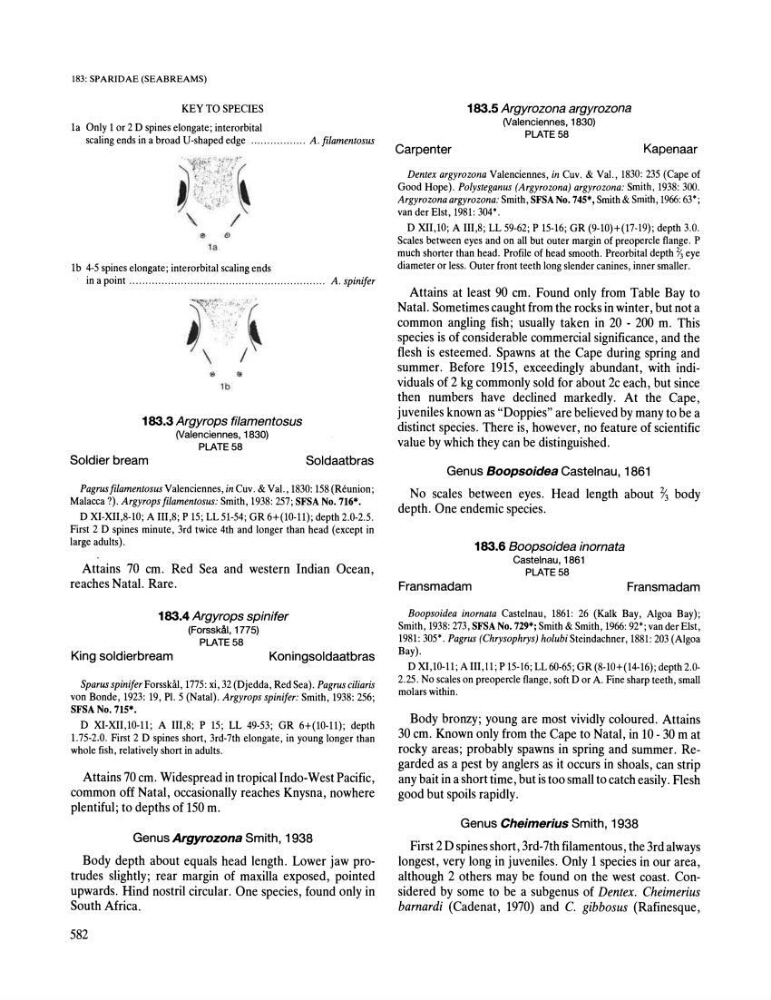
KEY TO SPECIES
la Only 1 or 2 D spines elongate; interorbital
scaling ends in a broad V-shaped edge ................. A. filamentosus
Ib 4-5 spines elongate; interorbital scaling ends
in a point .............. ...... .. ... ........... .......... .... .. ......... A. spinifer
iii
@
l b
183.3 Argyrops fi/amentosus
(Valenciennes, 1830)
PLATE 58
Soldier bream
Soldaatbras
Pagrusfilamentosus Valenciennes, in Cuv. & Val., 1830: 158 (Reunion;
Malacca ?) . Argyrops filamentosus: Smith, 1938: 257; SFSA No. 716*.
D XI-XII,8-10; A III,8; P 15; LL 51-54; GR 6+(10-11); depth 2.0-2.5.
First 2 D spines minute, 3rd twice 4th and longer than head (except in
large adults).
Attains 70 cm. Red Sea and western Indian Ocean,
reaches Natal. Rare.
183.4 Argyrops spinifer
(Forsskal, 1775)
PLATE 58
King soldierbream
Koningsoldaatbras
Sparus spiniJer Forsskal, 1775: xi, 32 (Djedda, Red Sea). Pagrus ciliaris
von Bonde, 1923: 19, PI. 5 (Natal). Argyrops spinifer: Smith, 1938: 256;
SFSA No. 715*.
D XI-XII,1O-11; A III,8; P 15; LL 49-53; GR 6+(10-11); depth
1.75-2.0. First 2 D spines short, 3rd-7th elongate, in young longer than
whole fish, relatively short in adults.
Attains 70 cm. Widespread in tropical Indo-West Pacific,
common off Natal, occasionally reaches Knysna, nowhere
plentiful; to depths of 150 m.
Genus Argyrozona Smith, 1938
Body depth about equals head length. Lower jaw protrudes slightly; rear margin of maxilla exposed, pointed
upwards. Hind nostril circular. One species, found only in
South Africa.
582
183.5 Argyrozona argyrozona
(Valenciennes, 1830)
PLATE 58
Carpenter
Kapenaar
Dentex argyrozona Valenciennes, in Cuv. & Val., 1830: 235 (Cape of
Good Hope) . Polysteganus (Argyrozona) argyrozona: Smith, 1938: 300.
Argyrozona argyrozona: Smith, SFSA No. 745*, Smith & Smith, 1966: 63*;
van der Elst, 1981: 304*.
D XII,1O; A III,8; LL 59-62; P 15-16; GR (9-10)+(17-19); depth 3.0.
Scales between eyes and on all but outer margin of preoperc1e flange. P
much shorter than head. Profile of head smooth. Preorbital depth ~ eye
diameter or less. Outer front teeth long slender canines, inner smaller.
Attains at least 90 cm. Found only from Table Bay to
Natal. Sometimes caught from the rocks in winter, but not a
common angling fish; usually taken in 20 - 200 m. This
species is of considerable commercial significance, and the
flesh is esteemed. Spawns at the Cape during spring and
summer. Before 1915, exceedingly abundant, with individuals of 2 kg commonly sold for about 2c each, but since
then numbers have declined markedly. At the Cape,
juveniles known as "Doppies" are believed by many to be a
distinct species. There is, however, no feature of scientific
value by which they can be distinguished.
Genus Boopsoidea Castelnau, 1861
No scales between eyes. Head length about 73 body
depth. One endemic species.
Fransmadam
183.6 Boopsoidea inornata
Castelnau, 1861
PLATE 58
Fransmadam
Boopsoidea in ornata Castelnau, 1861: 26 (Kalk Bay, Algoa Bay);
Smith, 1938: 273, SFSA No. 729*; Smith & Smith, 1966: 92*; van der Elst,
1981: 305*. Pagrus (Chrysophrys) holubi Steindachner, 1881: 203 (Algoa
Bay).
D XI,10-11; A III ,11 ; P 15-16; LL 60-65; GR (8-10+(14-16); depth 2.02.25. No scales on preoperc1e flange, soft D or A. Fine sharp teeth, small
molars within.
Body bronzy; young are most vividly coloured. Attains
30 cm. Known only from the Cape to Natal, in 10 - 30 m at
rocky areas; probably spawns in spring and summer. Regarded as a pest by anglers as it occurs in shoals, can strip
any bait in a short time, but is too small to catch easily. Flesh
good but spoils rapidly.
Genus Cheimerius Smith, 1938
First 2 0 spines short, 3rd-7th filamentous, the 3rd always
longest, very long in juveniles. Only 1 species in our area,
although 2 others may be found on the west coast. Considered by some to be a subgenus of Dentex. Cheimerius
barnardi (Cadenat, 1970) and C. gibbosus (Rafinesque,
KEY TO SPECIES
la Only 1 or 2 D spines elongate; interorbital
scaling ends in a broad V-shaped edge ................. A. filamentosus
Ib 4-5 spines elongate; interorbital scaling ends
in a point .............. ...... .. ... ........... .......... .... .. ......... A. spinifer
iii
@
l b
183.3 Argyrops fi/amentosus
(Valenciennes, 1830)
PLATE 58
Soldier bream
Soldaatbras
Pagrusfilamentosus Valenciennes, in Cuv. & Val., 1830: 158 (Reunion;
Malacca ?) . Argyrops filamentosus: Smith, 1938: 257; SFSA No. 716*.
D XI-XII,8-10; A III,8; P 15; LL 51-54; GR 6+(10-11); depth 2.0-2.5.
First 2 D spines minute, 3rd twice 4th and longer than head (except in
large adults).
Attains 70 cm. Red Sea and western Indian Ocean,
reaches Natal. Rare.
183.4 Argyrops spinifer
(Forsskal, 1775)
PLATE 58
King soldierbream
Koningsoldaatbras
Sparus spiniJer Forsskal, 1775: xi, 32 (Djedda, Red Sea). Pagrus ciliaris
von Bonde, 1923: 19, PI. 5 (Natal). Argyrops spinifer: Smith, 1938: 256;
SFSA No. 715*.
D XI-XII,1O-11; A III,8; P 15; LL 49-53; GR 6+(10-11); depth
1.75-2.0. First 2 D spines short, 3rd-7th elongate, in young longer than
whole fish, relatively short in adults.
Attains 70 cm. Widespread in tropical Indo-West Pacific,
common off Natal, occasionally reaches Knysna, nowhere
plentiful; to depths of 150 m.
Genus Argyrozona Smith, 1938
Body depth about equals head length. Lower jaw protrudes slightly; rear margin of maxilla exposed, pointed
upwards. Hind nostril circular. One species, found only in
South Africa.
582
183.5 Argyrozona argyrozona
(Valenciennes, 1830)
PLATE 58
Carpenter
Kapenaar
Dentex argyrozona Valenciennes, in Cuv. & Val., 1830: 235 (Cape of
Good Hope) . Polysteganus (Argyrozona) argyrozona: Smith, 1938: 300.
Argyrozona argyrozona: Smith, SFSA No. 745*, Smith & Smith, 1966: 63*;
van der Elst, 1981: 304*.
D XII,1O; A III,8; LL 59-62; P 15-16; GR (9-10)+(17-19); depth 3.0.
Scales between eyes and on all but outer margin of preoperc1e flange. P
much shorter than head. Profile of head smooth. Preorbital depth ~ eye
diameter or less. Outer front teeth long slender canines, inner smaller.
Attains at least 90 cm. Found only from Table Bay to
Natal. Sometimes caught from the rocks in winter, but not a
common angling fish; usually taken in 20 - 200 m. This
species is of considerable commercial significance, and the
flesh is esteemed. Spawns at the Cape during spring and
summer. Before 1915, exceedingly abundant, with individuals of 2 kg commonly sold for about 2c each, but since
then numbers have declined markedly. At the Cape,
juveniles known as "Doppies" are believed by many to be a
distinct species. There is, however, no feature of scientific
value by which they can be distinguished.
Genus Boopsoidea Castelnau, 1861
No scales between eyes. Head length about 73 body
depth. One endemic species.
Fransmadam
183.6 Boopsoidea inornata
Castelnau, 1861
PLATE 58
Fransmadam
Boopsoidea in ornata Castelnau, 1861: 26 (Kalk Bay, Algoa Bay);
Smith, 1938: 273, SFSA No. 729*; Smith & Smith, 1966: 92*; van der Elst,
1981: 305*. Pagrus (Chrysophrys) holubi Steindachner, 1881: 203 (Algoa
Bay).
D XI,10-11; A III ,11 ; P 15-16; LL 60-65; GR (8-10+(14-16); depth 2.02.25. No scales on preoperc1e flange, soft D or A. Fine sharp teeth, small
molars within.
Body bronzy; young are most vividly coloured. Attains
30 cm. Known only from the Cape to Natal, in 10 - 30 m at
rocky areas; probably spawns in spring and summer. Regarded as a pest by anglers as it occurs in shoals, can strip
any bait in a short time, but is too small to catch easily. Flesh
good but spoils rapidly.
Genus Cheimerius Smith, 1938
First 2 0 spines short, 3rd-7th filamentous, the 3rd always
longest, very long in juveniles. Only 1 species in our area,
although 2 others may be found on the west coast. Considered by some to be a subgenus of Dentex. Cheimerius
barnardi (Cadenat, 1970) and C. gibbosus (Rafinesque,