

BOOPSINAE (Typical herbivores, small invertebrates also eaten)
17a Cheek naked; iris deep blue; D spines 10 .... ...... Gymnocrotaphus
17b Some scales on cheek, iris not blue; D spines
100r 11 .. .. .... ...... ... ... ..... ... ........ .... .. .. ............ .. .. ....... ..... 18
18a Only one series of notched incisors in upper
jaw; A m,13-15 .. .. ........ ............ .... ...... .. ......... ........... Sarpa
18b Jaws with 2 or more series of teeth; A III,lO-ll ..................... 19
19a Outer teeth movable ........... .. ...... ........ .. ........ .. ... ... .......... 20
19b Outer teeth fixed .............. .. .. .. ........ .. ...... ... .. .. .. ............... 21
20a Edges of outer teeth wavy; LL 55-60 ........ ...... ........... Crenidens
20b Edges of outer teeth evenly pointed; LL 80-92 .... .. Spondyliosoma
21a Only 1 outer series of incisors; inner
teeth conical or molariform ; LL 67-78 ........ ....... Polyamblyodon
21 b More than 1 series of incisors , no molars ;
LL 60-65 and 80-86 .... ........ .. .... ................ ........ Pachymetopon
Genus Acanthopagrus Peters, 1852
D and A spines strong and heteracanth; 43-50 scales in
LL. Preopercle flange and interorbital naked. Soft D and A
with scaly sheath. The genus name Mylio Lacepede, 1802 is
sometimes used for these fishes, but this name is not valid
because Lacepede did not use it as a generic name but in the
combination "Sparus mylio". Rather rodent-like fishes of
shallow water of the tropical Indo-Pacific. Two species in
our area.
KEY TO SPECIES
la No dark bars across head ; A III,8-9 .. ................ ...... .... A. berda
1b Head with 2 vertical black bars; A III, 10-12 .. .. ....... A. bifasciatus
Riverbream
183.1 Acanthopagrus berda
(Forsskal,1775)
PLATE 58
Slimjannie
Sparus berda Forsskili, 1775: xvi , 32 (Arabia) . Acanthopagrus vagus
Peters, 1852: 681 (Mozambique). Pagrus caffer Castelnau, 1861: 30
(Durban) . Pagrus estuarius Gilchrist & Thompson, 1908: 170 (Natal) .
Pagrus robinsoni Gilchrist & Thompson, 1908: 170 (Natal). Acanthopagrus berda: Smith, 1938: 237* ; SFSA No. 707*, Smith & Smith , 1966: 130*;
van der Elst, 1981 : 303* .
D XI-XII,lO-13; A m,8-9; P 14; GR (6-7)+(9-10) ; LL 43- 47; depth
1.9-2.5; 4-6 incisors at front of upper jaw, 6-8 in lower jaw, followed by 3-5
rows of molars.
Head, body and fins greyish silver to black; A yellowish,
the membrane blackish basally. Attains 75 cm in our area,
90 cm in tropical waters. Abundant and widespread in
tropical Indo-Pacific and plentiful in Mozambique; adults
and juveniles are found in freshwater and estuaries in Natal
and Transkei, occasional specimens wander as far as Swartvlei, west of Knysna. A well-known angling fish, cunning,
183: SPARIDAE (SEABREAMS)
furtive and wary, it rarely takes any bait in clear water in
daylight, but often bites freely on most baits towards dusk,
fighting gamely.
When asked if he considered this fish "rodent-like" (see
above in genus description), A.R. Thorpe replied: "I certainly understand what J .L.B. meant when he said the riverbream was 'rodent-like'. I grew up catching riverbream and
spent many hours as a youngster persuading them to take a
bait. I often used to scatter 'putu' (mielie pap) in the shallow
water and watch them warily approach; keep absolutely
still, move a little closer, still again, until they would dart
forward, grab the food and dash off, just like a mouse or rat.
The only food left eventually would be the piece with my
hook in it."
Flesh excellent. Spawns in winter. Variable in form and
colour; has often been described under different names,
and anglers constantly distinguish different forms, but careful investigation so far indicates only one species.
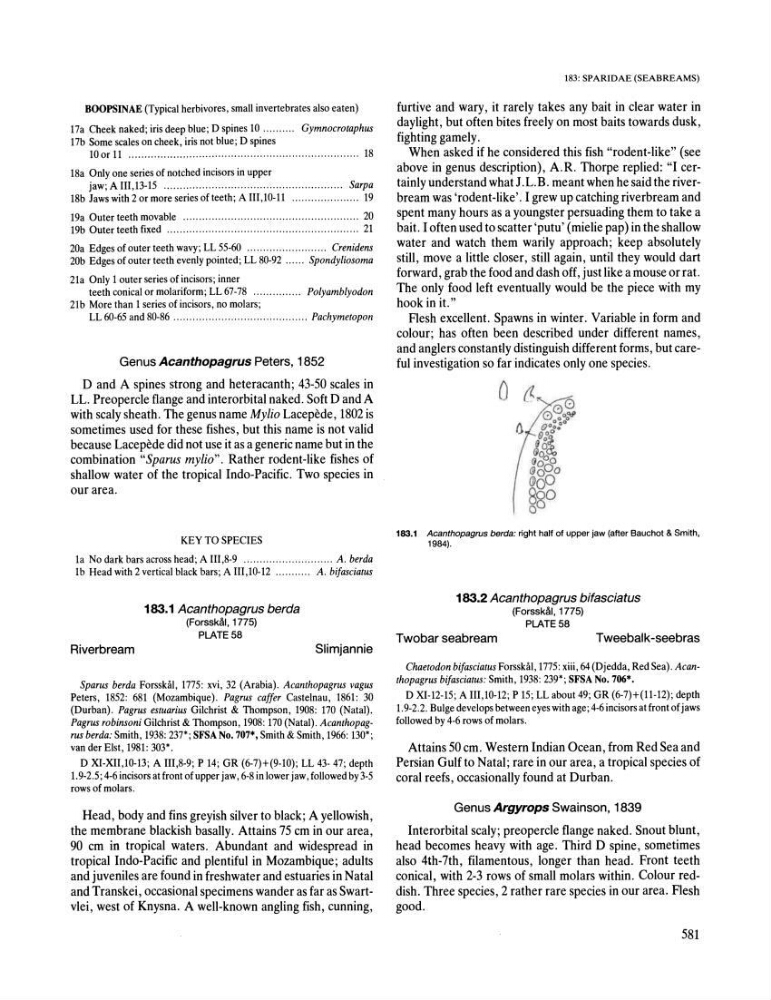
183.1 Acanthopagrus berda: right half of upper jaw (after Bauchot & Smith,
1984).
183.2 Acanthopagrus bifasciatus
(Forsskal, 1775)
PLATE 58
Twobar sea bream
Tweebalk-seebras
Chaetodon bifasciatus Forsskill, 1775: xiii , 64 (Djedda, Red Sea) . Acanthopagrus bifasciatus: Smith , 1938: 239*; SFSA No. 706*.
D XI-12-15 ; A III,1O-12; PIS; LL about 49; GR (6-7)+(11-12) ; depth
1. 9-2.2. Bulge develops between eyes with age ; 4-6 incisors at front of jaws
followed by 4-6 rows of molars.
Attains 50 cm. Western Indian Ocean, from Red Sea and
Persian Gulf to Natal; rare in our area, a tropical species of
coral reefs, occasionally found at Durban.
Genus Argyrops Swainson, 1839
Interorbital scaly; preopercle flange naked. Snout blunt,
head becomes heavy with age. Third D spine, sometimes
also 4th-7th, filamentous, longer than head. Front teeth
conical, with 2-3 rows of small molars within. Colour reddish. Three species, 2 rather rare species in our area. Flesh
good .
581
17a Cheek naked; iris deep blue; D spines 10 .... ...... Gymnocrotaphus
17b Some scales on cheek, iris not blue; D spines
100r 11 .. .. .... ...... ... ... ..... ... ........ .... .. .. ............ .. .. ....... ..... 18
18a Only one series of notched incisors in upper
jaw; A m,13-15 .. .. ........ ............ .... ...... .. ......... ........... Sarpa
18b Jaws with 2 or more series of teeth; A III,lO-ll ..................... 19
19a Outer teeth movable ........... .. ...... ........ .. ........ .. ... ... .......... 20
19b Outer teeth fixed .............. .. .. .. ........ .. ...... ... .. .. .. ............... 21
20a Edges of outer teeth wavy; LL 55-60 ........ ...... ........... Crenidens
20b Edges of outer teeth evenly pointed; LL 80-92 .... .. Spondyliosoma
21a Only 1 outer series of incisors; inner
teeth conical or molariform ; LL 67-78 ........ ....... Polyamblyodon
21 b More than 1 series of incisors , no molars ;
LL 60-65 and 80-86 .... ........ .. .... ................ ........ Pachymetopon
Genus Acanthopagrus Peters, 1852
D and A spines strong and heteracanth; 43-50 scales in
LL. Preopercle flange and interorbital naked. Soft D and A
with scaly sheath. The genus name Mylio Lacepede, 1802 is
sometimes used for these fishes, but this name is not valid
because Lacepede did not use it as a generic name but in the
combination "Sparus mylio". Rather rodent-like fishes of
shallow water of the tropical Indo-Pacific. Two species in
our area.
KEY TO SPECIES
la No dark bars across head ; A III,8-9 .. ................ ...... .... A. berda
1b Head with 2 vertical black bars; A III, 10-12 .. .. ....... A. bifasciatus
Riverbream
183.1 Acanthopagrus berda
(Forsskal,1775)
PLATE 58
Slimjannie
Sparus berda Forsskili, 1775: xvi , 32 (Arabia) . Acanthopagrus vagus
Peters, 1852: 681 (Mozambique). Pagrus caffer Castelnau, 1861: 30
(Durban) . Pagrus estuarius Gilchrist & Thompson, 1908: 170 (Natal) .
Pagrus robinsoni Gilchrist & Thompson, 1908: 170 (Natal). Acanthopagrus berda: Smith, 1938: 237* ; SFSA No. 707*, Smith & Smith , 1966: 130*;
van der Elst, 1981 : 303* .
D XI-XII,lO-13; A m,8-9; P 14; GR (6-7)+(9-10) ; LL 43- 47; depth
1.9-2.5; 4-6 incisors at front of upper jaw, 6-8 in lower jaw, followed by 3-5
rows of molars.
Head, body and fins greyish silver to black; A yellowish,
the membrane blackish basally. Attains 75 cm in our area,
90 cm in tropical waters. Abundant and widespread in
tropical Indo-Pacific and plentiful in Mozambique; adults
and juveniles are found in freshwater and estuaries in Natal
and Transkei, occasional specimens wander as far as Swartvlei, west of Knysna. A well-known angling fish, cunning,
183: SPARIDAE (SEABREAMS)
furtive and wary, it rarely takes any bait in clear water in
daylight, but often bites freely on most baits towards dusk,
fighting gamely.
When asked if he considered this fish "rodent-like" (see
above in genus description), A.R. Thorpe replied: "I certainly understand what J .L.B. meant when he said the riverbream was 'rodent-like'. I grew up catching riverbream and
spent many hours as a youngster persuading them to take a
bait. I often used to scatter 'putu' (mielie pap) in the shallow
water and watch them warily approach; keep absolutely
still, move a little closer, still again, until they would dart
forward, grab the food and dash off, just like a mouse or rat.
The only food left eventually would be the piece with my
hook in it."
Flesh excellent. Spawns in winter. Variable in form and
colour; has often been described under different names,
and anglers constantly distinguish different forms, but careful investigation so far indicates only one species.
183.1 Acanthopagrus berda: right half of upper jaw (after Bauchot & Smith,
1984).
183.2 Acanthopagrus bifasciatus
(Forsskal, 1775)
PLATE 58
Twobar sea bream
Tweebalk-seebras
Chaetodon bifasciatus Forsskill, 1775: xiii , 64 (Djedda, Red Sea) . Acanthopagrus bifasciatus: Smith , 1938: 239*; SFSA No. 706*.
D XI-12-15 ; A III,1O-12; PIS; LL about 49; GR (6-7)+(11-12) ; depth
1. 9-2.2. Bulge develops between eyes with age ; 4-6 incisors at front of jaws
followed by 4-6 rows of molars.
Attains 50 cm. Western Indian Ocean, from Red Sea and
Persian Gulf to Natal; rare in our area, a tropical species of
coral reefs, occasionally found at Durban.
Genus Argyrops Swainson, 1839
Interorbital scaly; preopercle flange naked. Snout blunt,
head becomes heavy with age. Third D spine, sometimes
also 4th-7th, filamentous, longer than head. Front teeth
conical, with 2-3 rows of small molars within. Colour reddish. Three species, 2 rather rare species in our area. Flesh
good .
581