

heavy mortality of this species at Knysna. Used extensively
for bait, flesh rather insipid. India, Arabia, Madagascar to
False Bay.
179.18 Pomadasys striatum
(Gilchrist & Thompson, 1908)
PLATE 52
Striped grunter
Gestreepte knorder
Pristipoma striatum Gilchrist & Thompson, 1908: 153 (Natal). Rhoneiseus striatus: Smith, SFSA No. 680*; van der Elst, 1981: 258*.
D XII,13-14; A III,6-7; P 16-17; GR (10-11)+(10-11)+3 minute
rudiments on expanded basibranchial; LL 51-54; interorbital equals eye.
Attains 22 cm. Known originally from Knysna to Beira
down to 30 m; recorded from Red Sea and Gulf of Suez
mainly around fringing reefs (Konchina, 1976; but this
could be P. stridens). Rare in our area, sometimes thrown
up after storms.
179.19 Pomadasys stridens
(Forsskal, 1775)
Lined piggy
Gestreepte varkie
Sciaena stridens Forsskal, 1775: 50 (Arabia). Rhonciscus stridens:
Smith, SFSA No. 681*.
D XII,13-14; A III,7-8; P 16; GR (7-8)+(15-16); LL 49-54; eye greater
than interorbital.
Silvery, darker above, with 4 stripes along body and opercular blotch dark brown. Attains nearly 20 cm; too small to
be of any importance in our area except possibly as bait.
India, Red Sea to Natal and has penetrated to eastern
Medi terranean .
179.19 Pomadasysstridens: 8 em (Inhaea).
Family No. 180: DINOPERCIDAE
by P.C. Heemstra
Cavebass
Spelonkbaars
Body oval, rather compressed; head, body and fins
covered with small, ctenoid scales; lateral line extends to
end of caudalfin. Dorsal fin with 9-11 spines and 18-20 softrays; anal fin with 3 spines and 12-14 soft-rays. Caudal fin
with 8+7 branched rays. Pectoral fins usually larger than
180: DINOPERCIDAE (CA VEBASS)
pelvics; no scaly axillary process at base of pelvics. Soft dorsal and anal fins high anteriorly. Maxilla exposed, scaly,
with a long slender supramaxilla. Small teeth in bands on
jaws, vomer, palatines and (in adults) on ectopterygoids.
Opercle ends in 2 points; preopercle serrate. Branchiostegal rays 7. Vertebrae 10+ 16; predorsal bones pattern
0/0/0+2+ 111111. Swimbladder large, connected anteriorly
to the vertebral column; posterior half of swimbladder
covered with 3 pairs of intrinsic muscles.
Two genera; Dinoperca and the monotypic Centrarchops
were previously included in the Serranidae, but Heemstra
and Hecht (1986) have established a separate family for
these two genera. Centrarchops chapini Fowler, 1923 is
known only from the northern coast of Angola. It has the
second anal fin spine longer than the third, deeper body
(depth 1.9-2.0 in SL), dark bars on the body, and 4 large,
tubular pores on the chin.
Genus Dinoperca Boulenger, 1895
Third anal fin spine longer than 2nd; no pores on chin.
The northern Indian Ocean species D. petersi (Day, 1875)
was synonymised with D. queketti by Smith (1949). According to Day's original description, D. petersi has "ca. 100"
lateral-line scales, but 2 recently collected specimens from
Pakistan have 56 and 61 lateral-line scales.
Cavebass
180.1 Dinoperca petersi
(Day, 1875)
PLATE 53
Spelonkbaars
Hap/ogenys Petersi Day, 1875: 77, PI. 20, Fig. 3 ("Sind und Meckran
coast" = Pakistan). Dinoperca queketti Boulenger, 1903: 63, PI. 2 (Natal) ;
Barnard, 1927: 490; Fowler, 1934: 427*; Morgans, 1982: 30. Dinoperca
petersii Smith, SFSA No. 454*; van der Elst, 1981: 287*; Johnson, 1983:
778 . Dinoperea petersi: Heemstra & Hecht, 1986* .
D IX-XI,18-20; A III,12-14; P 17-18; LL 53-63; GR (13-18)+(23-28).
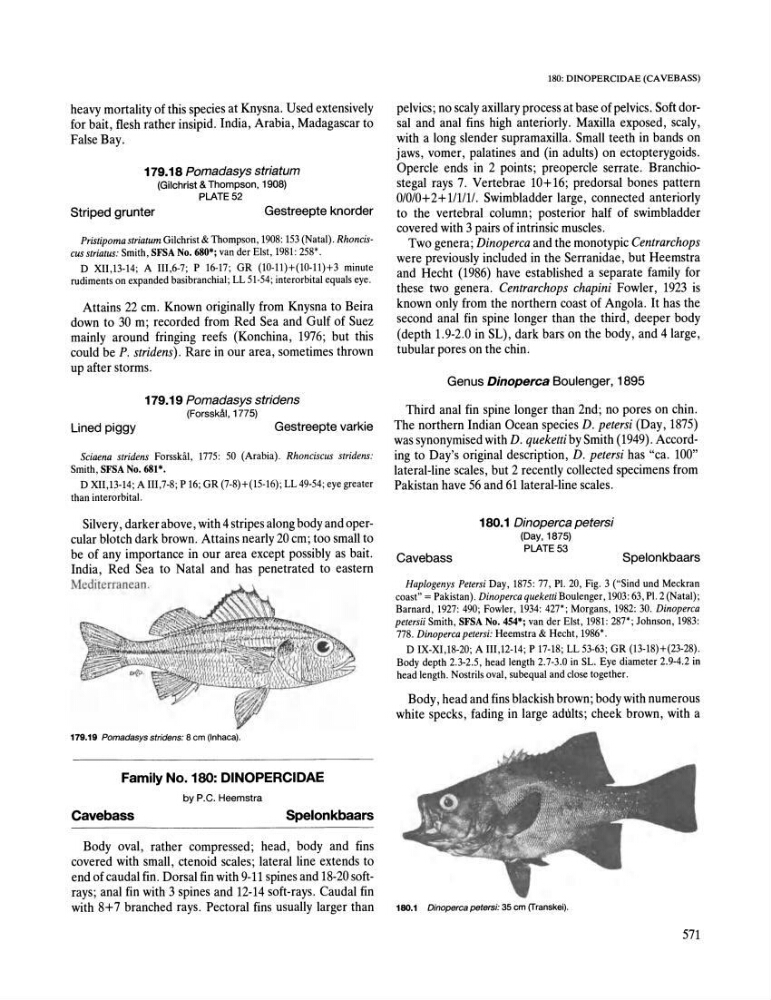
Body depth 2.3-2.5, head length 2.7-3 .0 in SL. Eye diameter 2.9-4.2 in
head length. Nostrils oval, subequal and close together.
Body, head and fins blackish brown; body with numerous
white specks, fading in large adults; cheek brown, with a
180.1 Dinoperca petersi: 35 em (Transkei).
571
for bait, flesh rather insipid. India, Arabia, Madagascar to
False Bay.
179.18 Pomadasys striatum
(Gilchrist & Thompson, 1908)
PLATE 52
Striped grunter
Gestreepte knorder
Pristipoma striatum Gilchrist & Thompson, 1908: 153 (Natal). Rhoneiseus striatus: Smith, SFSA No. 680*; van der Elst, 1981: 258*.
D XII,13-14; A III,6-7; P 16-17; GR (10-11)+(10-11)+3 minute
rudiments on expanded basibranchial; LL 51-54; interorbital equals eye.
Attains 22 cm. Known originally from Knysna to Beira
down to 30 m; recorded from Red Sea and Gulf of Suez
mainly around fringing reefs (Konchina, 1976; but this
could be P. stridens). Rare in our area, sometimes thrown
up after storms.
179.19 Pomadasys stridens
(Forsskal, 1775)
Lined piggy
Gestreepte varkie
Sciaena stridens Forsskal, 1775: 50 (Arabia). Rhonciscus stridens:
Smith, SFSA No. 681*.
D XII,13-14; A III,7-8; P 16; GR (7-8)+(15-16); LL 49-54; eye greater
than interorbital.
Silvery, darker above, with 4 stripes along body and opercular blotch dark brown. Attains nearly 20 cm; too small to
be of any importance in our area except possibly as bait.
India, Red Sea to Natal and has penetrated to eastern
Medi terranean .
179.19 Pomadasysstridens: 8 em (Inhaea).
Family No. 180: DINOPERCIDAE
by P.C. Heemstra
Cavebass
Spelonkbaars
Body oval, rather compressed; head, body and fins
covered with small, ctenoid scales; lateral line extends to
end of caudalfin. Dorsal fin with 9-11 spines and 18-20 softrays; anal fin with 3 spines and 12-14 soft-rays. Caudal fin
with 8+7 branched rays. Pectoral fins usually larger than
180: DINOPERCIDAE (CA VEBASS)
pelvics; no scaly axillary process at base of pelvics. Soft dorsal and anal fins high anteriorly. Maxilla exposed, scaly,
with a long slender supramaxilla. Small teeth in bands on
jaws, vomer, palatines and (in adults) on ectopterygoids.
Opercle ends in 2 points; preopercle serrate. Branchiostegal rays 7. Vertebrae 10+ 16; predorsal bones pattern
0/0/0+2+ 111111. Swimbladder large, connected anteriorly
to the vertebral column; posterior half of swimbladder
covered with 3 pairs of intrinsic muscles.
Two genera; Dinoperca and the monotypic Centrarchops
were previously included in the Serranidae, but Heemstra
and Hecht (1986) have established a separate family for
these two genera. Centrarchops chapini Fowler, 1923 is
known only from the northern coast of Angola. It has the
second anal fin spine longer than the third, deeper body
(depth 1.9-2.0 in SL), dark bars on the body, and 4 large,
tubular pores on the chin.
Genus Dinoperca Boulenger, 1895
Third anal fin spine longer than 2nd; no pores on chin.
The northern Indian Ocean species D. petersi (Day, 1875)
was synonymised with D. queketti by Smith (1949). According to Day's original description, D. petersi has "ca. 100"
lateral-line scales, but 2 recently collected specimens from
Pakistan have 56 and 61 lateral-line scales.
Cavebass
180.1 Dinoperca petersi
(Day, 1875)
PLATE 53
Spelonkbaars
Hap/ogenys Petersi Day, 1875: 77, PI. 20, Fig. 3 ("Sind und Meckran
coast" = Pakistan). Dinoperca queketti Boulenger, 1903: 63, PI. 2 (Natal) ;
Barnard, 1927: 490; Fowler, 1934: 427*; Morgans, 1982: 30. Dinoperca
petersii Smith, SFSA No. 454*; van der Elst, 1981: 287*; Johnson, 1983:
778 . Dinoperea petersi: Heemstra & Hecht, 1986* .
D IX-XI,18-20; A III,12-14; P 17-18; LL 53-63; GR (13-18)+(23-28).
Body depth 2.3-2.5, head length 2.7-3 .0 in SL. Eye diameter 2.9-4.2 in
head length. Nostrils oval, subequal and close together.
Body, head and fins blackish brown; body with numerous
white specks, fading in large adults; cheek brown, with a
180.1 Dinoperca petersi: 35 em (Transkei).
571