

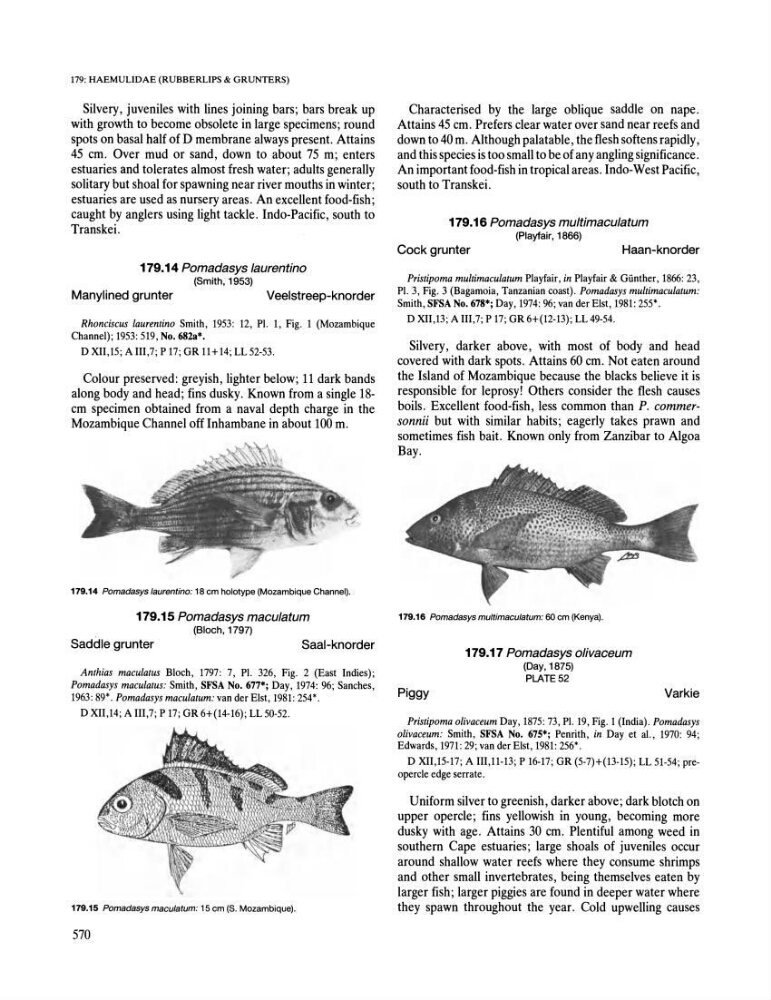
179: HAEMULIDAE (RUBBER LIPS & GRUNTERS)
Silvery, juveniles with lines joining bars; bars break up
with growth to become obsolete in large specimens; round
spots on basal half of D membrane always present. Attains
45 cm. Over mud or sand, down to about 75 m; enters
estuaries and tolerates almost fresh water; adults generally
solitary but shoal for spawning near river mouths in winter;
estuaries are used as nursery areas. An excellent food-fish;
caught by anglers using light tackle. Indo-Pacific, south to
Transkei.
179.14 Pomadasys laurentino
(Smith, 1953)
Manylined grunter
Veelstreep-knorder
Rhonciscus laurentino Smith, 1953: 12, PI. 1, Fig. 1 (Mozambique
Channel); 1953: 519, No. 682a*.
D XII,15; A III,7; P 17; GR 11 + 14; LL 52-53.
Colour preserved: greyish, lighter below; 11 dark bands
along body and head; fins dusky. Known from a single 18cm specimen obtained from a naval depth charge in the
Mozambique Channel off Inhambane in about 100 m.
179.14 Pomadasys laurentino: 18 em holotype (Mozambique Channel).
179.15 Pomadasys macula tum
(Bloch, 1797)
Saddle grunter
Saal-knorder
Anthias maculatus Bloch, 1797: 7, PI. 326, Fig. 2 (East Indies);
Pomadasys maculatus: Smith, SFSA No. 677*; Day, 1974: 96; Sanches,
1963: 89*. Pomadasys maculatum: van der Elst, 1981: 254*.
D XII,14; A III,7; P 17; GR 6+(14-16); LL 50-52.
179.15 Pomadasys maculatum: 15 em (S. Mozambique).
570
Characterised by the large oblique saddle on nape.
Attains 45 cm. Prefers clear water over sand near reefs and
down to 40 m. Although palatable, the flesh softens rapidly,
and this species is too small to be of any angling significance.
An important food-fish in tropical areas. Indo-West Pacific,
south to Transkei.
179.16 Pomadasys multimaculatum
(Playfair, 1866)
Cock grunter
Haan-knorder
Pristipoma multimaculatum Playfair, in Playfair & Giinther, 1866: 23,
PI. 3, Fig. 3 (Bagamoia, Tanzanian coast). Pomadasys multimaculatum:
Smith, SFSA No. 678*; Day, 1974: 96; van der Elst, 1981: 255*.
D XII,13; A III,7; P 17; GR 6+(12-13); LL 49-54.
Silvery, darker above, with most of body and head
covered with dark spots. Attains 60 cm. Not eaten around
the Island of Mozambique because the blacks believe it is
responsible for leprosy! Others consider the flesh causes
boils. Excellent food-fish, less common than P. commersonnii but with similar habits; eagerly takes prawn and
sometimes fish bait. Known only from Zanzibar to Algoa
Bay.
179.16 Pomadasys multimaculatum: 60 em (Kenya).
Piggy
179.17 Pomadasys olivaceum
(Day, 1875)
PLATE 52
Varkie
Pristipoma olivaceum Day, 1875: 73, PI. 19, Fig. 1 (India) . Pomadasys
olivaceum: Smith, SFSA No. 675*; Penrith, in Day et aI., 1970: 94;
Edwards, 1971: 29; van der Elst, 1981: 256* .
D XII,15-17; A III,ll-13; P 16-17; GR (5-7)+(13-15); LL 51-54; preoperc\e edge serrate.
Uniform silver to greenish, darker above; dark blotch on
upper opercle; fins yellowish in young, becoming more
dusky with age. Attains 30 cm. Plentiful among weed in
southern Cape estuaries; large shoals of juveniles occur
around shallow water reefs where they consume shrimps
and other small invertebrates, being themselves eaten by
larger fish; larger piggies are found in deeper water where
they spawn throughout the year. Cold upwelling causes
Silvery, juveniles with lines joining bars; bars break up
with growth to become obsolete in large specimens; round
spots on basal half of D membrane always present. Attains
45 cm. Over mud or sand, down to about 75 m; enters
estuaries and tolerates almost fresh water; adults generally
solitary but shoal for spawning near river mouths in winter;
estuaries are used as nursery areas. An excellent food-fish;
caught by anglers using light tackle. Indo-Pacific, south to
Transkei.
179.14 Pomadasys laurentino
(Smith, 1953)
Manylined grunter
Veelstreep-knorder
Rhonciscus laurentino Smith, 1953: 12, PI. 1, Fig. 1 (Mozambique
Channel); 1953: 519, No. 682a*.
D XII,15; A III,7; P 17; GR 11 + 14; LL 52-53.
Colour preserved: greyish, lighter below; 11 dark bands
along body and head; fins dusky. Known from a single 18cm specimen obtained from a naval depth charge in the
Mozambique Channel off Inhambane in about 100 m.
179.14 Pomadasys laurentino: 18 em holotype (Mozambique Channel).
179.15 Pomadasys macula tum
(Bloch, 1797)
Saddle grunter
Saal-knorder
Anthias maculatus Bloch, 1797: 7, PI. 326, Fig. 2 (East Indies);
Pomadasys maculatus: Smith, SFSA No. 677*; Day, 1974: 96; Sanches,
1963: 89*. Pomadasys maculatum: van der Elst, 1981: 254*.
D XII,14; A III,7; P 17; GR 6+(14-16); LL 50-52.
179.15 Pomadasys maculatum: 15 em (S. Mozambique).
570
Characterised by the large oblique saddle on nape.
Attains 45 cm. Prefers clear water over sand near reefs and
down to 40 m. Although palatable, the flesh softens rapidly,
and this species is too small to be of any angling significance.
An important food-fish in tropical areas. Indo-West Pacific,
south to Transkei.
179.16 Pomadasys multimaculatum
(Playfair, 1866)
Cock grunter
Haan-knorder
Pristipoma multimaculatum Playfair, in Playfair & Giinther, 1866: 23,
PI. 3, Fig. 3 (Bagamoia, Tanzanian coast). Pomadasys multimaculatum:
Smith, SFSA No. 678*; Day, 1974: 96; van der Elst, 1981: 255*.
D XII,13; A III,7; P 17; GR 6+(12-13); LL 49-54.
Silvery, darker above, with most of body and head
covered with dark spots. Attains 60 cm. Not eaten around
the Island of Mozambique because the blacks believe it is
responsible for leprosy! Others consider the flesh causes
boils. Excellent food-fish, less common than P. commersonnii but with similar habits; eagerly takes prawn and
sometimes fish bait. Known only from Zanzibar to Algoa
Bay.
179.16 Pomadasys multimaculatum: 60 em (Kenya).
Piggy
179.17 Pomadasys olivaceum
(Day, 1875)
PLATE 52
Varkie
Pristipoma olivaceum Day, 1875: 73, PI. 19, Fig. 1 (India) . Pomadasys
olivaceum: Smith, SFSA No. 675*; Penrith, in Day et aI., 1970: 94;
Edwards, 1971: 29; van der Elst, 1981: 256* .
D XII,15-17; A III,ll-13; P 16-17; GR (5-7)+(13-15); LL 51-54; preoperc\e edge serrate.
Uniform silver to greenish, darker above; dark blotch on
upper opercle; fins yellowish in young, becoming more
dusky with age. Attains 30 cm. Plentiful among weed in
southern Cape estuaries; large shoals of juveniles occur
around shallow water reefs where they consume shrimps
and other small invertebrates, being themselves eaten by
larger fish; larger piggies are found in deeper water where
they spawn throughout the year. Cold upwelling causes