

known of the grunters; it is a fine game fish, but wary and
easily frightened by noise, certainly in Cape estuaries,
except that in the Swartkops estuary it is apparently not disturbed by motorboats (Bennett, 1977). It frequently blows
small creatures from holes in mud or sand, and in shallow
water the tail may wave above the water. Hooked fishes
blow the bait, especially bloodworms, with such force that it
is often shot far up the line. Takes prawn, crayfish, razorshell, sea-lice, marine worms, cheese and bacon but rarely
fish bait. Flesh delicate and tasty, improved by bleeding the
fish and keeping cool, not frozen, for 12-18 hours. When
served cold it resembles tasty chicken. The strong spines
and serrated preopercle can inflict deep cuts.
Easily killed by the cold upwelling on our south Cape
coast, and this was probably responsible for numerous
grunters consumed by the strandlopers at the Cape.
Numerous enlarged supraoccipital bones have been discovered in the middens in False Bay, indicating that the seas
were warmer about 5 000 years ago and that large numbers
of these fishes were killed in that area, probably when
upwelling occurred. Not rock haunting, they were not likely
to be caught in primitive stone traps, and too wary to have
been caught or speared by primitive man.
Grey grunter
179.11 Pomadasys furcatum
(Bloch & Schneider, 1801)
PLATE 52
Grys knorder
Pristipoma Jurcatus Bloch & Schneider, 1801: 187, PI. 43 (East Indies).
Pomadasys taeniophorus Regan, 1908: 251, PI. 39 (Kosi Bay). Rhonciscus
anas: Smith, SFSA No. 682*; van der Elst, 1981: 257*.
D XII,14-15; A III,7; P 15-17; GR 5+(12-13); LL 50-52.
In juveniles, the bands are bifurcated anteriorly; in
adults, the bands are double lines. Attains 50 cm. Frequents
sandy areas near rocks; flesh good but softens rapidly.
Madagascar to Natal; rare south of Durban.
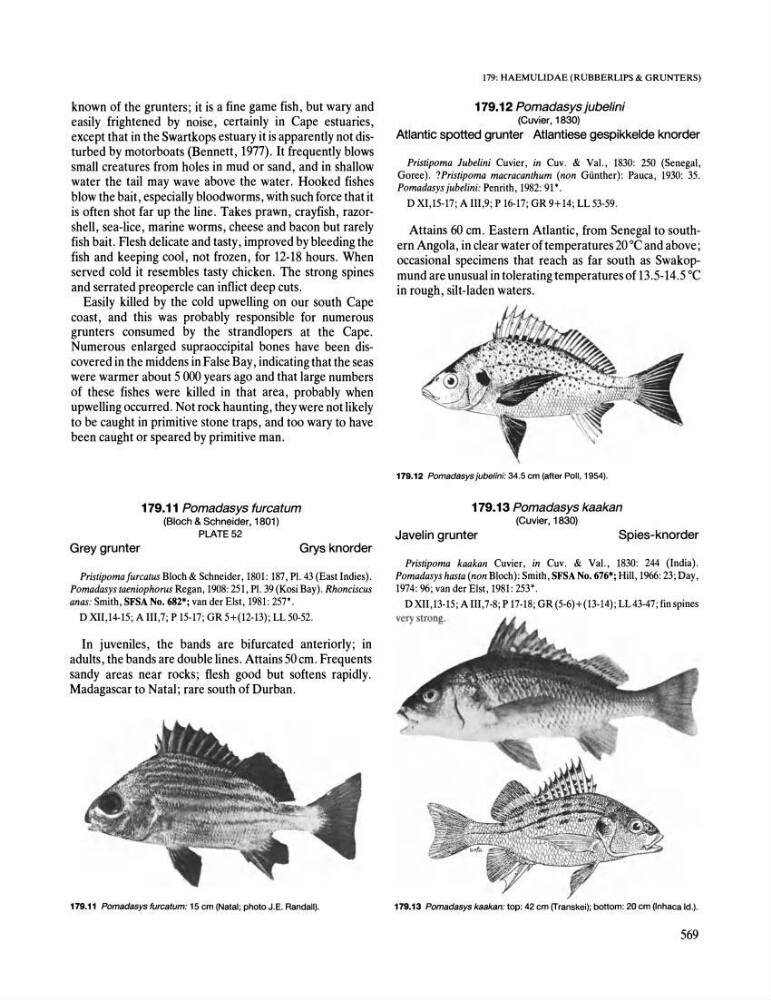
179.11 Pomadasys fureatum: 15 em (Natal; photo J.E. Randall).
179: HAEMULIDAE (RUBBERLIPS & GRUNTERS)
179.12 Pomadasys jubelini
(Cuvier, 1830)
Atlantic spotted grunter Atlantiese gespikkelde knorder
Pristipoma lubelini Cuvier, in Cuv. & Val., 1830: 250 (Senegal,
Goree). ?Pristipoma macracanthum (non Giinther): Pauca, 1930: 35.
Pomadasys jubelini: Penrith, 1982: 91 *.
D XI,15-17; A III,9; P 16-17; GR 9+ 14; LL 53-59.
Attains 60 cm. Eastern Atlantic, from Senegal to southern Angola, in clear water of temperatures 20°C and above;
occasional specimens that reach as far south as Swakopmund are unusual in tolerating temperatures of 13.5-14.5 °C
in rough, silt-laden waters.
179.12 Pomadasysjubelini: 34.5 em (after Poll, 1954).
179.13 Pomadasys kaakan
(Cuvier, 1830)
Javelin grunter
Spies-knorder
Pristipoma kaakan Cuvier, in Cuv. & Val., 1830: 244 (India).
Pomadasys hasta (non Bloch): Smith, SFSA No. 676*; Hill, 1966: 23; Day,
1974: 96; van der Elst, 1981: 253*.
D XII,13-15; A III,7-8; P 17-18; GR (5-6)+(13-14); LL43-47; fin spines
very strong.
179.13 Pomadasys kaakan: top: 42 em (Transkei); bottom: 20 em (Inhaea Id.).
569
easily frightened by noise, certainly in Cape estuaries,
except that in the Swartkops estuary it is apparently not disturbed by motorboats (Bennett, 1977). It frequently blows
small creatures from holes in mud or sand, and in shallow
water the tail may wave above the water. Hooked fishes
blow the bait, especially bloodworms, with such force that it
is often shot far up the line. Takes prawn, crayfish, razorshell, sea-lice, marine worms, cheese and bacon but rarely
fish bait. Flesh delicate and tasty, improved by bleeding the
fish and keeping cool, not frozen, for 12-18 hours. When
served cold it resembles tasty chicken. The strong spines
and serrated preopercle can inflict deep cuts.
Easily killed by the cold upwelling on our south Cape
coast, and this was probably responsible for numerous
grunters consumed by the strandlopers at the Cape.
Numerous enlarged supraoccipital bones have been discovered in the middens in False Bay, indicating that the seas
were warmer about 5 000 years ago and that large numbers
of these fishes were killed in that area, probably when
upwelling occurred. Not rock haunting, they were not likely
to be caught in primitive stone traps, and too wary to have
been caught or speared by primitive man.
Grey grunter
179.11 Pomadasys furcatum
(Bloch & Schneider, 1801)
PLATE 52
Grys knorder
Pristipoma Jurcatus Bloch & Schneider, 1801: 187, PI. 43 (East Indies).
Pomadasys taeniophorus Regan, 1908: 251, PI. 39 (Kosi Bay). Rhonciscus
anas: Smith, SFSA No. 682*; van der Elst, 1981: 257*.
D XII,14-15; A III,7; P 15-17; GR 5+(12-13); LL 50-52.
In juveniles, the bands are bifurcated anteriorly; in
adults, the bands are double lines. Attains 50 cm. Frequents
sandy areas near rocks; flesh good but softens rapidly.
Madagascar to Natal; rare south of Durban.
179.11 Pomadasys fureatum: 15 em (Natal; photo J.E. Randall).
179: HAEMULIDAE (RUBBERLIPS & GRUNTERS)
179.12 Pomadasys jubelini
(Cuvier, 1830)
Atlantic spotted grunter Atlantiese gespikkelde knorder
Pristipoma lubelini Cuvier, in Cuv. & Val., 1830: 250 (Senegal,
Goree). ?Pristipoma macracanthum (non Giinther): Pauca, 1930: 35.
Pomadasys jubelini: Penrith, 1982: 91 *.
D XI,15-17; A III,9; P 16-17; GR 9+ 14; LL 53-59.
Attains 60 cm. Eastern Atlantic, from Senegal to southern Angola, in clear water of temperatures 20°C and above;
occasional specimens that reach as far south as Swakopmund are unusual in tolerating temperatures of 13.5-14.5 °C
in rough, silt-laden waters.
179.12 Pomadasysjubelini: 34.5 em (after Poll, 1954).
179.13 Pomadasys kaakan
(Cuvier, 1830)
Javelin grunter
Spies-knorder
Pristipoma kaakan Cuvier, in Cuv. & Val., 1830: 244 (India).
Pomadasys hasta (non Bloch): Smith, SFSA No. 676*; Hill, 1966: 23; Day,
1974: 96; van der Elst, 1981: 253*.
D XII,13-15; A III,7-8; P 17-18; GR (5-6)+(13-14); LL43-47; fin spines
very strong.
179.13 Pomadasys kaakan: top: 42 em (Transkei); bottom: 20 em (Inhaea Id.).
569