

179: HAEMULIDAE (RUBBERLIPS & GRUNTERS)
179.9 Plectorhinchus sordidus
(Klunzinger, 1870)
PLATE 52
Redlip rubberlip
Rooilip-rubberlip
Diagramma sordidum Klunzinger , 1870: 735 ; 1884: 31 , PI. 3, Fig. 6
(Red Sea) . Gaterin sordidum: Smith , 1962: 479* .
D XII,17-18; A III ,7-8; P 17 ; GR (9-10)+(15-16) = 25-26; LL about 50
tubules, LS about 85; eye 3 x in head; prominence above eye with age; 4th
& 5th D spines longest; soft Dbase 1.1-1.25 (adult) in spinous D ; 2nd A
spine markedly stronger and longer than 3rd ; P slightly longer than V, C
rounded in young to emarginate in adults; lips fairly swollen with age ;
scales extend to nostrils; front half of preorbital naked.
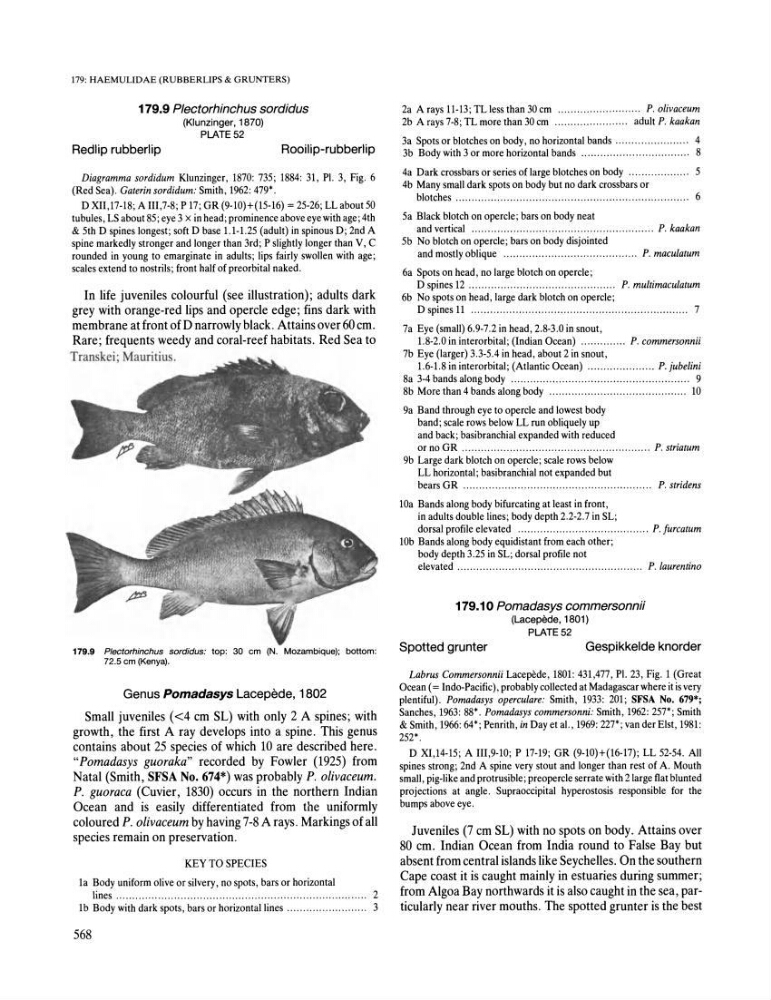
In life juveniles colourful (see illustration); adults dark
grey with orange-red lips and operde edge; fins dark with
membrane at front of D narrowly black. Attains over 60 cm.
Rare; frequents weedy and coral-reef habitats. Red Sea to
Transkei' Mauritius.
179.9 Plectorhinchus sordidus: top : 30 em (N. Mozambique); bottom:
72.5 em (Kenya).
Genus Pomadasys Lacepi:lde, 1802
Small juveniles «4 cm SL) with only 2 A spines; with
growth, the first A ray develops into a spine. This genus
contains about 25 species of which 10 are described here .
"Pomadasys guoraka" recorded by Fowler (1925) from
Natal (Smith, SFSA No. 674*) was probably P. olivaceum.
P. guoraca (Cuvier, 1830) occurs in the northern Indian
Ocean and is easily differentiated from the uniformly
coloured P. olivaceum by having 7-8 A rays . Markings of all
species remain on preservation.
KEY TO SPECIES
l a Body uniform olive or silvery , no spots, bars or horizontal
lines ..... .. .. .... ....... ... ......... ..... ............... ... .... .. .. .... .... .. ..... 2
Ib Body with dark spots , bars or horizontal lines .. .. .... ... ............. . 3
568
2a A rays 11-13; TL less than 30 cm ... .. .......... ....... .... P.olivaceum
2b A rays 7-8; TL more than 30 cm ............. ... .. ..... adult P. kaakan
3a Spots or blotches on body , no horizontal bands .. ... .. ............ .... 4
3b Body with 3 or more horizontal bands ..... .... ....... .. ... ... ........ .. 8
4a Dark crossbars or series of large blotches on body ..... .......... .. .. 5
4b Many small dark spots on body but no dark crossbars or
blotches ....... ..... .... ... .... ... ..... .. .... ..... ....... ........ .. .............. 6
5a Black blotch on opercle; bars on body neat
and vertical .. .. .. .. .. ..... .. ........ . ........ .. .. .. .... .. .. .. .... .. . P. kaakan
5b No blotch on opercle ; bars on body disjointed
and mostly oblique .. .... .. ...... .. ................. ... ...... P. maculatum
6a Spots on head, no large blotch on opercle;
D spines 12 .. .... , ......... .. ....................... ... .. P. multimaculatum
6b No spots on head, large dark blotch on opercle;
D spines 11 .... .. ..... .... ........ ......... .......... .. ... .... .. .... ........... 7
7a Eye (small) 6.9-7.2 in head, 2.8-3 .0 in snout ,
1.8-2.0 in interorbital ; (Indian Ocean) .. .. .. ..... ... P. commersonnii
7b Eye (larger) 3.3-5 .4 in head, about 2 in snout ,
1.6-1.8 in interorbital ; (Atlantic Ocean) ..... .. .............. P. jubelini
8a 3-4 bands along body ...... .. ...... .. ..... .... ..... .. .. .. ..... .. .. .. ... ...... 9
8b More than 4 bands along body .......... .. ....... .. ... .. .. ... .... .. .... .. 10
9a Band through eye to opercle and lowest body
band ; scale rows below LL run obliquely up
and back ; basibranchial expanded with reduced
or no GR .. ........ .... .. ... ........ ........ ........... .. ..... .. .... P. striatum
9b Large dark blotch on opercle; scale rows below
LL horizontal; basi branchial not expanded but
bears GR .. .. ...... .. ...... .. .. .. .... ... ................ .. .... .. .. .. P. stridens
lOa Bands along body bifurcating at least in front ,
in adults double lines; body depth 2.2-2.7 in SL;
dorsal profile elevated ..... .... ... ...... .... .. .... .... ...... ... P. [urcatum
lOb Bands along body equidistant from each other;
body depth 3.25 in SL; dorsal profile not
elevated ... .... ........ .. ... .. .... .. ................... ... .. ...... P. laurentino
179.10 Pomadasys commersonnii
(Lacepede, 1801)
PLATE 52
Spotted grunter
Gespikkelde knorder
Labrus Commersonnii Lacepede, 1801: 431,477, PI. 23, Fig. 1 (Great
Ocean (= Indo-Pacific) , probably collected at Madagascar where it is very
plentiful) . Pomadasys operculare: Smith, 1933: 201; SFSA No. 679*;
Sanches, 1963: 88* . Pomadasys commersonni: Smith , 1962: 257*; Smith
& Smith , 1966: 64* ; Penrith , in Day et aI., 1969: 227* ; van derElst , 1981 :
252* .
D XI ,14-15 ; A III ,9-1O; P 17-19; GR (9-10)+(16-17) ; LL 52-54. All
spines strong; 2nd A spine very stout and longer than rest of A. Mouth
small , pig-like and protrusible; preopercle serrate with 2 large flat blunted
projections at angle . Supraoccipital hyperostosis responsible for the
bumps above eye.
Juveniles (7 cm SL) with no spots on body. Attains over
80 cm. Indian Ocean from India round to False Bay but
absent from central islands like Seychelles. On the southern
Cape coast it is caught mainly in estuaries during summer;
from Algoa Bay northwards it is also caught in the sea, particularly near river mouths. The spotted grunter is the best
179.9 Plectorhinchus sordidus
(Klunzinger, 1870)
PLATE 52
Redlip rubberlip
Rooilip-rubberlip
Diagramma sordidum Klunzinger , 1870: 735 ; 1884: 31 , PI. 3, Fig. 6
(Red Sea) . Gaterin sordidum: Smith , 1962: 479* .
D XII,17-18; A III ,7-8; P 17 ; GR (9-10)+(15-16) = 25-26; LL about 50
tubules, LS about 85; eye 3 x in head; prominence above eye with age; 4th
& 5th D spines longest; soft Dbase 1.1-1.25 (adult) in spinous D ; 2nd A
spine markedly stronger and longer than 3rd ; P slightly longer than V, C
rounded in young to emarginate in adults; lips fairly swollen with age ;
scales extend to nostrils; front half of preorbital naked.
In life juveniles colourful (see illustration); adults dark
grey with orange-red lips and operde edge; fins dark with
membrane at front of D narrowly black. Attains over 60 cm.
Rare; frequents weedy and coral-reef habitats. Red Sea to
Transkei' Mauritius.
179.9 Plectorhinchus sordidus: top : 30 em (N. Mozambique); bottom:
72.5 em (Kenya).
Genus Pomadasys Lacepi:lde, 1802
Small juveniles «4 cm SL) with only 2 A spines; with
growth, the first A ray develops into a spine. This genus
contains about 25 species of which 10 are described here .
"Pomadasys guoraka" recorded by Fowler (1925) from
Natal (Smith, SFSA No. 674*) was probably P. olivaceum.
P. guoraca (Cuvier, 1830) occurs in the northern Indian
Ocean and is easily differentiated from the uniformly
coloured P. olivaceum by having 7-8 A rays . Markings of all
species remain on preservation.
KEY TO SPECIES
l a Body uniform olive or silvery , no spots, bars or horizontal
lines ..... .. .. .... ....... ... ......... ..... ............... ... .... .. .. .... .... .. ..... 2
Ib Body with dark spots , bars or horizontal lines .. .. .... ... ............. . 3
568
2a A rays 11-13; TL less than 30 cm ... .. .......... ....... .... P.olivaceum
2b A rays 7-8; TL more than 30 cm ............. ... .. ..... adult P. kaakan
3a Spots or blotches on body , no horizontal bands .. ... .. ............ .... 4
3b Body with 3 or more horizontal bands ..... .... ....... .. ... ... ........ .. 8
4a Dark crossbars or series of large blotches on body ..... .......... .. .. 5
4b Many small dark spots on body but no dark crossbars or
blotches ....... ..... .... ... .... ... ..... .. .... ..... ....... ........ .. .............. 6
5a Black blotch on opercle; bars on body neat
and vertical .. .. .. .. .. ..... .. ........ . ........ .. .. .. .... .. .. .. .... .. . P. kaakan
5b No blotch on opercle ; bars on body disjointed
and mostly oblique .. .... .. ...... .. ................. ... ...... P. maculatum
6a Spots on head, no large blotch on opercle;
D spines 12 .. .... , ......... .. ....................... ... .. P. multimaculatum
6b No spots on head, large dark blotch on opercle;
D spines 11 .... .. ..... .... ........ ......... .......... .. ... .... .. .... ........... 7
7a Eye (small) 6.9-7.2 in head, 2.8-3 .0 in snout ,
1.8-2.0 in interorbital ; (Indian Ocean) .. .. .. ..... ... P. commersonnii
7b Eye (larger) 3.3-5 .4 in head, about 2 in snout ,
1.6-1.8 in interorbital ; (Atlantic Ocean) ..... .. .............. P. jubelini
8a 3-4 bands along body ...... .. ...... .. ..... .... ..... .. .. .. ..... .. .. .. ... ...... 9
8b More than 4 bands along body .......... .. ....... .. ... .. .. ... .... .. .... .. 10
9a Band through eye to opercle and lowest body
band ; scale rows below LL run obliquely up
and back ; basibranchial expanded with reduced
or no GR .. ........ .... .. ... ........ ........ ........... .. ..... .. .... P. striatum
9b Large dark blotch on opercle; scale rows below
LL horizontal; basi branchial not expanded but
bears GR .. .. ...... .. ...... .. .. .. .... ... ................ .. .... .. .. .. P. stridens
lOa Bands along body bifurcating at least in front ,
in adults double lines; body depth 2.2-2.7 in SL;
dorsal profile elevated ..... .... ... ...... .... .. .... .... ...... ... P. [urcatum
lOb Bands along body equidistant from each other;
body depth 3.25 in SL; dorsal profile not
elevated ... .... ........ .. ... .. .... .. ................... ... .. ...... P. laurentino
179.10 Pomadasys commersonnii
(Lacepede, 1801)
PLATE 52
Spotted grunter
Gespikkelde knorder
Labrus Commersonnii Lacepede, 1801: 431,477, PI. 23, Fig. 1 (Great
Ocean (= Indo-Pacific) , probably collected at Madagascar where it is very
plentiful) . Pomadasys operculare: Smith, 1933: 201; SFSA No. 679*;
Sanches, 1963: 88* . Pomadasys commersonni: Smith , 1962: 257*; Smith
& Smith , 1966: 64* ; Penrith , in Day et aI., 1969: 227* ; van derElst , 1981 :
252* .
D XI ,14-15 ; A III ,9-1O; P 17-19; GR (9-10)+(16-17) ; LL 52-54. All
spines strong; 2nd A spine very stout and longer than rest of A. Mouth
small , pig-like and protrusible; preopercle serrate with 2 large flat blunted
projections at angle . Supraoccipital hyperostosis responsible for the
bumps above eye.
Juveniles (7 cm SL) with no spots on body. Attains over
80 cm. Indian Ocean from India round to False Bay but
absent from central islands like Seychelles. On the southern
Cape coast it is caught mainly in estuaries during summer;
from Algoa Bay northwards it is also caught in the sea, particularly near river mouths. The spotted grunter is the best