

180: DINOPERCIDAE (CAVE BASS)
black band from front of snout to angle of preopercle. Attains 62 cm, 5 kg. Usually seen under ledges or at the
entrance of caves. Makes a loud drumming noise. The distribution of this species is uncertain, apparently common in
Pakistan and South Africa (from Natal to Algoa Bay). Also
reported from Kenya and Mozambique.
Family No. 181: LUTJANIDAE
by W.O. Anderson, Jr. (Genus Lutjanus by G.A. Allen)
Snappers
Snappers
Body moderately elongate to deep. Dorsal fin single,
sometimes deeply incised. Soft dorsal and anal fins scaleless, scaly, or with a basal scaly sheath. Pelvic axillary process usually well developed. Upper jaw usually moderately
protractile (fixed in Aphareus); maxilla slipping for most or
all of its length under preorbital bone when mouth is closed.
Jaws with more or less distinct canines (absent in
Aphareus); vomer and palatines usually with small conical
teeth (toothless in Aphareus). Preopercle usually serrate.
Scales ctenoid; cheek and operculum scaly; maxilla with or
without scales; snout, preorbital and lower jaw naked.
Caudal fin truncate to deeply forked, with 17 principal rays.
Vertebrae 10+ 14. Body depth is measured at the dorsal fin
origin; gill-raker counts include rudiments.
Adults mostly bottom-associated fishes occurring in 1 -
550 m of warm seas throughout the world. Some species
reach 100 to 120 cm, and many are excellent food-fishes,
although in some areas certain species are ciguatoxic.
Important in both sport and commercial catches. Seventeen
genera and about 103 species. The limits and relationships
of the family have been studied in detail recently by Johnson
(1981).
Reports of Apsilus fuscus Valenciennes, 1830, an eastern
Atlantic species, from the western Indian Ocean appear to
be based on misidentifications, in part, perhaps of
Paracaesio xanthura. Alwyne Wheeler examined the
specimen (BMNH 1917.11.3.1) from Delagoa Bay which
was considered by Smith, SFSA No. 656, as a representative
of Apsilus fuscus, compared it with a specimen of A. fuscus
(BMNH 1939.7.12.21) of similar size from off west Africa,
and concluded that the two specimens are not conspecific.
Therefore, Apsilus fuscus has been deleted from this
revision.
KEY TO GENERA
la D and A without scales; D X,IO or 11 .................................... 2
Ib Soft D and A with scales; D X-XII,12-16 ................................ 7
2a Maxilla with scales ............................................................ 3
2b Maxilla without scales ........................................................ 4
3a D notched before soft-rayed portion; D X,l1 ..................... Etelis
3b D not notched; D X,IO ........................................... Paracaesio
572
4a Upper jaw not protrusible, attached at symphysis
by a frenum to skull; vomer and palatines without
teeth; teeth in jaws minute ....................................... Aphareus
4b Upper jaw protrusible, not attached by frenum
to skull; vomer and palatines with teeth; at least
some teeth in jaws caniniform ............................ .. ................ 5
5a Last D and A rays shorter than penultimate ray;
D X,IO ............................................................... Paracaesio
5b Last D and A rays longer than penultimate ray;
D X,11 ........................................................................... 6
6a Groove present on snout below nostrils; P shorter
than half length of head ............................................... Aprion
6b No groove on snout; P longer than half length
of head .......................................................... Pristipomoides
7a GR long, slender, 60 or more on lower limb
of 1st arch .............................................................. Macolor
7b GR shorter, 7-19 on lower limb of 1st gill arch ............... Lutjanus
Genus Aphareus Cuvier, 1830
Two species; both in our area.
KEY TO SPECIES
1a GR (6-10)+(16-18); colour steel blue ........................... A. furca
Ib GR (16-19)+(32-35); colour brick red or pink
dorsally .............................................................. A. rutilans
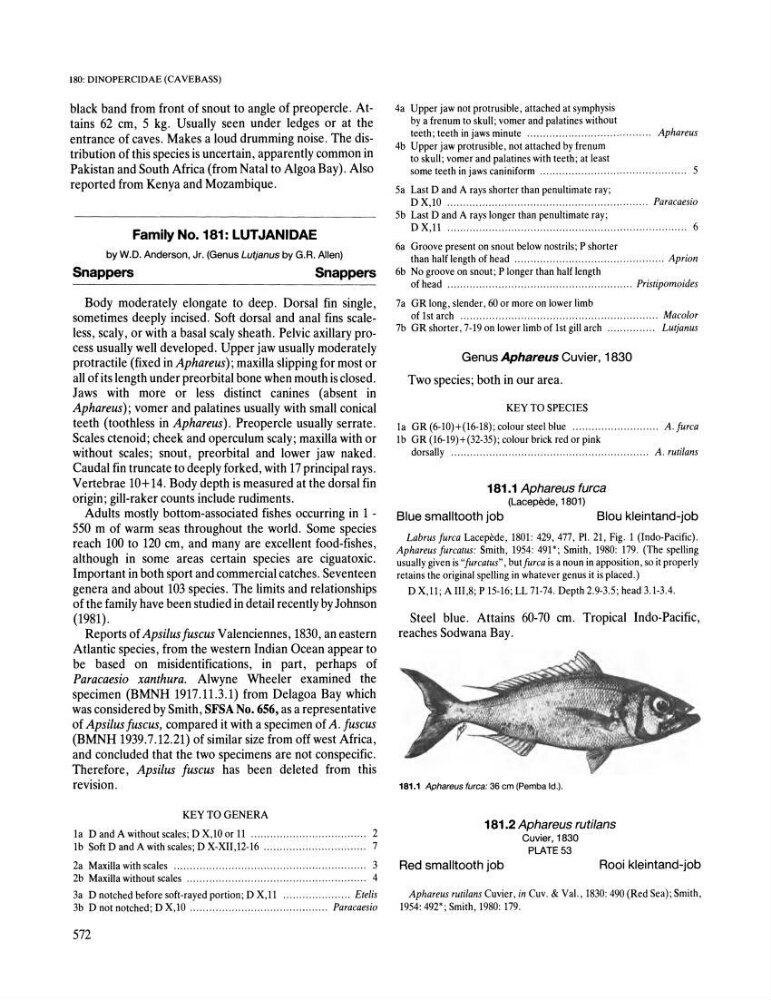
181.1 Aphareus (urea
(Lacepede, 1801)
Blue smalltooth job
Blou kleintand-job
Labrus furca Lacepede, 1801: 429, 477, PI. 21, Fig. 1 (Indo-Pacific).
Aphareus furcatus: Smith, 1954: 491 *; Smith, 1980: 179. (The spelling
usually given is "furcatus", butfurca is a noun in apposition, so it properly
retains the original spelling in whatever genus it is placed.)
D X,l1; A III,8; P 15-16; LL 71-74. Depth 2.9-3.5; head 3.1-3.4.
Steel blue. Attains 60-70 cm. Tropical Indo-Pacific,
reaches Sodwana Bay.
181.1 Aphareus furea: 36 em (Pemba Id.).
181.2 Aphareus rutilans
Cuvier, 1830
PLATE 53
Red smalltooth job
Rooi kleintand-job
Aphareus rutilans Cuvier, in Cuv. & Val., 1830: 490 (Red Sea); Smith,
1954: 492*; Smith, 1980: 179.
black band from front of snout to angle of preopercle. Attains 62 cm, 5 kg. Usually seen under ledges or at the
entrance of caves. Makes a loud drumming noise. The distribution of this species is uncertain, apparently common in
Pakistan and South Africa (from Natal to Algoa Bay). Also
reported from Kenya and Mozambique.
Family No. 181: LUTJANIDAE
by W.O. Anderson, Jr. (Genus Lutjanus by G.A. Allen)
Snappers
Snappers
Body moderately elongate to deep. Dorsal fin single,
sometimes deeply incised. Soft dorsal and anal fins scaleless, scaly, or with a basal scaly sheath. Pelvic axillary process usually well developed. Upper jaw usually moderately
protractile (fixed in Aphareus); maxilla slipping for most or
all of its length under preorbital bone when mouth is closed.
Jaws with more or less distinct canines (absent in
Aphareus); vomer and palatines usually with small conical
teeth (toothless in Aphareus). Preopercle usually serrate.
Scales ctenoid; cheek and operculum scaly; maxilla with or
without scales; snout, preorbital and lower jaw naked.
Caudal fin truncate to deeply forked, with 17 principal rays.
Vertebrae 10+ 14. Body depth is measured at the dorsal fin
origin; gill-raker counts include rudiments.
Adults mostly bottom-associated fishes occurring in 1 -
550 m of warm seas throughout the world. Some species
reach 100 to 120 cm, and many are excellent food-fishes,
although in some areas certain species are ciguatoxic.
Important in both sport and commercial catches. Seventeen
genera and about 103 species. The limits and relationships
of the family have been studied in detail recently by Johnson
(1981).
Reports of Apsilus fuscus Valenciennes, 1830, an eastern
Atlantic species, from the western Indian Ocean appear to
be based on misidentifications, in part, perhaps of
Paracaesio xanthura. Alwyne Wheeler examined the
specimen (BMNH 1917.11.3.1) from Delagoa Bay which
was considered by Smith, SFSA No. 656, as a representative
of Apsilus fuscus, compared it with a specimen of A. fuscus
(BMNH 1939.7.12.21) of similar size from off west Africa,
and concluded that the two specimens are not conspecific.
Therefore, Apsilus fuscus has been deleted from this
revision.
KEY TO GENERA
la D and A without scales; D X,IO or 11 .................................... 2
Ib Soft D and A with scales; D X-XII,12-16 ................................ 7
2a Maxilla with scales ............................................................ 3
2b Maxilla without scales ........................................................ 4
3a D notched before soft-rayed portion; D X,l1 ..................... Etelis
3b D not notched; D X,IO ........................................... Paracaesio
572
4a Upper jaw not protrusible, attached at symphysis
by a frenum to skull; vomer and palatines without
teeth; teeth in jaws minute ....................................... Aphareus
4b Upper jaw protrusible, not attached by frenum
to skull; vomer and palatines with teeth; at least
some teeth in jaws caniniform ............................ .. ................ 5
5a Last D and A rays shorter than penultimate ray;
D X,IO ............................................................... Paracaesio
5b Last D and A rays longer than penultimate ray;
D X,11 ........................................................................... 6
6a Groove present on snout below nostrils; P shorter
than half length of head ............................................... Aprion
6b No groove on snout; P longer than half length
of head .......................................................... Pristipomoides
7a GR long, slender, 60 or more on lower limb
of 1st arch .............................................................. Macolor
7b GR shorter, 7-19 on lower limb of 1st gill arch ............... Lutjanus
Genus Aphareus Cuvier, 1830
Two species; both in our area.
KEY TO SPECIES
1a GR (6-10)+(16-18); colour steel blue ........................... A. furca
Ib GR (16-19)+(32-35); colour brick red or pink
dorsally .............................................................. A. rutilans
181.1 Aphareus (urea
(Lacepede, 1801)
Blue smalltooth job
Blou kleintand-job
Labrus furca Lacepede, 1801: 429, 477, PI. 21, Fig. 1 (Indo-Pacific).
Aphareus furcatus: Smith, 1954: 491 *; Smith, 1980: 179. (The spelling
usually given is "furcatus", butfurca is a noun in apposition, so it properly
retains the original spelling in whatever genus it is placed.)
D X,l1; A III,8; P 15-16; LL 71-74. Depth 2.9-3.5; head 3.1-3.4.
Steel blue. Attains 60-70 cm. Tropical Indo-Pacific,
reaches Sodwana Bay.
181.1 Aphareus furea: 36 em (Pemba Id.).
181.2 Aphareus rutilans
Cuvier, 1830
PLATE 53
Red smalltooth job
Rooi kleintand-job
Aphareus rutilans Cuvier, in Cuv. & Val., 1830: 490 (Red Sea); Smith,
1954: 492*; Smith, 1980: 179.