

than head, with 16-19 rays. Pelvic fins with 1 spine and 5
branched rays. Caudal fin with 14 branched rays; rear margin truncate, convex or concave. Gasbladder present.
Scales ctenoid; lateral line single, complete, not continued
on caudal fin; head, maxilla and lower jaw scaly. Upper jaw
slightly protrusile; supramaxilla absent; 1 row or narrow
band of small conical teeth on jaws; no canines; vomer and
palatines with minute teeth. Two closely set nostrils. Gills 4,
a slit behind last; pseudobranch present; branchiostegals 6,
membranes separate, free from isthmus. Vertebrae (910)+ 13.
Bigeyes are found near the bottom in rocky areas or reefs
of tropical and temperate regions in depths of 1 - 400 m.
Three genera, all in our area; about 12 species.
KEY TO GENERA
1a D spines increase regularly in length from first to
last; 10th spine more than twice length of 2nd .............. Cookeolus
I b 10th D spine subequal to 2nd ............................................... 2
2a Body depth 2.3-2.9 in SL; LL 54-73 .......................... Priacanthus
2b Body depth 1.9-2.1 in SL; LL 36-38 ........... .. .. ............ Pristigenys
Genus Cookeo/us Fowler, 1929
V longer than head in fish larger than 15 cm SL; A base
shorter than head. One worldwide species.
Bulleye
174.1 Cookeo/us boops
(Schneider, 1801)
PLATE 47
Buloog
Anthias boops Schneider, in Bloch & Schneider, 1801: 308 (Atlantic
Ocean near St. Helena). Priacanthus boops: Smith, SFSA No. 404*.
D X,12-13; A I1I,12-13 (3rd spine longer than orbit diameter); P 17-19;
LL54-59; GR (5-7)+(15-20) not counting rudiments. Depth 1.8-2.8; head
2.6-3.0.
Head and body reddish silver, paler ventrally; membrane
of D & A dark anteriorly; V membrane blackish; the rays
pale. Attains 60 cm. Beira to Algoa Bay in depths of 100400m.
Genus Priacanthus Oken, 1817
About 6 species; 2 in our area. Previous records of P.
arenatus Cuvier from southern Africa (Smith, SFSA No.
405) are unsubstantiated.
KEY TO SPECIES
la No scales on rear margin of preoperc\e; adults
with well-developed U-shaped gap under
pre opercular spine at junction of suboperc\e and
interoperc\e; C truncate to convex, usually with
dark dots; interorbital space 3.3-3.7 in head ............. P. cruentatus
174: PRIACANTHIDAE (BIGEYES)
Ib Preoperc\e entirely scaled; adults without
U-shaped gap under preopercular spine; C
truncate to concave, without dark dots;
interorbital space 3.6-4.5 in head ............................... P. hamrur
174.2 Priacanthus cruentatus
(Lacepede, 1801)
PLATE 47
Glass bigeye
Glas-grootoog
Labrus cruentatus Lacepede, 1801: 452, 522 (America). Priacanthus
cruentatus: Fowler, 1936: 66; ?Smith, SFSA No. 403* (Fig. 403 on PI. 104 is
of P. hamrur).
D X,13-14; A I1I,13-15; P 18-19; LL 60-69; GR (3-4)+(17-19) not
counting rudiments. Depth 2.4-2.7; head 2.8-3.1. Eye 2.3-2.8, V 1.3-1.6 in
head; V (20-26% SL) shorter than in P. hamrur. Preopercle spine distinct.
Colour silver or reddish or mottled silvery and red;
median fins with small dark spots; V uniformly pale or
dusky, but without distinct spots. Attains 30 cm. East coast
of Africa to Hawaii, south to at least Durban; also in Atlantic.
174.3 Priacanthus hamrur
(Forsskai, 1775)
PLATE 44
Crescent-tail bigeye
Sekelstert-grootoog
Sciaena hamrur Forsskal, 1775: 45 (Djedda, Red Sea); Klausewitz &
Nielsen, 1965: 18, PI. 11. Priacanthus hamrur: ?Smith, SFSA No. 406*;
Smith & Smith, 1966: 120'. Priacanthus cruentatus Smith, SFSA No. 403*
(Fig. only).
.
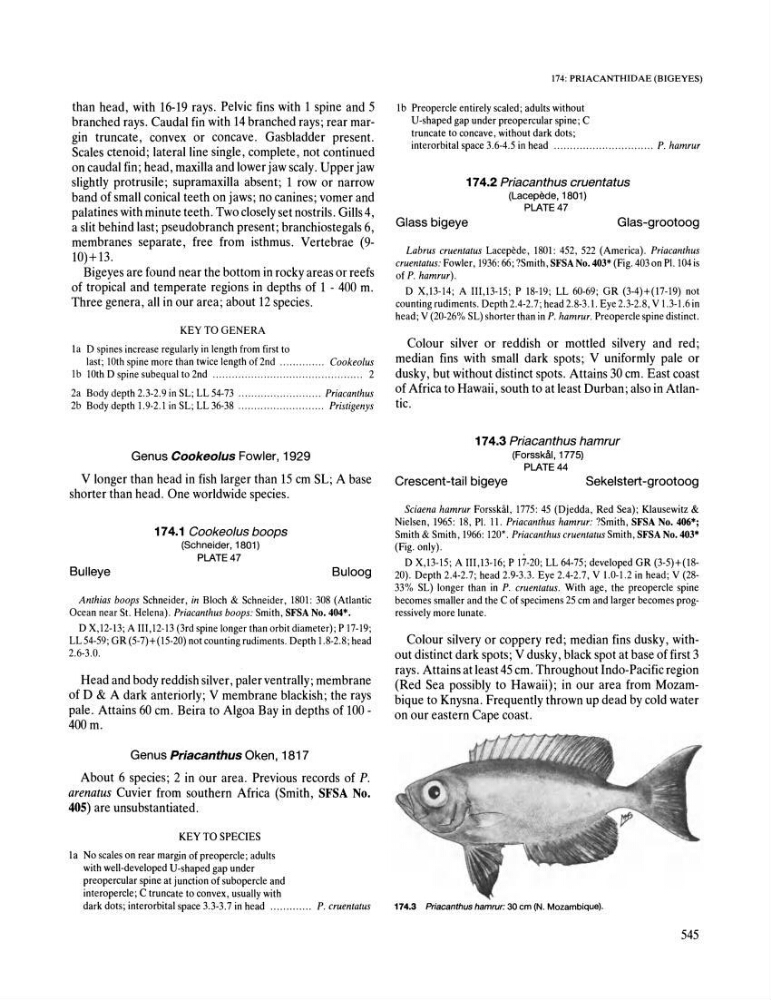
D X,13-15; A I1I,13-16; P 17-20; LL 64-75; developed GR (3-5)+(1820). Depth 2.4-2.7; head 2.9-3.3. Eye 2.4-2.7, V 1.0-1.2 in head; V (2833% SL) longer than in P. cruentatus. With age, the preopercle spine
becomes smaller and the C of specimens 25 cm and larger becomes progressively more lunate.
Colour silvery or coppery red; median fins dusky, without distinct dark spots; V dusky, black spot at base of first 3
rays. Attains at least 45 cm. Throughout Indo-Pacific region
(Red Sea possibly to Hawaii); in our area from Mozambique to Knysna. Frequently thrown up dead by cold water
on our eastern Cape coast.
174.3 Priacanthus hamrur: 30 cm (N. Mozambique).
545
branched rays. Caudal fin with 14 branched rays; rear margin truncate, convex or concave. Gasbladder present.
Scales ctenoid; lateral line single, complete, not continued
on caudal fin; head, maxilla and lower jaw scaly. Upper jaw
slightly protrusile; supramaxilla absent; 1 row or narrow
band of small conical teeth on jaws; no canines; vomer and
palatines with minute teeth. Two closely set nostrils. Gills 4,
a slit behind last; pseudobranch present; branchiostegals 6,
membranes separate, free from isthmus. Vertebrae (910)+ 13.
Bigeyes are found near the bottom in rocky areas or reefs
of tropical and temperate regions in depths of 1 - 400 m.
Three genera, all in our area; about 12 species.
KEY TO GENERA
1a D spines increase regularly in length from first to
last; 10th spine more than twice length of 2nd .............. Cookeolus
I b 10th D spine subequal to 2nd ............................................... 2
2a Body depth 2.3-2.9 in SL; LL 54-73 .......................... Priacanthus
2b Body depth 1.9-2.1 in SL; LL 36-38 ........... .. .. ............ Pristigenys
Genus Cookeo/us Fowler, 1929
V longer than head in fish larger than 15 cm SL; A base
shorter than head. One worldwide species.
Bulleye
174.1 Cookeo/us boops
(Schneider, 1801)
PLATE 47
Buloog
Anthias boops Schneider, in Bloch & Schneider, 1801: 308 (Atlantic
Ocean near St. Helena). Priacanthus boops: Smith, SFSA No. 404*.
D X,12-13; A I1I,12-13 (3rd spine longer than orbit diameter); P 17-19;
LL54-59; GR (5-7)+(15-20) not counting rudiments. Depth 1.8-2.8; head
2.6-3.0.
Head and body reddish silver, paler ventrally; membrane
of D & A dark anteriorly; V membrane blackish; the rays
pale. Attains 60 cm. Beira to Algoa Bay in depths of 100400m.
Genus Priacanthus Oken, 1817
About 6 species; 2 in our area. Previous records of P.
arenatus Cuvier from southern Africa (Smith, SFSA No.
405) are unsubstantiated.
KEY TO SPECIES
la No scales on rear margin of preoperc\e; adults
with well-developed U-shaped gap under
pre opercular spine at junction of suboperc\e and
interoperc\e; C truncate to convex, usually with
dark dots; interorbital space 3.3-3.7 in head ............. P. cruentatus
174: PRIACANTHIDAE (BIGEYES)
Ib Preoperc\e entirely scaled; adults without
U-shaped gap under preopercular spine; C
truncate to concave, without dark dots;
interorbital space 3.6-4.5 in head ............................... P. hamrur
174.2 Priacanthus cruentatus
(Lacepede, 1801)
PLATE 47
Glass bigeye
Glas-grootoog
Labrus cruentatus Lacepede, 1801: 452, 522 (America). Priacanthus
cruentatus: Fowler, 1936: 66; ?Smith, SFSA No. 403* (Fig. 403 on PI. 104 is
of P. hamrur).
D X,13-14; A I1I,13-15; P 18-19; LL 60-69; GR (3-4)+(17-19) not
counting rudiments. Depth 2.4-2.7; head 2.8-3.1. Eye 2.3-2.8, V 1.3-1.6 in
head; V (20-26% SL) shorter than in P. hamrur. Preopercle spine distinct.
Colour silver or reddish or mottled silvery and red;
median fins with small dark spots; V uniformly pale or
dusky, but without distinct spots. Attains 30 cm. East coast
of Africa to Hawaii, south to at least Durban; also in Atlantic.
174.3 Priacanthus hamrur
(Forsskai, 1775)
PLATE 44
Crescent-tail bigeye
Sekelstert-grootoog
Sciaena hamrur Forsskal, 1775: 45 (Djedda, Red Sea); Klausewitz &
Nielsen, 1965: 18, PI. 11. Priacanthus hamrur: ?Smith, SFSA No. 406*;
Smith & Smith, 1966: 120'. Priacanthus cruentatus Smith, SFSA No. 403*
(Fig. only).
.
D X,13-15; A I1I,13-16; P 17-20; LL 64-75; developed GR (3-5)+(1820). Depth 2.4-2.7; head 2.9-3.3. Eye 2.4-2.7, V 1.0-1.2 in head; V (2833% SL) longer than in P. cruentatus. With age, the preopercle spine
becomes smaller and the C of specimens 25 cm and larger becomes progressively more lunate.
Colour silvery or coppery red; median fins dusky, without distinct dark spots; V dusky, black spot at base of first 3
rays. Attains at least 45 cm. Throughout Indo-Pacific region
(Red Sea possibly to Hawaii); in our area from Mozambique to Knysna. Frequently thrown up dead by cold water
on our eastern Cape coast.
174.3 Priacanthus hamrur: 30 cm (N. Mozambique).
545