

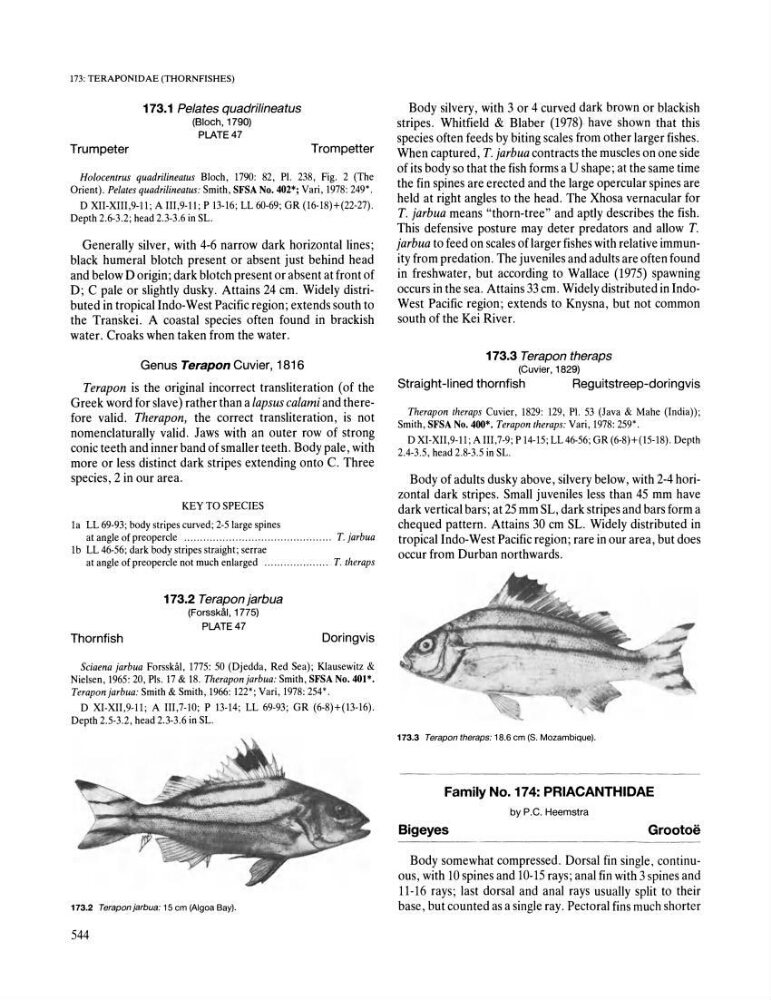
173: TERAPONIDAE (THORNFISHES)
Trumpeter
173.1 Pelates quadrilineatus
(Bloch, 1790)
PLATE 47
Trompetter
Holocentrus quadrilineatus Bloch, 1790: 82, PI. 238, Fig. 2 (The
Orient). Pelates quadrilineatus: Smith, SFSA No. 402*; Vari, 1978: 249*.
D XII-XIII,9-11; A III,9-11; P 13-16; LL 60-69; GR (16-18)+(22-27).
Depth 2.6-3.2; head 2.3-3.6 in SL.
Generally silver, with 4-6 narrow dark horizontal lines;
black humeral blotch present or absent just behind head
and below D origin; dark blotch present or absent at front of
D; C pale or slightly dusky. Attains 24 cm. Widely distributed in tropical Indo-West Pacific region; extends south to
the Transkei. A coastal species often found in brackish
water. Croaks when taken from the water.
Genus Terapon Cuvier, 1816
Terapon is the original incorrect transliteration (of the
Greek word for slave) rather than a lapsus calami and therefore valid. Therapon, the correct transliteration, is not
nomenclaturally valid. Jaws with an outer row of strong
conic teeth and inner band of smaller teeth. Body pale, with
more or less distinct dark stripes extending onto C. Three
species, 2 in our area.
KEY TO SPECIES
la LL 69-93; body stripes curved; 2-5 large spines
at angle of preopercle .............................................. T. jarbua
Ib LL 46-56; dark body stripes straight; serrae
at angle of preopercle not much enlarged ...... .. ... .. .. ..... T. the raps
Thornfish
173.2 Terapon jarbua
(Forsskal, 1775)
PLATE 47
Doringvis
Sciaena jarbua Forsskfll, 1775: 50 (Djedda, Red Sea); Klausewitz &
Nielsen, 1965: 20, Pis. 17 & 18. Therapon jarbua: Smith, SFSA No. 401*.
Teraponjarbua: Smith & Smith, 1966: 122*; Vari, 1978: 254*.
D XI-XII,9-11; A III,7-1O; P 13-14; LL 69-93; GR (6-8)+(13-16).
Depth 2.5-3.2, head 2.3-3.6 in SL.
173.2 Teraponjarbua: 15 em (Algoa Bay).
544
Body silvery, with 3 or 4 curved dark brown or blackish
stripes. Whitfield & Blaber (1978) have shown that this
species often feeds by biting scales from other larger fishes.
When captured, T. jarbua contracts the muscles on one side
of its body so that the fish forms a U shape; at the same time
the fin spines are erected and the large opercular spines are
held at right angles to the head. The Xhosa vernacular for
T. jarbua means "thorn-tree" and aptly describes the fish.
This defensive posture may deter predators and allow T.
jarbua to feed on scales of larger fishes with relative immunity from predation. The juveniles and adults are often found
in freshwater, but according to Wallace (1975) spawning
occurs in the sea. Attains 33 cm. Widely distributed in IndoWest Pacific region; extends to Knysna, but not common
south of the Kei River.
173.3 Terapon theraps
(Cuvier,1829)
Straight-lined thornfish
Reguitstreep-doringvis
Therapon theraps Cuvier, 1829: 129, PI. 53 (Java & Mahe (India));
Smith, SFSA No. 400*. Terapon theraps: Vari, 1978: 259*.
D XI-XII,9-11; A III,7-9; P 14-15; LL 46-56; GR (6-8)+(15-18). Depth
2.4-3.5, head 2.8-3.5 in SL.
Body of adults dusky above, silvery below, with 2-4 horizontal dark stripes. Small juveniles less than 45 mm have
dark vertical bars; at 25 mm SL, dark stripes and bars form a
chequed pattern. Attains 30 cm SL. Widely distributed in
tropical Indo-West Pacific region; rare in our area, but does
occur from Durban northwards.
173.3 Terapon theraps: 18.6 em (S. Mozambique).
Family No. 174: PRIACANTHIDAE
by P.C. Heemstra
Bigeyes
Grootoe
Body somewhat compressed. Dorsal fin single, continuous, with 10 spines and 10-15 rays; anal fin with 3 spines and
11-16 rays; last dorsal and anal rays usually split to their
base, but counted as a single ray. Pectoral fins much shorter
Trumpeter
173.1 Pelates quadrilineatus
(Bloch, 1790)
PLATE 47
Trompetter
Holocentrus quadrilineatus Bloch, 1790: 82, PI. 238, Fig. 2 (The
Orient). Pelates quadrilineatus: Smith, SFSA No. 402*; Vari, 1978: 249*.
D XII-XIII,9-11; A III,9-11; P 13-16; LL 60-69; GR (16-18)+(22-27).
Depth 2.6-3.2; head 2.3-3.6 in SL.
Generally silver, with 4-6 narrow dark horizontal lines;
black humeral blotch present or absent just behind head
and below D origin; dark blotch present or absent at front of
D; C pale or slightly dusky. Attains 24 cm. Widely distributed in tropical Indo-West Pacific region; extends south to
the Transkei. A coastal species often found in brackish
water. Croaks when taken from the water.
Genus Terapon Cuvier, 1816
Terapon is the original incorrect transliteration (of the
Greek word for slave) rather than a lapsus calami and therefore valid. Therapon, the correct transliteration, is not
nomenclaturally valid. Jaws with an outer row of strong
conic teeth and inner band of smaller teeth. Body pale, with
more or less distinct dark stripes extending onto C. Three
species, 2 in our area.
KEY TO SPECIES
la LL 69-93; body stripes curved; 2-5 large spines
at angle of preopercle .............................................. T. jarbua
Ib LL 46-56; dark body stripes straight; serrae
at angle of preopercle not much enlarged ...... .. ... .. .. ..... T. the raps
Thornfish
173.2 Terapon jarbua
(Forsskal, 1775)
PLATE 47
Doringvis
Sciaena jarbua Forsskfll, 1775: 50 (Djedda, Red Sea); Klausewitz &
Nielsen, 1965: 20, Pis. 17 & 18. Therapon jarbua: Smith, SFSA No. 401*.
Teraponjarbua: Smith & Smith, 1966: 122*; Vari, 1978: 254*.
D XI-XII,9-11; A III,7-1O; P 13-14; LL 69-93; GR (6-8)+(13-16).
Depth 2.5-3.2, head 2.3-3.6 in SL.
173.2 Teraponjarbua: 15 em (Algoa Bay).
544
Body silvery, with 3 or 4 curved dark brown or blackish
stripes. Whitfield & Blaber (1978) have shown that this
species often feeds by biting scales from other larger fishes.
When captured, T. jarbua contracts the muscles on one side
of its body so that the fish forms a U shape; at the same time
the fin spines are erected and the large opercular spines are
held at right angles to the head. The Xhosa vernacular for
T. jarbua means "thorn-tree" and aptly describes the fish.
This defensive posture may deter predators and allow T.
jarbua to feed on scales of larger fishes with relative immunity from predation. The juveniles and adults are often found
in freshwater, but according to Wallace (1975) spawning
occurs in the sea. Attains 33 cm. Widely distributed in IndoWest Pacific region; extends to Knysna, but not common
south of the Kei River.
173.3 Terapon theraps
(Cuvier,1829)
Straight-lined thornfish
Reguitstreep-doringvis
Therapon theraps Cuvier, 1829: 129, PI. 53 (Java & Mahe (India));
Smith, SFSA No. 400*. Terapon theraps: Vari, 1978: 259*.
D XI-XII,9-11; A III,7-9; P 14-15; LL 46-56; GR (6-8)+(15-18). Depth
2.4-3.5, head 2.8-3.5 in SL.
Body of adults dusky above, silvery below, with 2-4 horizontal dark stripes. Small juveniles less than 45 mm have
dark vertical bars; at 25 mm SL, dark stripes and bars form a
chequed pattern. Attains 30 cm SL. Widely distributed in
tropical Indo-West Pacific region; rare in our area, but does
occur from Durban northwards.
173.3 Terapon theraps: 18.6 em (S. Mozambique).
Family No. 174: PRIACANTHIDAE
by P.C. Heemstra
Bigeyes
Grootoe
Body somewhat compressed. Dorsal fin single, continuous, with 10 spines and 10-15 rays; anal fin with 3 spines and
11-16 rays; last dorsal and anal rays usually split to their
base, but counted as a single ray. Pectoral fins much shorter