

ocellus just above base of last 3 D rays; yellow spot at base
of upper Crays; P rays bright yellow, the fin membrane
transparent. Attains 16 cm. Widespread in tropical IndoPacific; reported from northern Mozambique and the Red
Sea.
Genus Plesiops Cuvier, 1816
Six species, 2 in our area.
KEY TO SPECIES
1a D XI,6-7; upper LL 18-21 ..... ... .................... P. coeruleolineatus
1b D XII,7; upper LL 25-30 ......... .. ......... ........ ... P. multisquamatus
172.2 Plesiops coeruleolineatus
Ruppel!,1835
Crimsontip longfin
Rooipunt-Iangvin
Plesiops coeruleolineatus Riippell, 1835: 5, PI. 2, Fig. 5 (Massaua =
Mits'iwa, Red Sea); Smith, SFSA No. 411*; 1952: 143*; Inger, 1955: 270'.
D X-XII,6-8; A III,8; P 19-23; LL 18-2116-13; GR (2-3)+(7-9) not
counting rudiments. Depth 3.3-3.6, head 2.6-3.0 in SL; eye 3.3-3.8, interorbitaI7.0-7.5 in head.
Colour variable; body generally black or brown; 2 dark
stripes behind eye; D spines orange distally; bluish stripe
along basal part of D. Attains 8 cm. Occurs from Red Sea to
Japan and Oceania; on our coast south to De\agoa Bay.
172.2 Plesiops coeruleolineatus: 5.5 em (N. Mozambique).
172.3 Plesiops multtsquamatus
Inger, 1955
PLATE 47
;:;potted longfin
Gespikkelde langvin
Plesiops nigricans (non Riippell): Smith, SFSA No. 410*; 1952: 141, PI.
9 (Natal). Plesiops multisquamata Inger, 1955: 264 (on P. nigricans of
Smith, 1952).
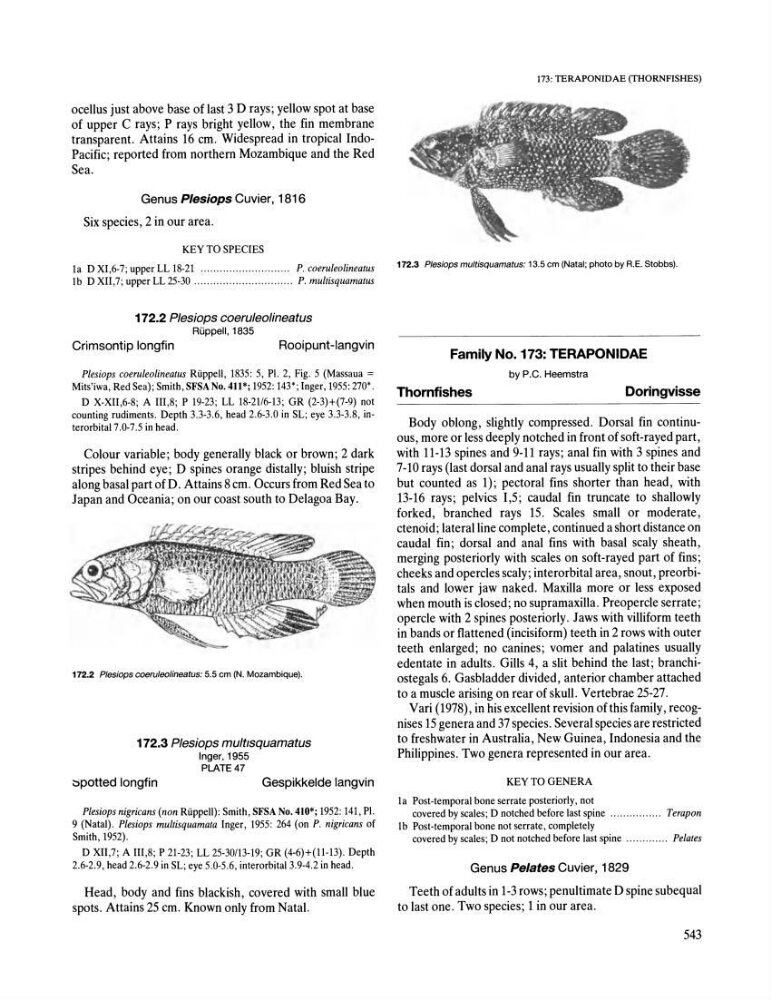
D XII,7; A III,8; P 21-23; LL 25-30/13-19; GR (4-6)+(11-13). Depth
2.6-2.9, head 2.6-2.9 in SL; eye 5.0-5 .6, interorbital 3.9-4.2 in head.
Head, body and fins blackish, covered with small blue
spots. Attains 25 cm. Known only from Natal.
173: TERAPONIDAE (THORNFISHES)
172.3 Plesiops multisquamatus: 13.5 em (Natal; photo by R.E. Stobbs).
Family No. 173: TERAPONIDAE
by P.C. Heemstra
Thornfishes
Doringvisse
Body oblong, slightly compressed. Dorsal fin continuous, more or less deeply notched in front of soft-rayed part,
with 11-13 spines and 9-11 rays; anal fin with 3 spines and
7 -10 rays (last dorsal and anal rays usually split to their base
but counted as 1); pectoral fins shorter than head, with
13-16 rays; pelvics 1,5; caudal fin truncate to shallowly
forked, branched rays 15. Scales small or moderate,
ctenoid; lateral line complete, continued a short distance on
caudal fin; dorsal and anal fins with basal scaly sheath,
merging posteriorly with scales on soft-rayed part of fins;
cheeks and opercles scaly; interorbital area, snout, preorbitals and lower jaw naked. Maxilla more or less exposed
when mouth is closed; no supramaxilla. Preopercle serrate;
opercle with 2 spines posteriorly. Jaws with villiform teeth
in bands or flattened (incisiform) teeth in 2 rows with outer
teeth enlarged; no canines; vomer and palatines usually
edentate in adults. Gills 4, a slit behind the last; branchiostegals 6. Gasbladder divided, anterior chamber attached
to a muscle arising on rear of skull. Vertebrae 25-27.
Vari (1978), in his excellent revision of this family, recognises 15 genera and 37 species. Several species are restricted
to freshwater in Australia, New Guinea, Indonesia and the
Philippines. Two genera represented in our area.
KEY TO GENERA
1a Post-temporal bone serrate posteriorly, not
covered by scales; D notched before last spine ....... ... ...... Terapon
Ib Post-temporal bone not serrate, completely
covered by scales; D not notched before last spine .. .. ......... Pelates
Genus Pelates Cuvier, 1829
Teeth of adults in 1-3 rows; penultimate D spine subequal
to last one. Two species; 1 in our area.
543
of upper Crays; P rays bright yellow, the fin membrane
transparent. Attains 16 cm. Widespread in tropical IndoPacific; reported from northern Mozambique and the Red
Sea.
Genus Plesiops Cuvier, 1816
Six species, 2 in our area.
KEY TO SPECIES
1a D XI,6-7; upper LL 18-21 ..... ... .................... P. coeruleolineatus
1b D XII,7; upper LL 25-30 ......... .. ......... ........ ... P. multisquamatus
172.2 Plesiops coeruleolineatus
Ruppel!,1835
Crimsontip longfin
Rooipunt-Iangvin
Plesiops coeruleolineatus Riippell, 1835: 5, PI. 2, Fig. 5 (Massaua =
Mits'iwa, Red Sea); Smith, SFSA No. 411*; 1952: 143*; Inger, 1955: 270'.
D X-XII,6-8; A III,8; P 19-23; LL 18-2116-13; GR (2-3)+(7-9) not
counting rudiments. Depth 3.3-3.6, head 2.6-3.0 in SL; eye 3.3-3.8, interorbitaI7.0-7.5 in head.
Colour variable; body generally black or brown; 2 dark
stripes behind eye; D spines orange distally; bluish stripe
along basal part of D. Attains 8 cm. Occurs from Red Sea to
Japan and Oceania; on our coast south to De\agoa Bay.
172.2 Plesiops coeruleolineatus: 5.5 em (N. Mozambique).
172.3 Plesiops multtsquamatus
Inger, 1955
PLATE 47
;:;potted longfin
Gespikkelde langvin
Plesiops nigricans (non Riippell): Smith, SFSA No. 410*; 1952: 141, PI.
9 (Natal). Plesiops multisquamata Inger, 1955: 264 (on P. nigricans of
Smith, 1952).
D XII,7; A III,8; P 21-23; LL 25-30/13-19; GR (4-6)+(11-13). Depth
2.6-2.9, head 2.6-2.9 in SL; eye 5.0-5 .6, interorbital 3.9-4.2 in head.
Head, body and fins blackish, covered with small blue
spots. Attains 25 cm. Known only from Natal.
173: TERAPONIDAE (THORNFISHES)
172.3 Plesiops multisquamatus: 13.5 em (Natal; photo by R.E. Stobbs).
Family No. 173: TERAPONIDAE
by P.C. Heemstra
Thornfishes
Doringvisse
Body oblong, slightly compressed. Dorsal fin continuous, more or less deeply notched in front of soft-rayed part,
with 11-13 spines and 9-11 rays; anal fin with 3 spines and
7 -10 rays (last dorsal and anal rays usually split to their base
but counted as 1); pectoral fins shorter than head, with
13-16 rays; pelvics 1,5; caudal fin truncate to shallowly
forked, branched rays 15. Scales small or moderate,
ctenoid; lateral line complete, continued a short distance on
caudal fin; dorsal and anal fins with basal scaly sheath,
merging posteriorly with scales on soft-rayed part of fins;
cheeks and opercles scaly; interorbital area, snout, preorbitals and lower jaw naked. Maxilla more or less exposed
when mouth is closed; no supramaxilla. Preopercle serrate;
opercle with 2 spines posteriorly. Jaws with villiform teeth
in bands or flattened (incisiform) teeth in 2 rows with outer
teeth enlarged; no canines; vomer and palatines usually
edentate in adults. Gills 4, a slit behind the last; branchiostegals 6. Gasbladder divided, anterior chamber attached
to a muscle arising on rear of skull. Vertebrae 25-27.
Vari (1978), in his excellent revision of this family, recognises 15 genera and 37 species. Several species are restricted
to freshwater in Australia, New Guinea, Indonesia and the
Philippines. Two genera represented in our area.
KEY TO GENERA
1a Post-temporal bone serrate posteriorly, not
covered by scales; D notched before last spine ....... ... ...... Terapon
Ib Post-temporal bone not serrate, completely
covered by scales; D not notched before last spine .. .. ......... Pelates
Genus Pelates Cuvier, 1829
Teeth of adults in 1-3 rows; penultimate D spine subequal
to last one. Two species; 1 in our area.
543