

171: PSEUDOGRAMMIDAE (PODGES)
Dull olive-yellow brown with darker blotches and dusky
brown fins. Iris yellow with dusky shading. Attains 10 cm;
Family No. 172: PLESIOPIDAE
from Kenya (4°43'S) to Sodwana Bay, around coral.
by P.C. Heemstra
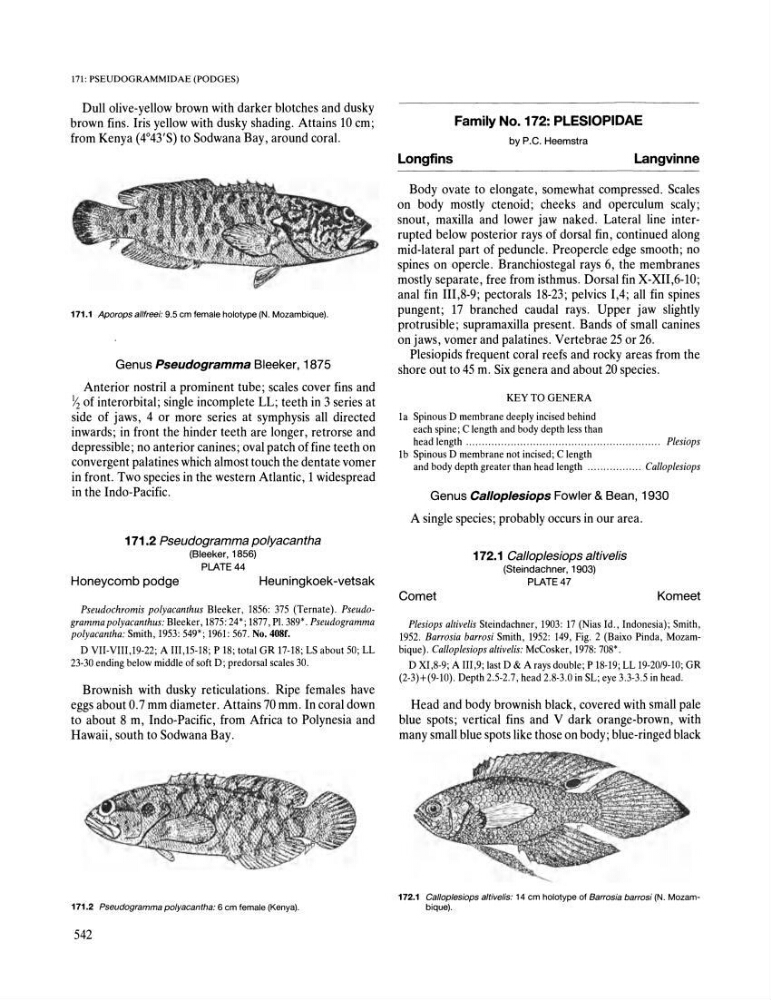
171.1 Aporops al/freei.· 9.5 em female holotype (N. Mozambique).
Genus Pseudogramma Bleeker, 1875
Anterior nostril a prominent tube; scales cover fins and
~ of interorbital; single incomplete LL; teeth in 3 series at
side of jaws, 4 or more series at symphysis all directed
inwards; in front the hinder teeth are longer, retrorse and
depressible; no anterior canines; oval patch of fine teeth on
convergent palatines which almost touch the dentate vomer
in front. Two species in the western Atlantic, 1 widespread
in the Indo-Pacific.
171.2 Pseudogramma polyacantha
(Bleeker, 1856)
PLATE 44
Honeycomb podge
Heuningkoek-vetsak
Pseudochromis polyacanthus Bleeker, 1856: 375 (Ternate). Pseudogramma polyacanthus: Bleeker, 1875: 24 *; 1877, PI. 389*. Pseudogramma
polyacantha: Smith, 1953: 549*; 1961: 567. No. 40Sf.
D VII-VIII,19-22; A 1Il,15-18; P 18; total GR 17-18; LS about 50; LL
23-30 ending below middle of soft D; predorsal scales 30.
Brownish with dusky reticulations. Ripe females have
eggs about 0.7 mm diameter. Attains 70 mm. In coral down
to about 8 m, Indo-Pacific, from Africa to Polynesia and
Hawaii, south to Sodwana Bay.
171.2 Pseudogramma po/yacantha: 6 em female (Kenya).
542
Longfins
Langvinne
Body ovate to elongate, somewhat compressed. Scales
on body mostly ctenoid; cheeks and operculum scaly;
snout, maxilla and lower jaw naked. Lateral line interrupted below posterior rays of dorsal fin, continued along
mid-lateral part of peduncle. Preopercle edge smooth; no
spines on opercle. Branchiostegal rays 6, the membranes
mostly separate, free from isthmus. Dorsal fin X-XII,6-1O;
anal fin III,8-9; pectorals 18-23; pelvics 1,4; all fin spines
pungent; 17 branched caudal rays. Upper jaw slightly
protrusible; supramaxilla present. Bands of small canines
on jaws, vomer and palatines. Vertebrae 25 or 26.
Plesiopids frequent coral reefs and rocky areas from the
shore out to 45 m. Six genera and about 20 species.
KEY TO GENERA
1a Spinous D membrane deeply incised behind
each spine; C length and body depth less than
head length............................................................. Plesiops
Ib Spinous D membrane not incised; C length
and body depth greater than head length ................. Cal/oplesiops
Genus Cal/op/esiops Fowler & Bean, 1930
A single species; probably occurs in our area.
Comet
172.1 Ca/loplesiops altivelis
(Steindachner, 1903)
PLATE 47
Komeet
Plesiops altivelis Steindachner, 1903: 17 (Nias Id., Indonesia); Smith,
1952. Barrosia barrosi Smith, 1952: 149, Fig. 2 (Baixo Pinda, Mozambique). Cal/oplesiops altivelis: McCosker, 1978: 708*.
D XI,8-9; A III ,9; last D & A rays double; P 18-19; LL 19-20/9-10; GR
(2-3)+(9-10). Depth 2.5-2.7, head 2.8-3.0 in SL; eye 3.3-3.5 in head.
Head and body brownish black, covered with small pale
blue spots; vertical fins and V dark orange-brown, with
many small blue spots like those on body; blue-ringed black
172.1 Cal/op/esiops a/tivelis: 14 em holotype of Barrosia barrosi (N. Mozambique).
Dull olive-yellow brown with darker blotches and dusky
brown fins. Iris yellow with dusky shading. Attains 10 cm;
Family No. 172: PLESIOPIDAE
from Kenya (4°43'S) to Sodwana Bay, around coral.
by P.C. Heemstra
171.1 Aporops al/freei.· 9.5 em female holotype (N. Mozambique).
Genus Pseudogramma Bleeker, 1875
Anterior nostril a prominent tube; scales cover fins and
~ of interorbital; single incomplete LL; teeth in 3 series at
side of jaws, 4 or more series at symphysis all directed
inwards; in front the hinder teeth are longer, retrorse and
depressible; no anterior canines; oval patch of fine teeth on
convergent palatines which almost touch the dentate vomer
in front. Two species in the western Atlantic, 1 widespread
in the Indo-Pacific.
171.2 Pseudogramma polyacantha
(Bleeker, 1856)
PLATE 44
Honeycomb podge
Heuningkoek-vetsak
Pseudochromis polyacanthus Bleeker, 1856: 375 (Ternate). Pseudogramma polyacanthus: Bleeker, 1875: 24 *; 1877, PI. 389*. Pseudogramma
polyacantha: Smith, 1953: 549*; 1961: 567. No. 40Sf.
D VII-VIII,19-22; A 1Il,15-18; P 18; total GR 17-18; LS about 50; LL
23-30 ending below middle of soft D; predorsal scales 30.
Brownish with dusky reticulations. Ripe females have
eggs about 0.7 mm diameter. Attains 70 mm. In coral down
to about 8 m, Indo-Pacific, from Africa to Polynesia and
Hawaii, south to Sodwana Bay.
171.2 Pseudogramma po/yacantha: 6 em female (Kenya).
542
Longfins
Langvinne
Body ovate to elongate, somewhat compressed. Scales
on body mostly ctenoid; cheeks and operculum scaly;
snout, maxilla and lower jaw naked. Lateral line interrupted below posterior rays of dorsal fin, continued along
mid-lateral part of peduncle. Preopercle edge smooth; no
spines on opercle. Branchiostegal rays 6, the membranes
mostly separate, free from isthmus. Dorsal fin X-XII,6-1O;
anal fin III,8-9; pectorals 18-23; pelvics 1,4; all fin spines
pungent; 17 branched caudal rays. Upper jaw slightly
protrusible; supramaxilla present. Bands of small canines
on jaws, vomer and palatines. Vertebrae 25 or 26.
Plesiopids frequent coral reefs and rocky areas from the
shore out to 45 m. Six genera and about 20 species.
KEY TO GENERA
1a Spinous D membrane deeply incised behind
each spine; C length and body depth less than
head length............................................................. Plesiops
Ib Spinous D membrane not incised; C length
and body depth greater than head length ................. Cal/oplesiops
Genus Cal/op/esiops Fowler & Bean, 1930
A single species; probably occurs in our area.
Comet
172.1 Ca/loplesiops altivelis
(Steindachner, 1903)
PLATE 47
Komeet
Plesiops altivelis Steindachner, 1903: 17 (Nias Id., Indonesia); Smith,
1952. Barrosia barrosi Smith, 1952: 149, Fig. 2 (Baixo Pinda, Mozambique). Cal/oplesiops altivelis: McCosker, 1978: 708*.
D XI,8-9; A III ,9; last D & A rays double; P 18-19; LL 19-20/9-10; GR
(2-3)+(9-10). Depth 2.5-2.7, head 2.8-3.0 in SL; eye 3.3-3.5 in head.
Head and body brownish black, covered with small pale
blue spots; vertical fins and V dark orange-brown, with
many small blue spots like those on body; blue-ringed black
172.1 Cal/op/esiops a/tivelis: 14 em holotype of Barrosia barrosi (N. Mozambique).