

174: PRIACANTHIDAE (BIGEYES)
Genus Pristigenys Agassiz, 1835
Middle D spines longest; V shorter than or subequal to
head length; A base shorter than head. Four species, 1 in
our area.
174.4 Pristigenys niphonia
(Cuvier, 1829)
PLATE 47
Japanese bigeye
Japanse grootoog
Priacanthus niphonius Cuvier, in Cuv. & Val. , 1829: 107 (Japan) .
Pseudopriacanthus niphonius: Smith, 1953: 517, No. 406a. Pristigenys
niphonia: Smith , 1966* ; Masuda et aI., 1975: 208*.
D X,1l-12; A II ,lO-11 ; P 18-19; LL 36-38; GR (7-8)+(16-20) . Depth
1.9-2.1 ; head 2.4-2.6 in SL. Eye 1.9-2.1 and bony interorbital width
5.9-6.4 in head .
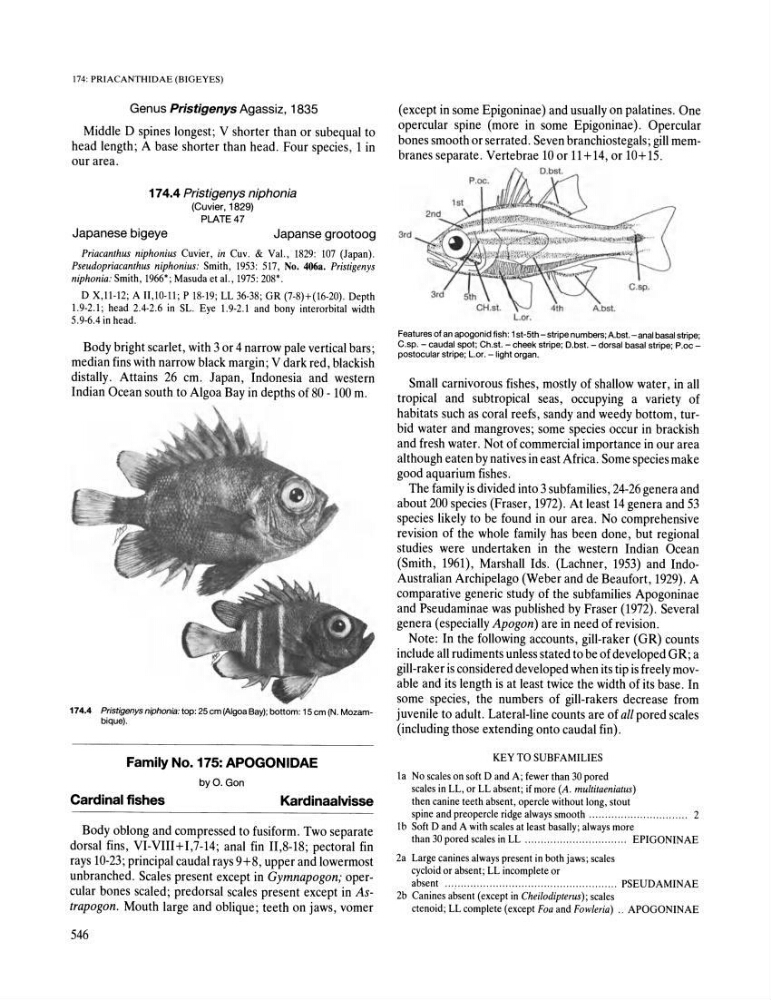
Body bright scarlet, with 3 or 4 narrow pale vertical bars;
median fins with narrow black margin; V dark red, blackish
distally. Attains 26 cm. Japan, Indonesia and western
Indian Ocean south to Algoa Bay in depths of SO - 100 m.
174.4 Pristigenys niphonia: top: 25 cm (Algoa Bay); bottom: 15 cm (N. Mozambique).
Family No. 175: APOGONIDAE
byO. Gon
Cardinal fishes
Kardinaalvisse
Body oblong and compressed to fusiform. Two separate
dorsal fins, VI-VIII+I,7-14; anal fin II,S-lS; pectoral fin
rays 10-23; principal caudal rays 9+S, upper and lowermost
unbranched. Scales present except in Gymnapogon; opercular bones scaled; pre dorsal scales present except in Astrapogon. Mouth large and oblique; teeth on jaws, vomer
546
(except in some Epigoninae) and usually on palatines. One
opercular spine (more in some Epigoninae). Opercular
bones smooth or serrated. Seven branchiostegals; gill membranes separate. Vertebrae 10 or 11 + 14, or 10+ 15.
3rd
L.or.
Features of an apogonid fish : 1st-5th - stripe numbers; A.bst. - anal basal stripe;
C.sp. - caudal spot; Ch.st. - cheek stripe; D.bst. - dorsal basal stripe; P.ocpostocular stripe; L.or. -light organ .
Small carnivorous fishes, mostly of shallow water, in all
tropical and subtropical seas, occupying a variety of
habitats such as coral reefs, sandy and weedy bottom, turbid water and mangroves; some species occur in brackish
and fresh water. Not of commercial importance in our area
although eaten by natives in east Africa. Some species make
good aquarium fishes.
The family is divided into 3 subfamilies, 24-26 genera and
about 200 species (Fraser, 1972). At least 14 genera and 53
species likely to be found in our area. No comprehensive
revision of the whole family has been done , but regional
studies were undertaken in the western Indian Ocean
(Smith , 1961), Marshall Ids. (Lachner, 1953) and IndoAustralian Archipelago (Weber and de Beaufort, 1929). A
comparative generic study of the subfamilies Apogoninae
and Pseudaminae was published by Fraser (1972). Several
genera (especially Apogon) are in need of revision.
Note: In the following accounts, gill-raker (GR) counts
include all rudiments unless stated to be of developed GR; a
gill-raker is considered developed when its tip is freely movable and its length is at least twice the width of its base . In
some species, the numbers of gill-rakers decrease from
juvenile to adult. Lateral-line counts are of all pored scales
(including those extending onto caudal fin).
KEY TO SUBFAMILIES
la No scales on soft D and A; fewer than 30 pored
scales in LL, or LL absent ; if more (A. multitaeniatus)
then canine teeth absent, opercle without long, stout
spine and preopercle ridge always smooth .. .. ...... ... ...... ... ..... .... 2
Ib Soft D and A with scales at least basally; always more
than 30 pored scales in LL ....... ... ... ... .. ..... ... ... ... EPIGONINAE
2a Large canines always present in both jaws; scales
cycloid or absent; LL incomplete or
absent ..... .... .... ... ....... ...... .............. ...... .... . PSEUDAMINAE
2b Canines absent (except in Cheilodipterus) ; scales
ctenoid ; LL complete (except Foa and Fowleria) .. APOGONINAE
Genus Pristigenys Agassiz, 1835
Middle D spines longest; V shorter than or subequal to
head length; A base shorter than head. Four species, 1 in
our area.
174.4 Pristigenys niphonia
(Cuvier, 1829)
PLATE 47
Japanese bigeye
Japanse grootoog
Priacanthus niphonius Cuvier, in Cuv. & Val. , 1829: 107 (Japan) .
Pseudopriacanthus niphonius: Smith, 1953: 517, No. 406a. Pristigenys
niphonia: Smith , 1966* ; Masuda et aI., 1975: 208*.
D X,1l-12; A II ,lO-11 ; P 18-19; LL 36-38; GR (7-8)+(16-20) . Depth
1.9-2.1 ; head 2.4-2.6 in SL. Eye 1.9-2.1 and bony interorbital width
5.9-6.4 in head .
Body bright scarlet, with 3 or 4 narrow pale vertical bars;
median fins with narrow black margin; V dark red, blackish
distally. Attains 26 cm. Japan, Indonesia and western
Indian Ocean south to Algoa Bay in depths of SO - 100 m.
174.4 Pristigenys niphonia: top: 25 cm (Algoa Bay); bottom: 15 cm (N. Mozambique).
Family No. 175: APOGONIDAE
byO. Gon
Cardinal fishes
Kardinaalvisse
Body oblong and compressed to fusiform. Two separate
dorsal fins, VI-VIII+I,7-14; anal fin II,S-lS; pectoral fin
rays 10-23; principal caudal rays 9+S, upper and lowermost
unbranched. Scales present except in Gymnapogon; opercular bones scaled; pre dorsal scales present except in Astrapogon. Mouth large and oblique; teeth on jaws, vomer
546
(except in some Epigoninae) and usually on palatines. One
opercular spine (more in some Epigoninae). Opercular
bones smooth or serrated. Seven branchiostegals; gill membranes separate. Vertebrae 10 or 11 + 14, or 10+ 15.
3rd
L.or.
Features of an apogonid fish : 1st-5th - stripe numbers; A.bst. - anal basal stripe;
C.sp. - caudal spot; Ch.st. - cheek stripe; D.bst. - dorsal basal stripe; P.ocpostocular stripe; L.or. -light organ .
Small carnivorous fishes, mostly of shallow water, in all
tropical and subtropical seas, occupying a variety of
habitats such as coral reefs, sandy and weedy bottom, turbid water and mangroves; some species occur in brackish
and fresh water. Not of commercial importance in our area
although eaten by natives in east Africa. Some species make
good aquarium fishes.
The family is divided into 3 subfamilies, 24-26 genera and
about 200 species (Fraser, 1972). At least 14 genera and 53
species likely to be found in our area. No comprehensive
revision of the whole family has been done , but regional
studies were undertaken in the western Indian Ocean
(Smith , 1961), Marshall Ids. (Lachner, 1953) and IndoAustralian Archipelago (Weber and de Beaufort, 1929). A
comparative generic study of the subfamilies Apogoninae
and Pseudaminae was published by Fraser (1972). Several
genera (especially Apogon) are in need of revision.
Note: In the following accounts, gill-raker (GR) counts
include all rudiments unless stated to be of developed GR; a
gill-raker is considered developed when its tip is freely movable and its length is at least twice the width of its base . In
some species, the numbers of gill-rakers decrease from
juvenile to adult. Lateral-line counts are of all pored scales
(including those extending onto caudal fin).
KEY TO SUBFAMILIES
la No scales on soft D and A; fewer than 30 pored
scales in LL, or LL absent ; if more (A. multitaeniatus)
then canine teeth absent, opercle without long, stout
spine and preopercle ridge always smooth .. .. ...... ... ...... ... ..... .... 2
Ib Soft D and A with scales at least basally; always more
than 30 pored scales in LL ....... ... ... ... .. ..... ... ... ... EPIGONINAE
2a Large canines always present in both jaws; scales
cycloid or absent; LL incomplete or
absent ..... .... .... ... ....... ...... .............. ...... .... . PSEUDAMINAE
2b Canines absent (except in Cheilodipterus) ; scales
ctenoid ; LL complete (except Foa and Fowleria) .. APOGONINAE