

160: PSYCHROLUTIOAE (FATHEADS)
KEY TO SPECIES
la Terminal chin pore single . .... . .... . . . . . . . . .. P. inermis
Ib Terminal chin pore paired ... . .. .. .. .. . " P. macrocephalus
160.3 Psychrolutes inermis
(Vaillant, 1888)
Cottunculus inermis Vaillant, 1888: 365 , PI. 28, Fig. 2 (Banc d' Arguin,
Mauritania). Psychrolutes inermis: Nelson, 1982: 1489* (in part).
Similar in meristic and morphometric characters to P. macrocephalus.
Differs from P. macrocephalus in having a minute, unpaired terminal chin
pore and in one of the head bones (also appears to occur in deeper water
and attain a larger size) .
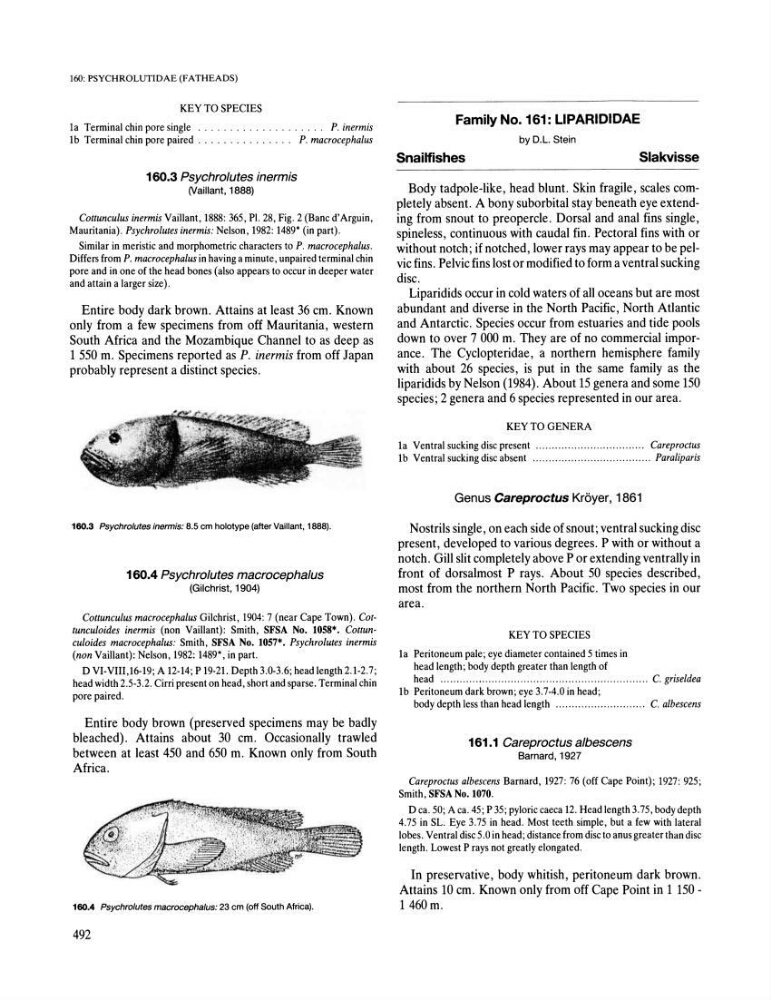
Entire body dark brown. Attains at least 36 cm. Known
only from a few specimens from off Mauritania, western
South Africa and the Mozambique Channel to as deep as
1 550 m. Specimens reported as P. inermis from off Japan
probably represent a distinct species.
160.3 Psychrolutes inermis: 6.5 cm holotype (after Vaillant. 1666).
160.4 Psychrolutes macrocephalus
(Gilchrist, 1904)
Cottunculus macrocephalus Gilchrist, 1904: 7 (near Cape Town). Cottunculoides inermis (non Vaillant): Smith, SFSA No. 1058*. Cottunculoides macrocephalus: Smith, SFSA No. 1057*. Psychrolutes inermis
(non Vaillant) : Nelson , 1982: 1489* , in part.
D VI-VIII,16-19; A 12-14; P 19-21. Depth 3.0-3.6; head length 2.1-2.7;
head width 2.5-3.2. Cirri present on head, short and sparse . Terminal chin
pore paired.
Entire body brown (preserved specimens may be badly
bleached). Attains about 30 cm. Occasionally trawled
between at least 450 and 650 m. Known only from South
Africa.
160.4 Psychrolutes macrocephalus: 23 cm (off South Africa).
492
Family No. 161: LlPARIDIDAE
by D.L. Stein
Snailfishes
Slakvisse
Body tadpole-like, head blunt. Skin fragile, scales completely absent. A bony suborbital stay beneath eye extending from snout to preoperc1e. Dorsal and anal fins single,
spineless, continuous with caudal fin. Pectoral fins with or
without notch; if notched, lower rays may appear to be pelvic fins. Pelvic fins lost or modified to form a ventral sucking
disc.
Liparidids occur in cold waters of all oceans but are most
abundant and diverse in the North Pacific, North Atlantic
and Antarctic. Species occur from estuaries and tide pools
down to over 7 000 m. They are of no commercial imporance . The Cyc1opteridae, a northern hemisphere family
with about 26 species, is put in the same family as the
liparidids by Nelson (1984) . About 15 genera and some 150
species; 2 genera and 6 species represented in our area.
KEY TO GENERA
la Ventral sucking disc present ....... ...... .. .. ... .. .. .. .. ... .. . Careproctus
Ib Ventral sucking disc absent .. .. ..... .................. ......... . Paraliparis
Genus Careproctus Kroyer, 1861
Nostrils single , on each side of snout; ventral sucking disc
present, developed to various degrees. P with or without a
notch. Gill slit completely above P or extending ventrally in
front of dorsal most P rays. About 50 species described ,
most from the northern North Pacific. Two species in our
area.
KEY TO SPECIES
la Peritoneum pale ; eye diameter contained 5 times in
head length ; body depth greater than length of
head .. ... .... .. ................. ... ... ....... ..... ..... .. ... ......... C. griseldea
Ib Peritoneum dark brown ; eye 3.7-4.0 in head;
body depth less than head length .... ...... ...... ...... .... .. C. albescens
161.1 Careproctus albescens
Barnard. 1927
Careproctus albescens Barnard, 1927: 76 (off Cape Point); 1927: 925 ;
Smith , SFSA No. 1070.
Dca. 50; A ca. 45; P 35; pyloric caeca 12. Head length 3.75 , body depth
4.75 in SL. Eye 3.75 in head. Most teeth simple , but a few with lateral
lobes. Ventral disc 5.0 in head; distance from disc to anus greater than disc
length . Lowest P rays not greatly elongated.
In preservative, body whitish, peritoneum dark brown.
Attains 10 cm. Known only from off Cape Point in 1 1501460 m.
KEY TO SPECIES
la Terminal chin pore single . .... . .... . . . . . . . . .. P. inermis
Ib Terminal chin pore paired ... . .. .. .. .. . " P. macrocephalus
160.3 Psychrolutes inermis
(Vaillant, 1888)
Cottunculus inermis Vaillant, 1888: 365 , PI. 28, Fig. 2 (Banc d' Arguin,
Mauritania). Psychrolutes inermis: Nelson, 1982: 1489* (in part).
Similar in meristic and morphometric characters to P. macrocephalus.
Differs from P. macrocephalus in having a minute, unpaired terminal chin
pore and in one of the head bones (also appears to occur in deeper water
and attain a larger size) .
Entire body dark brown. Attains at least 36 cm. Known
only from a few specimens from off Mauritania, western
South Africa and the Mozambique Channel to as deep as
1 550 m. Specimens reported as P. inermis from off Japan
probably represent a distinct species.
160.3 Psychrolutes inermis: 6.5 cm holotype (after Vaillant. 1666).
160.4 Psychrolutes macrocephalus
(Gilchrist, 1904)
Cottunculus macrocephalus Gilchrist, 1904: 7 (near Cape Town). Cottunculoides inermis (non Vaillant): Smith, SFSA No. 1058*. Cottunculoides macrocephalus: Smith, SFSA No. 1057*. Psychrolutes inermis
(non Vaillant) : Nelson , 1982: 1489* , in part.
D VI-VIII,16-19; A 12-14; P 19-21. Depth 3.0-3.6; head length 2.1-2.7;
head width 2.5-3.2. Cirri present on head, short and sparse . Terminal chin
pore paired.
Entire body brown (preserved specimens may be badly
bleached). Attains about 30 cm. Occasionally trawled
between at least 450 and 650 m. Known only from South
Africa.
160.4 Psychrolutes macrocephalus: 23 cm (off South Africa).
492
Family No. 161: LlPARIDIDAE
by D.L. Stein
Snailfishes
Slakvisse
Body tadpole-like, head blunt. Skin fragile, scales completely absent. A bony suborbital stay beneath eye extending from snout to preoperc1e. Dorsal and anal fins single,
spineless, continuous with caudal fin. Pectoral fins with or
without notch; if notched, lower rays may appear to be pelvic fins. Pelvic fins lost or modified to form a ventral sucking
disc.
Liparidids occur in cold waters of all oceans but are most
abundant and diverse in the North Pacific, North Atlantic
and Antarctic. Species occur from estuaries and tide pools
down to over 7 000 m. They are of no commercial imporance . The Cyc1opteridae, a northern hemisphere family
with about 26 species, is put in the same family as the
liparidids by Nelson (1984) . About 15 genera and some 150
species; 2 genera and 6 species represented in our area.
KEY TO GENERA
la Ventral sucking disc present ....... ...... .. .. ... .. .. .. .. ... .. . Careproctus
Ib Ventral sucking disc absent .. .. ..... .................. ......... . Paraliparis
Genus Careproctus Kroyer, 1861
Nostrils single , on each side of snout; ventral sucking disc
present, developed to various degrees. P with or without a
notch. Gill slit completely above P or extending ventrally in
front of dorsal most P rays. About 50 species described ,
most from the northern North Pacific. Two species in our
area.
KEY TO SPECIES
la Peritoneum pale ; eye diameter contained 5 times in
head length ; body depth greater than length of
head .. ... .... .. ................. ... ... ....... ..... ..... .. ... ......... C. griseldea
Ib Peritoneum dark brown ; eye 3.7-4.0 in head;
body depth less than head length .... ...... ...... ...... .... .. C. albescens
161.1 Careproctus albescens
Barnard. 1927
Careproctus albescens Barnard, 1927: 76 (off Cape Point); 1927: 925 ;
Smith , SFSA No. 1070.
Dca. 50; A ca. 45; P 35; pyloric caeca 12. Head length 3.75 , body depth
4.75 in SL. Eye 3.75 in head. Most teeth simple , but a few with lateral
lobes. Ventral disc 5.0 in head; distance from disc to anus greater than disc
length . Lowest P rays not greatly elongated.
In preservative, body whitish, peritoneum dark brown.
Attains 10 cm. Known only from off Cape Point in 1 1501460 m.