

Family No. 160: PSYCHROLUTIDAE
by J.S. Nelson
Fatheads
Vetkoppe
Large head, body tapers abruptly behind (fish generally
tadpole-shaped). Skin loose in most species (usually covering dorsal and anal fins, making it difficult to count rays).
Body naked (in South African species) or with plates bearing prickles; cirri present or absent. Interorbital space wide,
usually much greater than exposed eye diameter. Most
species with continuous dorsal fin, first portion spiny and
often hidden in skin. Pelvic fins small and slender, with 1
minute spine and 3 soft-rays. Lateral line with 20 or fewer
pores (may be microscopic). Conical teeth in several rows
on upper and lower jaws; teeth present or absent on head of
vomer. System of well-developed bony arches under skin
on cranium which mayor may not bear well-developed
spines. Colour usually brown or in shades of black and
white.
Adults usually benthic and trawled between 100 and 1600
m. About 7 genera with 29 species, 4 in our area. The South
African species were formerly in the nominal Family Cottunculidae (now placed in synonymy with Psychrolutidae).
Some workers prefer to include Psychrolutidae in Cottidae.
The systematics of several genera in this family, particularly
Ebinania and Psychrolutes of South African genera, are
poorly known and the species composition is subject to
change. Reviewed, in part, by Nelson (1977,1982).
KEY TO GENERA
la Interorbital area with spines; vomerine teeth
present in adults (may be absent in specimens
under about 8 cm) ........................ Cottunculus
1b Interorbital area smooth (convex, soft, and without
spines); vomerine teeth present or absent ................ 2
2a Vomerine teeth present ...................... Ebinania
2b Vomerine teeth absent ............. . ... . ... Psychrolutes
Genus Cottunculus Collett, 1875
Five species; 1 in our area.
160.1 Cottunculus spinosus
Gilchrist, 1906
Cottunculus spinosus Gilchrist, 1906: 149, PI. 38 (Cape Point); Gilchrist, 1922: 78; Nelson, 1982: 1473. Cottunculoides spinosus: Barnard,
1927: 924; Smith, SFSA No. 1056*.
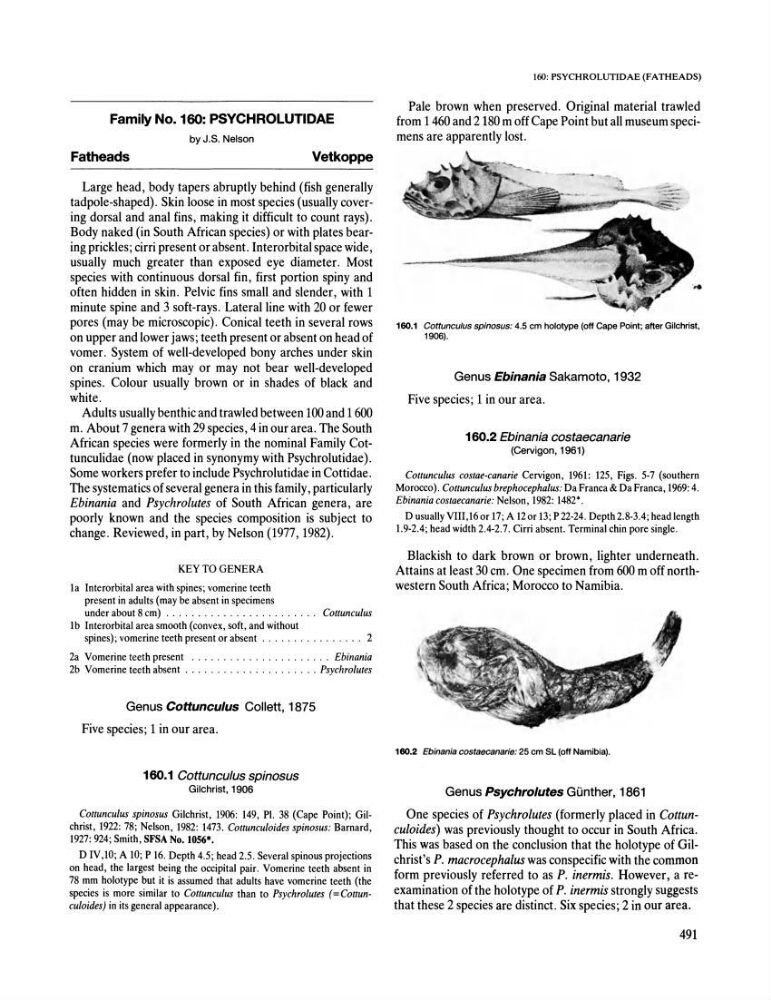
D IV,lO; A 10; P 16. Depth 4.5; head 2.5. Several spinous projections
on head, the largest being the occipital pair. Vomerine teeth absent in
78 mm holotype but it is assumed that adults have vomerine teeth (the
species is more similar to Cottunculus than to Psychrolutes (= Cottunculoides) in its general appearance).
160: PSYCHROLUTIDAE (FATHEADS)
Pale brown when preserved. Original material trawled
from 1 460 and 2 180 m off Cape Point but all museum specimens are apparently lost.
160.1 Cottunculus spinosus: 4.5 em holotype (off Cape Point; after Gilchrist,
1906).
Genus Ebinania Sakamoto, 1932
Five species; 1 in our area.
160.2 Ebinania costaecanarie
(Cervigon, 1961)
Cottunculus costae-canarie Cervigon, 1961: 125, Figs. 5-7 (southern
Morocco). Cottunculus brephocephalus: Da Franca & Da Franca, 1969: 4.
Ebinania costaecanarie: Nelson, 1982: 1482*.
D usually VIII,16 or 17; A 120r 13; P22-24. Depth 2.8-3.4; head length
1. 9-2.4; head width 2.4-2.7. Cirri absent. Terminal chin pore single.
Blackish to dark brown or brown, lighter underneath.
Attains at least 30 cm. One specimen from 600 m off northwestern South Africa; Morocco to Namibia.
160.2 Ebinania costaecanarie: 25 em SL (off Namibia).
Genus Psychrolutes Gunther, 1861
One species of Psychrolutes (formerly placed in Cottunculoides) was previously thought to occur in South Africa.
This was based on the conclusion that the holotype of Gilchrist's P. macrocephalus was conspecific with the common
form previously referred to as P. inermis. However, a reexamination of the holotype of P. inermis strongly suggests
that these 2 species are distinct. Six species; 2 in our area.
491
by J.S. Nelson
Fatheads
Vetkoppe
Large head, body tapers abruptly behind (fish generally
tadpole-shaped). Skin loose in most species (usually covering dorsal and anal fins, making it difficult to count rays).
Body naked (in South African species) or with plates bearing prickles; cirri present or absent. Interorbital space wide,
usually much greater than exposed eye diameter. Most
species with continuous dorsal fin, first portion spiny and
often hidden in skin. Pelvic fins small and slender, with 1
minute spine and 3 soft-rays. Lateral line with 20 or fewer
pores (may be microscopic). Conical teeth in several rows
on upper and lower jaws; teeth present or absent on head of
vomer. System of well-developed bony arches under skin
on cranium which mayor may not bear well-developed
spines. Colour usually brown or in shades of black and
white.
Adults usually benthic and trawled between 100 and 1600
m. About 7 genera with 29 species, 4 in our area. The South
African species were formerly in the nominal Family Cottunculidae (now placed in synonymy with Psychrolutidae).
Some workers prefer to include Psychrolutidae in Cottidae.
The systematics of several genera in this family, particularly
Ebinania and Psychrolutes of South African genera, are
poorly known and the species composition is subject to
change. Reviewed, in part, by Nelson (1977,1982).
KEY TO GENERA
la Interorbital area with spines; vomerine teeth
present in adults (may be absent in specimens
under about 8 cm) ........................ Cottunculus
1b Interorbital area smooth (convex, soft, and without
spines); vomerine teeth present or absent ................ 2
2a Vomerine teeth present ...................... Ebinania
2b Vomerine teeth absent ............. . ... . ... Psychrolutes
Genus Cottunculus Collett, 1875
Five species; 1 in our area.
160.1 Cottunculus spinosus
Gilchrist, 1906
Cottunculus spinosus Gilchrist, 1906: 149, PI. 38 (Cape Point); Gilchrist, 1922: 78; Nelson, 1982: 1473. Cottunculoides spinosus: Barnard,
1927: 924; Smith, SFSA No. 1056*.
D IV,lO; A 10; P 16. Depth 4.5; head 2.5. Several spinous projections
on head, the largest being the occipital pair. Vomerine teeth absent in
78 mm holotype but it is assumed that adults have vomerine teeth (the
species is more similar to Cottunculus than to Psychrolutes (= Cottunculoides) in its general appearance).
160: PSYCHROLUTIDAE (FATHEADS)
Pale brown when preserved. Original material trawled
from 1 460 and 2 180 m off Cape Point but all museum specimens are apparently lost.
160.1 Cottunculus spinosus: 4.5 em holotype (off Cape Point; after Gilchrist,
1906).
Genus Ebinania Sakamoto, 1932
Five species; 1 in our area.
160.2 Ebinania costaecanarie
(Cervigon, 1961)
Cottunculus costae-canarie Cervigon, 1961: 125, Figs. 5-7 (southern
Morocco). Cottunculus brephocephalus: Da Franca & Da Franca, 1969: 4.
Ebinania costaecanarie: Nelson, 1982: 1482*.
D usually VIII,16 or 17; A 120r 13; P22-24. Depth 2.8-3.4; head length
1. 9-2.4; head width 2.4-2.7. Cirri absent. Terminal chin pore single.
Blackish to dark brown or brown, lighter underneath.
Attains at least 30 cm. One specimen from 600 m off northwestern South Africa; Morocco to Namibia.
160.2 Ebinania costaecanarie: 25 em SL (off Namibia).
Genus Psychrolutes Gunther, 1861
One species of Psychrolutes (formerly placed in Cottunculoides) was previously thought to occur in South Africa.
This was based on the conclusion that the holotype of Gilchrist's P. macrocephalus was conspecific with the common
form previously referred to as P. inermis. However, a reexamination of the holotype of P. inermis strongly suggests
that these 2 species are distinct. Six species; 2 in our area.
491