

158: PERISTEDIIDAE (ARMOURED GURNARDS)
cm. Off Durban in 550 m. Miller (1974) reckons this species
may be synonymous with Peristethus hians Gilbert &
Cramer (1897).
Family No. 159: DACTYLOPTERIDAE
by W.N. Eschmeyer
Helmet gumards
Helmknorhane
Body squarish, tapering behind. Head large, blunt, with
bones united to form a bony helmet; preopercle spine very
long. Mouth small, on underside of head.
Although these benthic fishes are often called "flying
gurnards", they cannot fly or glide out of the water. The
greatly enlarged pectoral fins have led to the erroneous
impression, often repeated in books on fishes, that dactylopterids are able to fly or glide in air in the manner of the
true flying fishes (Family Exocoetidae). The body is heavy
and the fins weak, and dactylopterids probably use their
pectoral fins in defence displays, courtship or possibly feeding behaviour; the greatly enlarged fins of most gurnards
(Family Triglidae) and some scorpionfishes (Family Scorpaenidae) are probably used in the same ways. Two genera
and 7 species; 1 genus in our area; genus Dactylopterus confined to the Atlantic. Family reviewed by Eschmeyer (in
press).
Genus Dactyloptena Jordan & Richardson, 1908
Indo-Pacific. Six species, 2 in our area.
KEY TO SPECIES
la Two free D spines, 1st just behind head, 2nd
midway between 1st spine and remainder of
spinous D ............................. D. orientalis
Ib One free D spine (just behind head), then a
wide gap to remainder of spinous D ............ D. peterseni
159.1 Dactyloptena orientalis
(Cuvier, 1829)
PLATE 31
Helmet Qurnard
Helmknorhaan
Dactylopterus orientalis Cuvier, in Cuv. & Val., 1829: 134, PI. 86
(India). Dactyloptena orientalis: Smith, SFSA No. 1076·.
D 1+ 1+ V +i,8; A 6; P 32-35.
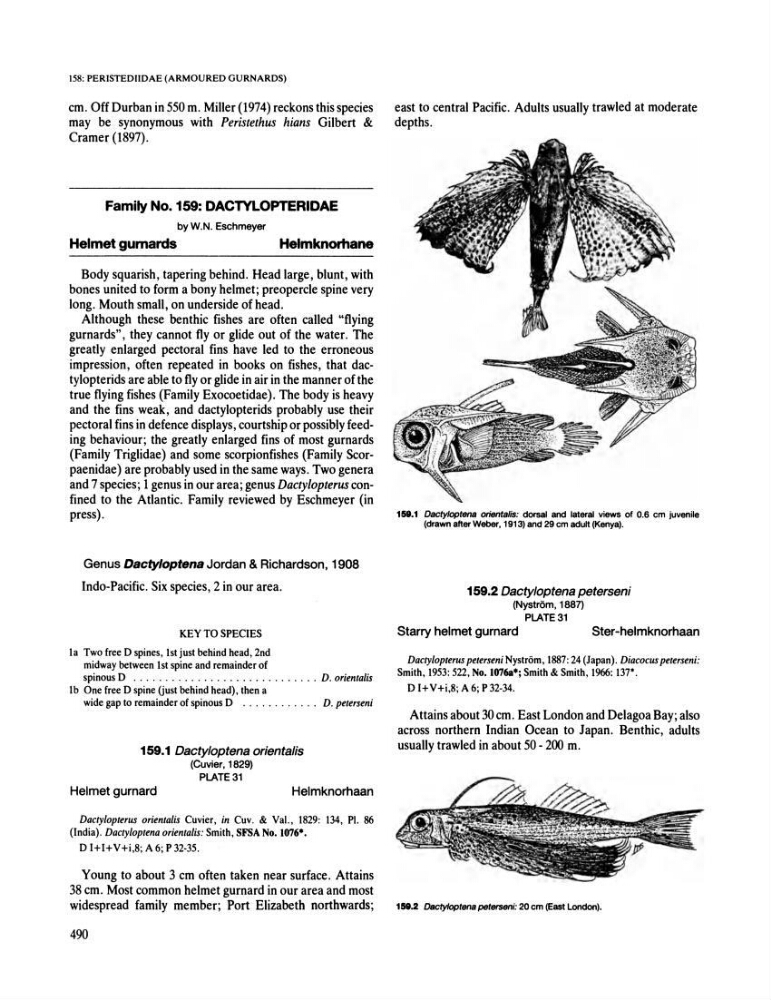
Young to about 3 cm often taken near surface. Attains
38 cm. Most common helmet gurnard in our area and most
widespread family member; Port Elizabeth northwards;
490
east to central Pacific. Adults usually trawled at moderate
depths.
159.1 Dactyloptens orienta/is: dorsal and lateral views of 0.6 em juvenile
(drawn after Weber, 1913) and 29 em adult (Kenya).
159.2 Dactyloptena peterseni
(Nystrom, 1887)
PLATE 31
Starry helmet Qurnard
Ster-helmknorhaan
Dactylopterus peterseni Nystrom, 1887: 24 (Japan). Diacocus peterseni:
Smith, 1953: 522, No. 1076&·; Smith & Smith, 1966: 137*.
D 1+ V +i,8; A 6; P 32-34.
Attains about 30 cm. East London and Delagoa Bay; also
across northern Indian Ocean to Japan. Benthic, adults
usually trawled in about 50 - 200 m.
159.2 Dactyloptena peterseni: 20 em (East London).
cm. Off Durban in 550 m. Miller (1974) reckons this species
may be synonymous with Peristethus hians Gilbert &
Cramer (1897).
Family No. 159: DACTYLOPTERIDAE
by W.N. Eschmeyer
Helmet gumards
Helmknorhane
Body squarish, tapering behind. Head large, blunt, with
bones united to form a bony helmet; preopercle spine very
long. Mouth small, on underside of head.
Although these benthic fishes are often called "flying
gurnards", they cannot fly or glide out of the water. The
greatly enlarged pectoral fins have led to the erroneous
impression, often repeated in books on fishes, that dactylopterids are able to fly or glide in air in the manner of the
true flying fishes (Family Exocoetidae). The body is heavy
and the fins weak, and dactylopterids probably use their
pectoral fins in defence displays, courtship or possibly feeding behaviour; the greatly enlarged fins of most gurnards
(Family Triglidae) and some scorpionfishes (Family Scorpaenidae) are probably used in the same ways. Two genera
and 7 species; 1 genus in our area; genus Dactylopterus confined to the Atlantic. Family reviewed by Eschmeyer (in
press).
Genus Dactyloptena Jordan & Richardson, 1908
Indo-Pacific. Six species, 2 in our area.
KEY TO SPECIES
la Two free D spines, 1st just behind head, 2nd
midway between 1st spine and remainder of
spinous D ............................. D. orientalis
Ib One free D spine (just behind head), then a
wide gap to remainder of spinous D ............ D. peterseni
159.1 Dactyloptena orientalis
(Cuvier, 1829)
PLATE 31
Helmet Qurnard
Helmknorhaan
Dactylopterus orientalis Cuvier, in Cuv. & Val., 1829: 134, PI. 86
(India). Dactyloptena orientalis: Smith, SFSA No. 1076·.
D 1+ 1+ V +i,8; A 6; P 32-35.
Young to about 3 cm often taken near surface. Attains
38 cm. Most common helmet gurnard in our area and most
widespread family member; Port Elizabeth northwards;
490
east to central Pacific. Adults usually trawled at moderate
depths.
159.1 Dactyloptens orienta/is: dorsal and lateral views of 0.6 em juvenile
(drawn after Weber, 1913) and 29 em adult (Kenya).
159.2 Dactyloptena peterseni
(Nystrom, 1887)
PLATE 31
Starry helmet Qurnard
Ster-helmknorhaan
Dactylopterus peterseni Nystrom, 1887: 24 (Japan). Diacocus peterseni:
Smith, 1953: 522, No. 1076&·; Smith & Smith, 1966: 137*.
D 1+ V +i,8; A 6; P 32-34.
Attains about 30 cm. East London and Delagoa Bay; also
across northern Indian Ocean to Japan. Benthic, adults
usually trawled in about 50 - 200 m.
159.2 Dactyloptena peterseni: 20 em (East London).