

161.2 Careproctus grise/dea
Lloris, 1982
Careproctus griseldea Lioris, 1982:-106, Figs. 2 & 3 (off Namibia,
24°59'S; depth 600 m).
D 55; A 48; P 34, of which the lower 12 or 13 are free. Head length 4.25.0, body depth 3.6-4.0 in SL. Teeth villiform, simple, lanceolate, slightly
curved. Ventral disc 5 in head length. Lower P rays not elongated.
Colour in life: reddish, median fins darker; peritoneum
pale. Attains 23 cm. Known only off southern Namibia in
600 - 615 m.
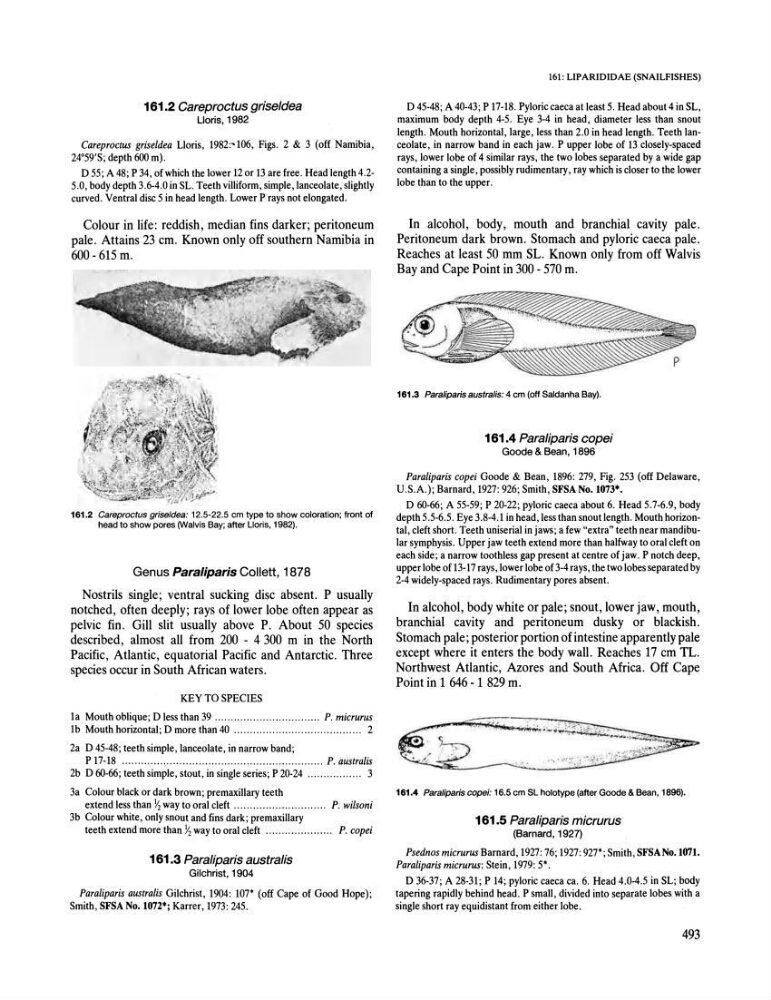
161.2 Careproctus griseldea: 12.5-22.5 cm type to show coloration; front of
head to show pores (Walvis Bay; after Lioris, 1982).
Genus Paraliparis Collett, 1878
Nostrils single; ventral sucking disc absent. P usually
notched, often deeply; rays of lower lobe often appear as
pelvic fin. Gill slit usually above P. About 50 species
described, almost all from 200 - 4300 m in the North
Pacific, Atlantic, equatorial Pacific and Antarctic. Three
species occur in South African waters.
KEY TO SPECIES
1a Mouth oblique; D less than 39 ................................. P. micrurus
Ib Mouth horizontal; D more than 40 ........................................ 2
2a D 45-48; teeth simple, lanceolate, in narrow band;
P 17-18 ............................................................... P. australis
2b D 60-66; teeth simple, stout, in single series; P 20-24 ................. 3
3a Colour black or dark brown; premaxillary teeth
extend less than Yz way to oral cleft ............................. P. wilsoni
3b Colour white, only snout and fins dark; premaxillary
teeth extend more than Yz way to oral cleft ..................... P. copei
161.3 Paraliparis australis
Gilchrist, 1904
Paraliparis australis Gilchrist, 1904: 107* (off Cape of Good Hope);
Smith, SFSA No. 1072*; Karrer, 1973: 245.
161: LIPARIDIDAE (SNAILFISHES)
D 45-48; A 40-43; P 17-18. Pyloric caeca at least 5. Head about 4 in SL,
maximum body depth 4-5. Eye 3-4 in head, diameter less than snout
length. Mouth horizontal, large, less than 2.0 in head length. Teeth lanceolate, in narrow band in each jaw. P upper lobe of 13 closely-spaced
rays, lower lobe of 4 similar rays, the two lobes separated by a wide gap
containing a single, possibly rudimentary, ray which is closer to the lower
lobe than to the upper.
In alcohol, body, mouth and branchial cavity pale.
Peritoneum dark brown. Stomach and pyloric caeca pale.
Reaches at least 50 mm SL. Known only from off Walvis
Bay and Cape Point in 300 - 570 m.
161.3 Paraliparis australis: 4 cm (off Saldanha Bay).
161.4 Par ali paris copei
Goode & Bean, 1896
Paraliparis copei Goode & Bean, 1896: 279, Fig. 253 (off Delaware,
U.S.A.); Barnard, 1927: 926; Smith, SFSA No. 1073*.
D 60-66; ASS-59; P 20-22; pyloric caeca about 6. Head 5.7-6.9, body
depth 5.5-6.5. Eye 3.8-4.1 in head, less than snout length. Mouth horizontal, cleft short. Teeth uniserial in jaws; a few "extra" teeth near mandibular symphysis. Upper jaw teeth extend more than halfway to oral cleft on
each side; a narrow toothless gap present at centre of jaw. P notch deep,
upper lobe of 13-17 rays, lower lobe of3-4 rays, the two lobes separated by
2-4 widely-spaced rays. Rudimentary pores absent.
In alcohol, body white or pale; snout, lower jaw, mouth,
branchial cavity and peritoneum dusky or blackish.
Stomach pale; posterior portion of intestine apparently pale
except where it enters the body wall. Reaches 17 cm TL.
Northwest Atlantic, Azores and South Africa. Off Cape
Point in 1 646 - 1 829 m.
161.4 Paraliparis copei: 16.5 em SL holotype (after Goode & Bean, 1896).
161.5 Paraliparis micrurus
(Barnard, 1927)
Psednos micrurus Barnard, 1927: 76; 1927: 927*; Smith, SFSANo.I071.
Paraliparis micrurus: Stein, 1979: 5*.
D 36-37; A 28-31; P 14; pyloric caeca ca. 6. Head 4.0-4.5 in SL; body
tapering rapidly behind head. P small, divided into separate lobes with a
single short ray equidistant from either lobe.
493
Lloris, 1982
Careproctus griseldea Lioris, 1982:-106, Figs. 2 & 3 (off Namibia,
24°59'S; depth 600 m).
D 55; A 48; P 34, of which the lower 12 or 13 are free. Head length 4.25.0, body depth 3.6-4.0 in SL. Teeth villiform, simple, lanceolate, slightly
curved. Ventral disc 5 in head length. Lower P rays not elongated.
Colour in life: reddish, median fins darker; peritoneum
pale. Attains 23 cm. Known only off southern Namibia in
600 - 615 m.
161.2 Careproctus griseldea: 12.5-22.5 cm type to show coloration; front of
head to show pores (Walvis Bay; after Lioris, 1982).
Genus Paraliparis Collett, 1878
Nostrils single; ventral sucking disc absent. P usually
notched, often deeply; rays of lower lobe often appear as
pelvic fin. Gill slit usually above P. About 50 species
described, almost all from 200 - 4300 m in the North
Pacific, Atlantic, equatorial Pacific and Antarctic. Three
species occur in South African waters.
KEY TO SPECIES
1a Mouth oblique; D less than 39 ................................. P. micrurus
Ib Mouth horizontal; D more than 40 ........................................ 2
2a D 45-48; teeth simple, lanceolate, in narrow band;
P 17-18 ............................................................... P. australis
2b D 60-66; teeth simple, stout, in single series; P 20-24 ................. 3
3a Colour black or dark brown; premaxillary teeth
extend less than Yz way to oral cleft ............................. P. wilsoni
3b Colour white, only snout and fins dark; premaxillary
teeth extend more than Yz way to oral cleft ..................... P. copei
161.3 Paraliparis australis
Gilchrist, 1904
Paraliparis australis Gilchrist, 1904: 107* (off Cape of Good Hope);
Smith, SFSA No. 1072*; Karrer, 1973: 245.
161: LIPARIDIDAE (SNAILFISHES)
D 45-48; A 40-43; P 17-18. Pyloric caeca at least 5. Head about 4 in SL,
maximum body depth 4-5. Eye 3-4 in head, diameter less than snout
length. Mouth horizontal, large, less than 2.0 in head length. Teeth lanceolate, in narrow band in each jaw. P upper lobe of 13 closely-spaced
rays, lower lobe of 4 similar rays, the two lobes separated by a wide gap
containing a single, possibly rudimentary, ray which is closer to the lower
lobe than to the upper.
In alcohol, body, mouth and branchial cavity pale.
Peritoneum dark brown. Stomach and pyloric caeca pale.
Reaches at least 50 mm SL. Known only from off Walvis
Bay and Cape Point in 300 - 570 m.
161.3 Paraliparis australis: 4 cm (off Saldanha Bay).
161.4 Par ali paris copei
Goode & Bean, 1896
Paraliparis copei Goode & Bean, 1896: 279, Fig. 253 (off Delaware,
U.S.A.); Barnard, 1927: 926; Smith, SFSA No. 1073*.
D 60-66; ASS-59; P 20-22; pyloric caeca about 6. Head 5.7-6.9, body
depth 5.5-6.5. Eye 3.8-4.1 in head, less than snout length. Mouth horizontal, cleft short. Teeth uniserial in jaws; a few "extra" teeth near mandibular symphysis. Upper jaw teeth extend more than halfway to oral cleft on
each side; a narrow toothless gap present at centre of jaw. P notch deep,
upper lobe of 13-17 rays, lower lobe of3-4 rays, the two lobes separated by
2-4 widely-spaced rays. Rudimentary pores absent.
In alcohol, body white or pale; snout, lower jaw, mouth,
branchial cavity and peritoneum dusky or blackish.
Stomach pale; posterior portion of intestine apparently pale
except where it enters the body wall. Reaches 17 cm TL.
Northwest Atlantic, Azores and South Africa. Off Cape
Point in 1 646 - 1 829 m.
161.4 Paraliparis copei: 16.5 em SL holotype (after Goode & Bean, 1896).
161.5 Paraliparis micrurus
(Barnard, 1927)
Psednos micrurus Barnard, 1927: 76; 1927: 927*; Smith, SFSANo.I071.
Paraliparis micrurus: Stein, 1979: 5*.
D 36-37; A 28-31; P 14; pyloric caeca ca. 6. Head 4.0-4.5 in SL; body
tapering rapidly behind head. P small, divided into separate lobes with a
single short ray equidistant from either lobe.
493