

143: AULOSTOMIDAE (TRUMPETFISHES)
Family No. 143: AULOSTOMIDAE
by P.C. Heemstra
Trumpetfishes
Trompetvisse
Body very elongate, somewhat compressed, covered
with small ctenoid scales. Head very compressed; snout
produced into an elongate tube. First dorsal fin represented
by 8-13 isolated, short spines; pelvic fins reach anus, with 6
branched rays and no spine; caudal fin rounded, with 5+5
branched rays. Branchiostegal membranes separate, free
from isthmus, with 4 or 5 rays. No teeth in upper jaw;
minute teeth at front of lower jaw; elongate band of teeth
on vomer. Barbel at symphysis of lower jaw. Gills 4, a slit
behind last; gill-rakers absent. Vertebrae 59-64, the first 4
fused and greatly elongated.
A common reef predator, the trumpetfish feeds on small
fishes and prawns; it often conceals itself by floating in a
vertical head-down position among the branches of gorgonians. Another favourite trick it uses is to swim alongside a
large fish moving over the reef until it is near enough to rush
and capture its prey. One genus, Aulostomus Lacepede,
1803, with 2 or 3 species; 1 species in our area.
Trumpetfish
143.1 Aulostomus chinensis
(Linnaeus, 1766)
PLATE 23
Trompetvis
Fistularia chinensis Linnaeus, 1766: 515 (in part; type-locality "India
orientalis", as restricted by Shaw, 1804). Aulostomus valentini: Smith,
SFSA No. 360*. Aulostomus chinensis: Wheeler, 1955: 616.
D VIII-XIII+III,23-27; A III,23-26; P 16. Depth 7-9, head 2.8-3.1 in
SL. Body with 3 bony plates along dorsal midline just behind head.
Colour variable; body generally brownish, often with
pale vertical bars; dark stripe along base of soft D & A;
black spot at base of each V; round black spot usually
present at middle of upper C rays and another sometimes
visible at middle of lower rays; some specimens completely
yellow. Attains 50 cm. Widespread in Indo-West Pacific
region, extends south to East London.
Family No. 144: FISTULARIIDAE
by P.C. Heemstra
Flutemouths
Fluitbekke
Body extremely elongate, slightly depressed; snout prolonged, tubular; no dorsal or anal fin spines; caudal fin
forked, the middle rays greatly prolonged; pelvic fins with 6
rays; anus close behind pelvics.
The elongate tubular snout is a very efficient device for
sucking in small fishes, which are the most common food
444
item for these stealthy predators. One genus, Fistularia
Linnaeus, 1758 (from the Latinjistularis, of a pipe), with 4
species; recently reviewed by Fritzsche (1976). Two species
in our area.
KEY TO SPECIES
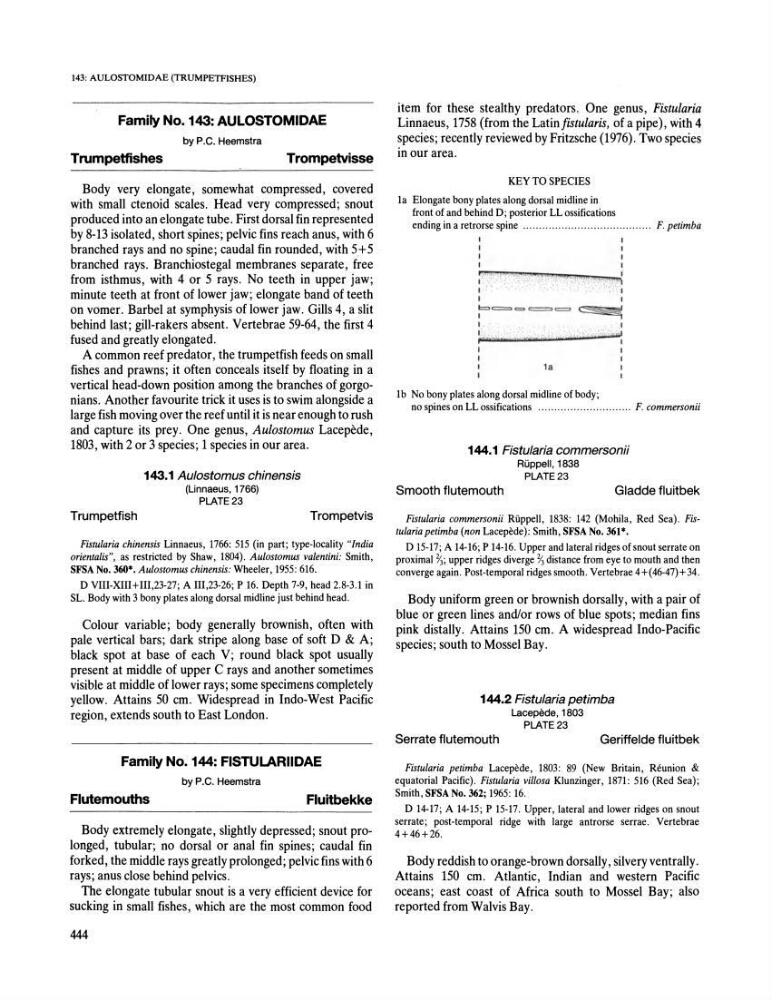
la Elongate bony plates along dorsal midline in
front of and behind D; posterior LL ossifications
ending in a retrorse spine ........................................ F. petimba
1
F : W:~? ;.c=- ,~_ . ~ , ; :pc ex,,>.
I
(
. : • .-, '",', '
',' - 0 ':,":': ": ~:!, ~.'~T:I
I "
',. 1
1
~~~~~ C'c~~&(~
1
1
"'~"" "'.:.i " "' ''' ' ,; ... ~"" ..... ...... ,., ..... iIi<;' ' ' ' ' '
''''' ' ''' ' .... " ... ' - .... '.-.-- ; .. ~
1a
Ib No bony plates along dorsal midline of body;
no spines on LL ossifications ............................. F. commersonii
144.1 Fistularia commersonii
Ruppeli,1838
PLATE 23
Smooth flutemouth
Gladde fluitbek
Fistularia commersonii Riippel\, 1838: 142 (Mohila, Red Sea). Fistularia petimba (non Lacepede): Smith, SFSA No. 361*.
D 15-17; A 14-16; P 14-16. Upper and lateral ridges of snout serrate on
proximal 3); upper ridges diverge 3) distance from eye to mouth and then
converge again. Post-temporal ridges smooth. Vertebrae 4 + (46-47) + 34.
Body uniform green or brownish dorsally, with a pair of
blue or green lines and/or rows of blue spots; median fins
pink distally. Attains 150 cm. A widespread Indo-Pacific
species; south to Mossel Bay.
144.2 Fistularia petimba
Lacepede, 1803
PLATE 23
Serrate flutemouth
Geriffelde fluitbek
Fistularia petimba Lacepede, 1803: 89 (New Britain, Reunion &
equatorial Pacific). Fistularia villosa Klunzinger, 1871: 516 (Red Sea);
Smith, SFSA No. 362; 1965: 16.
D 14-17; A 14-15; P 15-17. Upper, lateral and lower ridges on snout
serrate; post-temporal ridge with large antrorse serrae. Vertebrae
4+46+26.
Body reddish to orange-brown dorsally, silvery ventrally.
Attains 150 cm. Atlantic, Indian and western Pacific
oceans; east coast of Africa south to Mossel Bay; also
reported from Walvis Bay.
Family No. 143: AULOSTOMIDAE
by P.C. Heemstra
Trumpetfishes
Trompetvisse
Body very elongate, somewhat compressed, covered
with small ctenoid scales. Head very compressed; snout
produced into an elongate tube. First dorsal fin represented
by 8-13 isolated, short spines; pelvic fins reach anus, with 6
branched rays and no spine; caudal fin rounded, with 5+5
branched rays. Branchiostegal membranes separate, free
from isthmus, with 4 or 5 rays. No teeth in upper jaw;
minute teeth at front of lower jaw; elongate band of teeth
on vomer. Barbel at symphysis of lower jaw. Gills 4, a slit
behind last; gill-rakers absent. Vertebrae 59-64, the first 4
fused and greatly elongated.
A common reef predator, the trumpetfish feeds on small
fishes and prawns; it often conceals itself by floating in a
vertical head-down position among the branches of gorgonians. Another favourite trick it uses is to swim alongside a
large fish moving over the reef until it is near enough to rush
and capture its prey. One genus, Aulostomus Lacepede,
1803, with 2 or 3 species; 1 species in our area.
Trumpetfish
143.1 Aulostomus chinensis
(Linnaeus, 1766)
PLATE 23
Trompetvis
Fistularia chinensis Linnaeus, 1766: 515 (in part; type-locality "India
orientalis", as restricted by Shaw, 1804). Aulostomus valentini: Smith,
SFSA No. 360*. Aulostomus chinensis: Wheeler, 1955: 616.
D VIII-XIII+III,23-27; A III,23-26; P 16. Depth 7-9, head 2.8-3.1 in
SL. Body with 3 bony plates along dorsal midline just behind head.
Colour variable; body generally brownish, often with
pale vertical bars; dark stripe along base of soft D & A;
black spot at base of each V; round black spot usually
present at middle of upper C rays and another sometimes
visible at middle of lower rays; some specimens completely
yellow. Attains 50 cm. Widespread in Indo-West Pacific
region, extends south to East London.
Family No. 144: FISTULARIIDAE
by P.C. Heemstra
Flutemouths
Fluitbekke
Body extremely elongate, slightly depressed; snout prolonged, tubular; no dorsal or anal fin spines; caudal fin
forked, the middle rays greatly prolonged; pelvic fins with 6
rays; anus close behind pelvics.
The elongate tubular snout is a very efficient device for
sucking in small fishes, which are the most common food
444
item for these stealthy predators. One genus, Fistularia
Linnaeus, 1758 (from the Latinjistularis, of a pipe), with 4
species; recently reviewed by Fritzsche (1976). Two species
in our area.
KEY TO SPECIES
la Elongate bony plates along dorsal midline in
front of and behind D; posterior LL ossifications
ending in a retrorse spine ........................................ F. petimba
1
F : W:~? ;.c=- ,~_ . ~ , ; :pc ex,,>.
I
(
. : • .-, '",', '
',' - 0 ':,":': ": ~:!, ~.'~T:I
I "
',. 1
1
~~~~~ C'c~~&(~
1
1
"'~"" "'.:.i " "' ''' ' ,; ... ~"" ..... ...... ,., ..... iIi<;' ' ' ' ' '
''''' ' ''' ' .... " ... ' - .... '.-.-- ; .. ~
1a
Ib No bony plates along dorsal midline of body;
no spines on LL ossifications ............................. F. commersonii
144.1 Fistularia commersonii
Ruppeli,1838
PLATE 23
Smooth flutemouth
Gladde fluitbek
Fistularia commersonii Riippel\, 1838: 142 (Mohila, Red Sea). Fistularia petimba (non Lacepede): Smith, SFSA No. 361*.
D 15-17; A 14-16; P 14-16. Upper and lateral ridges of snout serrate on
proximal 3); upper ridges diverge 3) distance from eye to mouth and then
converge again. Post-temporal ridges smooth. Vertebrae 4 + (46-47) + 34.
Body uniform green or brownish dorsally, with a pair of
blue or green lines and/or rows of blue spots; median fins
pink distally. Attains 150 cm. A widespread Indo-Pacific
species; south to Mossel Bay.
144.2 Fistularia petimba
Lacepede, 1803
PLATE 23
Serrate flutemouth
Geriffelde fluitbek
Fistularia petimba Lacepede, 1803: 89 (New Britain, Reunion &
equatorial Pacific). Fistularia villosa Klunzinger, 1871: 516 (Red Sea);
Smith, SFSA No. 362; 1965: 16.
D 14-17; A 14-15; P 15-17. Upper, lateral and lower ridges on snout
serrate; post-temporal ridge with large antrorse serrae. Vertebrae
4+46+26.
Body reddish to orange-brown dorsally, silvery ventrally.
Attains 150 cm. Atlantic, Indian and western Pacific
oceans; east coast of Africa south to Mossel Bay; also
reported from Walvis Bay.