

Family No. 142: PEGASIDAE
by M.M. Smith
Seamoths
Seemotte
Armoured body with bony rings, tail similar but flexible;
pelvic fins abdominal, of 1 slender spine and 1-2 rays;
pectoral fins enlarged, horizontal, but not used in aerial
gliding; enlarged nasal bone forms rostrum projecting well
forward above the small toothless mouth.
Cryptic colouring and a strange shape enable seamoths to
live undetected in weed. Nothing is known of their biology,
thus their breeding habits are still a mystery. Four genera
with 5 species all restricted to the Indo-Pacific; 2 recorded
from our area.
KEY TO GENERA
la 8 tail rings; 2 deep grooves behind head; rostrum
rounded in front ................................................ Eurypegasus
Ib 12 tail rings; no grooves behind head; rostrum
sword-like ............................................................... Pegasus
Genus Eurypegasus Bleeker, 1863
Chubby, short-tailed; 2 species: E. papilio (Gilbert,
1905) from deep water off Hawaii and 1 in our area.
Seamoth
142.1 Eurypegasus draconis
(Linnaeus, 1766)
PLATE 24
Seemot
Pegasus draconis Linnaeus, 1766: 418 (India); Smith, SFSA No. 371*.
05; A 5; P 10-12; V I,2; 3 body rings, 8 tail rings, 7 behind vent, some
spines on side of tail.
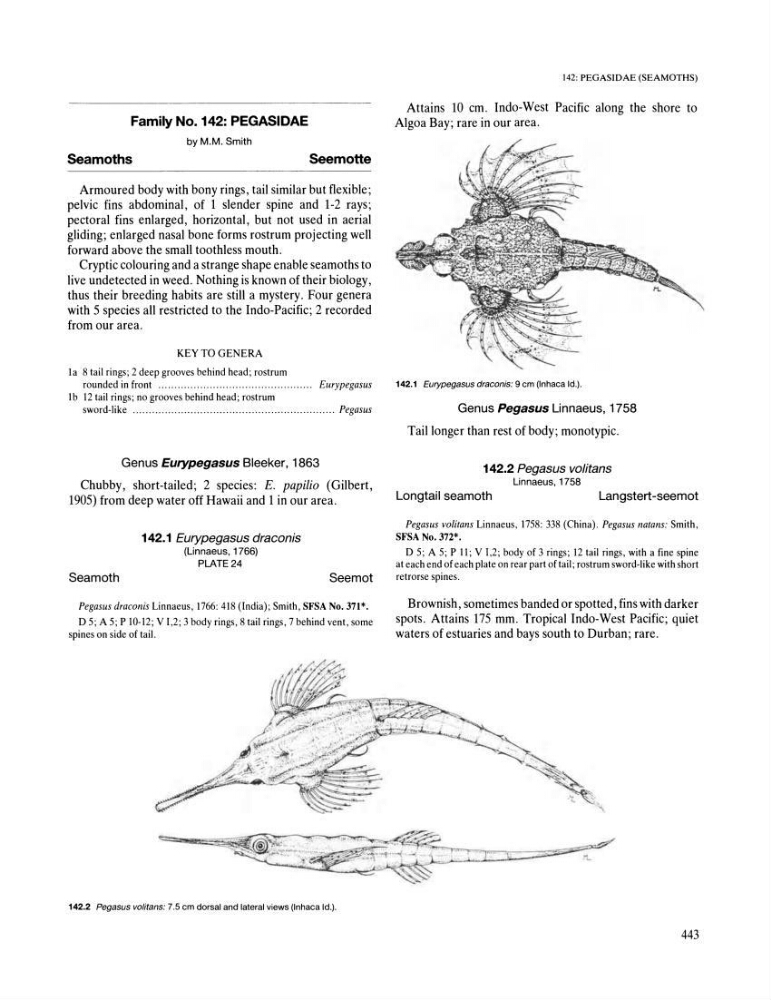
142.2 Pegasus volitans: 7.5 em dorsal and lateral views (Inhaea Id.).
142: PEGASIDAE (SEAMOTHS)
Attains 10 cm. Indo-West Pacific along the shore to
Algoa Bay; rare in our area.
142.1 Eurypegasus draconis: 9 em (Inhaea Id.).
Genus Pegasus Linnaeus, 1758
Tail longer than rest of body; monotypic.
142.2 Pegasus volitans
Linnaeus, 1758
Longtail seamoth
Langstert -seemot
Pegasus volitans Linnaeus, 1758: 338 (China). Pegasus natans: Smith,
SFSA No. 372*.
05; A 5; P 11; V I,2; body of 3 rings; 12 tail rings, with a fine spine
at each end of each plate on rear part of tail; rostrum sword-like with short
retrorse spines.
Brownish, sometimes banded or spotted, fins with darker
spots. Attains 175 mm. Tropical Indo-West Pacific; quiet
waters of estuaries and bays south to Durban; rare.
',
~'
'-,
''l.
y . ,
443
by M.M. Smith
Seamoths
Seemotte
Armoured body with bony rings, tail similar but flexible;
pelvic fins abdominal, of 1 slender spine and 1-2 rays;
pectoral fins enlarged, horizontal, but not used in aerial
gliding; enlarged nasal bone forms rostrum projecting well
forward above the small toothless mouth.
Cryptic colouring and a strange shape enable seamoths to
live undetected in weed. Nothing is known of their biology,
thus their breeding habits are still a mystery. Four genera
with 5 species all restricted to the Indo-Pacific; 2 recorded
from our area.
KEY TO GENERA
la 8 tail rings; 2 deep grooves behind head; rostrum
rounded in front ................................................ Eurypegasus
Ib 12 tail rings; no grooves behind head; rostrum
sword-like ............................................................... Pegasus
Genus Eurypegasus Bleeker, 1863
Chubby, short-tailed; 2 species: E. papilio (Gilbert,
1905) from deep water off Hawaii and 1 in our area.
Seamoth
142.1 Eurypegasus draconis
(Linnaeus, 1766)
PLATE 24
Seemot
Pegasus draconis Linnaeus, 1766: 418 (India); Smith, SFSA No. 371*.
05; A 5; P 10-12; V I,2; 3 body rings, 8 tail rings, 7 behind vent, some
spines on side of tail.
142.2 Pegasus volitans: 7.5 em dorsal and lateral views (Inhaea Id.).
142: PEGASIDAE (SEAMOTHS)
Attains 10 cm. Indo-West Pacific along the shore to
Algoa Bay; rare in our area.
142.1 Eurypegasus draconis: 9 em (Inhaea Id.).
Genus Pegasus Linnaeus, 1758
Tail longer than rest of body; monotypic.
142.2 Pegasus volitans
Linnaeus, 1758
Longtail seamoth
Langstert -seemot
Pegasus volitans Linnaeus, 1758: 338 (China). Pegasus natans: Smith,
SFSA No. 372*.
05; A 5; P 11; V I,2; body of 3 rings; 12 tail rings, with a fine spine
at each end of each plate on rear part of tail; rostrum sword-like with short
retrorse spines.
Brownish, sometimes banded or spotted, fins with darker
spots. Attains 175 mm. Tropical Indo-West Pacific; quiet
waters of estuaries and bays south to Durban; rare.
',
~'
'-,
''l.
y . ,
443