

Order SYNGNATHIFORMES
The Order Syngnathiformes comprises 7 families of
highly specialised species derived from some primitive
acanthopterygian. Some authors include the Gasterosteriformes in this order (Pietsch, 1978; Lauder & Liem,
1983), but the evidence for this relationship is not convincing. Anterior vertebral centra elongated; branchiostegal
rays 1-5.
KEY TO FAMILIES
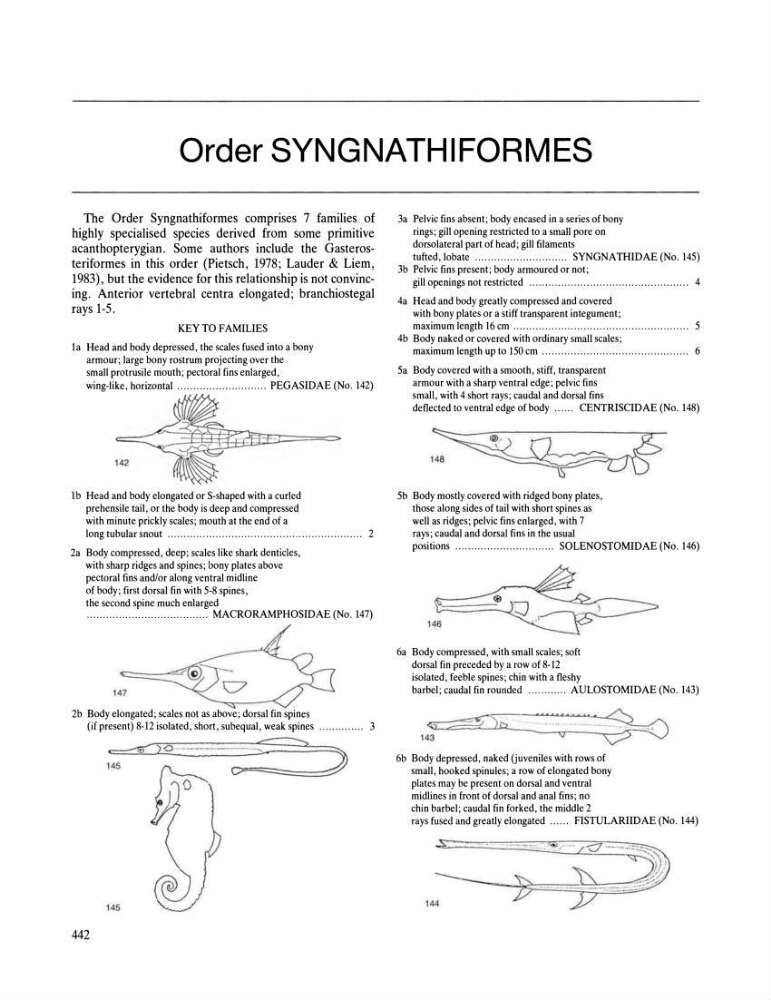
la Head and body depressed, the scales fused into a bony
armour; large bony rostrum projecting over the
small protrusile mouth; pectoral fins enlarged,
wing-like, horizontal ............................ PEGASIDAE (No. 142)
Ib Head and body elongated or S-shaped with a curled
prehensile tail, or the body is deep and compressed
with minute prickly scales; mouth at the end of a
long tubular snout ............................................................. 2
2a Body compressed, deep; scales like shark denticles,
with sharp ridges and spines; bony plates above
pectoral fins and/or along ventral midline
of body; first dorsal fin with S-8 spines,
the second spine much enlarged
...................................... MACRORAMPHOSIDAE (No. 147)
147
2b Body elongated; scales not as above; dorsal fin spines
(if present) 8-12 isolated, short, subequal, weak spines .............. 3
442
3a Pelvic fins absent; body encased in a series of bony
rings; gill opening restricted to a small pore on
dorsolateral part of head; gill filaments
tufted, lobate ............................. SYNGNATHIDAE (No. 14S)
3b Pelvic fins present; body armoured or not;
gill openings not restricted .................................................. 4
4a Head and body greatly compressed and covered
with bony plates or a stiff transparent integument;
maximum length 16 em .......................................... .. ........... S
4b Body naked or covered with ordinary small scales;
maximum length up to ISO cm .............................................. 6
Sa Body covered with a smooth, stiff, transparent
armour with a sharp ventral edge; pelvic fins
small, with 4 short rays; caudal and dorsal fins
deflected to ventral edge of body ...... CENTRISCIDAE (No. 148)
Sb Body mostly covered with ridged bony plates,
those along sides of tail with short spines as
well as ridges; pelvic fins enlarged, with 7
rays; caudal and dorsal fins in the usual
positions ............................... SOLENOSTOMIDAE (No. 146)
146
6a Body compressed, with small scales; soft
dorsal fin preceded by a row of 8-12
isolated, feeble spines; chin with a fleshy
barbel; caudal fin rounded ............ AULOSTOMIDAE (No. 143)
6b Body depressed, naked (juveniles with rows of
small, hooked spinules; a row of elongated bony
plates may be present on dorsal and ventral
midlines in front of dorsal and anal fins; no
chin barbel; caudal fin forked, the middle 2
rays fused and greatly elongated ...... FISTULARIIDAE (No. 144)
The Order Syngnathiformes comprises 7 families of
highly specialised species derived from some primitive
acanthopterygian. Some authors include the Gasterosteriformes in this order (Pietsch, 1978; Lauder & Liem,
1983), but the evidence for this relationship is not convincing. Anterior vertebral centra elongated; branchiostegal
rays 1-5.
KEY TO FAMILIES
la Head and body depressed, the scales fused into a bony
armour; large bony rostrum projecting over the
small protrusile mouth; pectoral fins enlarged,
wing-like, horizontal ............................ PEGASIDAE (No. 142)
Ib Head and body elongated or S-shaped with a curled
prehensile tail, or the body is deep and compressed
with minute prickly scales; mouth at the end of a
long tubular snout ............................................................. 2
2a Body compressed, deep; scales like shark denticles,
with sharp ridges and spines; bony plates above
pectoral fins and/or along ventral midline
of body; first dorsal fin with S-8 spines,
the second spine much enlarged
...................................... MACRORAMPHOSIDAE (No. 147)
147
2b Body elongated; scales not as above; dorsal fin spines
(if present) 8-12 isolated, short, subequal, weak spines .............. 3
442
3a Pelvic fins absent; body encased in a series of bony
rings; gill opening restricted to a small pore on
dorsolateral part of head; gill filaments
tufted, lobate ............................. SYNGNATHIDAE (No. 14S)
3b Pelvic fins present; body armoured or not;
gill openings not restricted .................................................. 4
4a Head and body greatly compressed and covered
with bony plates or a stiff transparent integument;
maximum length 16 em .......................................... .. ........... S
4b Body naked or covered with ordinary small scales;
maximum length up to ISO cm .............................................. 6
Sa Body covered with a smooth, stiff, transparent
armour with a sharp ventral edge; pelvic fins
small, with 4 short rays; caudal and dorsal fins
deflected to ventral edge of body ...... CENTRISCIDAE (No. 148)
Sb Body mostly covered with ridged bony plates,
those along sides of tail with short spines as
well as ridges; pelvic fins enlarged, with 7
rays; caudal and dorsal fins in the usual
positions ............................... SOLENOSTOMIDAE (No. 146)
146
6a Body compressed, with small scales; soft
dorsal fin preceded by a row of 8-12
isolated, feeble spines; chin with a fleshy
barbel; caudal fin rounded ............ AULOSTOMIDAE (No. 143)
6b Body depressed, naked (juveniles with rows of
small, hooked spinules; a row of elongated bony
plates may be present on dorsal and ventral
midlines in front of dorsal and anal fins; no
chin barbel; caudal fin forked, the middle 2
rays fused and greatly elongated ...... FISTULARIIDAE (No. 144)