

Family No. 145: SYNGNATHIDAE
Seahorses
and pipefishes
by C.E. Dawson
Seeperdjies
en pypvisse
Typically slender and elongate fishes, with or without a
prehensile tail, with body armoured by dermal plates
arranged to form a series of rings and with or without a
fleshy exter~al inte?ument. Mouth small, terminal, usually
on a ~rotrudmg tubiform snout; no true teeth; gill opening a
P?re m membrane above opercle; four complete gill arches,
gIlI~ lobate; spinous dorsal and pelvic fins absent, other fins
vanously present or absent. Sexually dimorphic; males
carry the eggs exposed or partly to completely concealed
within a well-defined pouch under trunk or tail. Larvae and
early ~ostlarvae are often like adults, but there are significant dIfferences between early young and adults in some
genera (see Dawson & Allen, 1978; Dawson et aI., 1979).
Syngnathids range from boreal regions to southern cold
waters. Species abundance is perhaps highest in temperate/
s~btropica~ are~s, .and greatest diversity (ca. 70% of recognIsed speCIes) IS m the subtropical/tropical Indo-Pacific.
The family, including some 52 genera and more than 200
species, is predominantly marine but freshwater and
estuarine forms are not uncommon. A few species are
oceanic but most are taken near shore in less than 50 m
depth. Some species mature at lengths of 20-25 mm, while
others may exceed 60 cm. These fishes have little economic
~alue but they are sometimes sold as curios, and some (particularly seahorses) are popular aquarium exhibits.
Within our area, there is 1 genus and about 6 species of
seahorses, and 14 genera (including 6 subgenera) with at
least 2~ species of pipefishes. Syngnathus phlegon (Risso,
1826) IS a Mediterranean species that was erroneously
recorded from South Africa (see Smith, SFSA No. 349). As
there are no confirmed records of Syngnathus pelagicus Linnaeus from the southeastern Atlantic or Indo-Pacific its
reported occurrence in southern Africa (see Smith, SFSA
~o .. 353, based on Gunther, 1870) is apparently erroneous.
SImIlarly, there are no confirmed records of an Indo-Pacific
species Syngnathus fasciatus Gray, 1830 = Corythoichthys
haematopterus (Bleeker, 1851) south of 20 0 S (see Smith,
SFSA No. 354), but Smith, 1963: 536, PI. 81 gives a good illustration of specimens from Pinda and Zanzibar.
Identification o~ specimens usually requires a microscope
and depends mamly on the following characters and
methods:
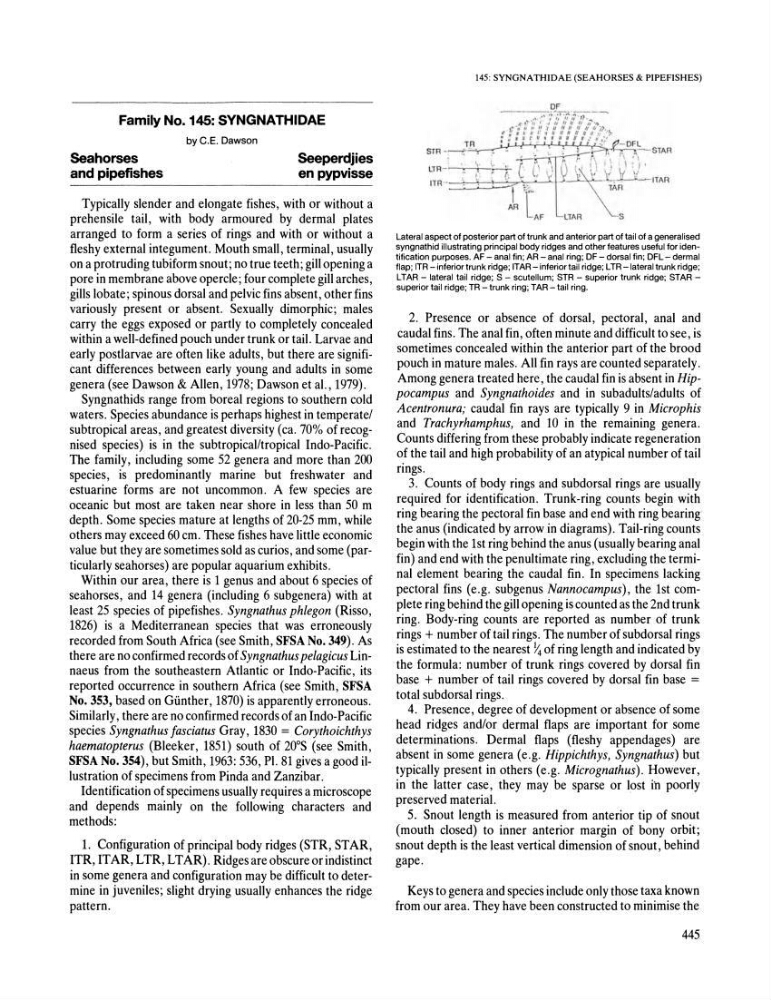
1. Configuration of principal body ridges (STR, STAR,
ITR, ITAR, LTR, LTAR). Ridges are obscure or indistinct
in some genera and configuration may be difficult to determine in juveniles; slight drying usually enhances the ridge
pattern.
145: SYNGNATHIDAE (SEAHORSES & PIPEFISHES)
Lateral aspect of posterior part of trunk and anterior part of tail of a generalised
syngnathld Illustrating pnncipal body ridges and other features useful for identification purposes. AF - anal fin; AR - anal ring; OF - dorsal fin; OFL - dermal
flap; ITR - inferiortrunk ridge; ITAR - inferior tail ridge; L TR -lateral trunk ridge;
LTAH- lateral tall ndge; S - scutellum; STR - superior trunk ridge; STARsupenor tall ndge; TR - trunk ring; TAR - tail ring.
2. Presence or absence of dorsal, pectoral, anal and
caudal fins. The anal fin, often minute and difficult to see is
sometimes concealed within the anterior part of the bro~d
pouch in mature males. All fin rays are counted separately.
Among genera treated here, the caudal fin is absent in Hippocampus and Syngnathoides and in sub adults/adults of
Acentronura; caudal fin rays are typically 9 in Microphis
and Trachyrhamphus, and 10 in the remaining genera.
Counts differing from these probably indicate regeneration
of the tail and high probability of an atypical number of tail
rings.
3 .. Counts of body rings and subdorsal rings are usually
r~qUlred .for identification. Trunk-ring counts begin with
nng bean?g t.he pectoral fin base and end with ring bearing
the anus (mdlcated by arrow in diagrams). Tail-ring counts
begin with the 1st ring behind the anus (usually bearing anal
fin) and end with the penultimate ring, excluding the terminal element bearing the caudal fin. In specimens lacking
pectoral fins (e.g. subgenus Nannocampus), the 1st complete ring behind the gill opening is counted as the 2nd trunk
ring. Body-ring counts are reported as number of trunk
rings + number of tail rings. The number of subdorsal rings
is estimated to the nearest ~ of ring length and indicated by
the formula: number of trunk rings covered by dorsal fin
base + number of tail rings covered by dorsal fin base =
total subdorsal rings.
4. Presence, degree of development or absence of some
head ridges and/or dermal flaps are important for some
determ~nations. Dermal flaps (fleshy appendages) are
absent m some genera (e.g. Hippichthys, Syngnathus) but
!ypically present in others (e.g. Micrognathus). However,
m the latter case, they may be sparse or lost ih poorly
preserved material.
5. Snout length is measured from anterior tip of snout
(mouth closed) to inner anterior margin of bony orbit;
snout depth is the least vertical dimension of snout behind
,
gape.
Keys to genera and species include only those taxa known
from our area. They have been constructed to minimise the
445
Seahorses
and pipefishes
by C.E. Dawson
Seeperdjies
en pypvisse
Typically slender and elongate fishes, with or without a
prehensile tail, with body armoured by dermal plates
arranged to form a series of rings and with or without a
fleshy exter~al inte?ument. Mouth small, terminal, usually
on a ~rotrudmg tubiform snout; no true teeth; gill opening a
P?re m membrane above opercle; four complete gill arches,
gIlI~ lobate; spinous dorsal and pelvic fins absent, other fins
vanously present or absent. Sexually dimorphic; males
carry the eggs exposed or partly to completely concealed
within a well-defined pouch under trunk or tail. Larvae and
early ~ostlarvae are often like adults, but there are significant dIfferences between early young and adults in some
genera (see Dawson & Allen, 1978; Dawson et aI., 1979).
Syngnathids range from boreal regions to southern cold
waters. Species abundance is perhaps highest in temperate/
s~btropica~ are~s, .and greatest diversity (ca. 70% of recognIsed speCIes) IS m the subtropical/tropical Indo-Pacific.
The family, including some 52 genera and more than 200
species, is predominantly marine but freshwater and
estuarine forms are not uncommon. A few species are
oceanic but most are taken near shore in less than 50 m
depth. Some species mature at lengths of 20-25 mm, while
others may exceed 60 cm. These fishes have little economic
~alue but they are sometimes sold as curios, and some (particularly seahorses) are popular aquarium exhibits.
Within our area, there is 1 genus and about 6 species of
seahorses, and 14 genera (including 6 subgenera) with at
least 2~ species of pipefishes. Syngnathus phlegon (Risso,
1826) IS a Mediterranean species that was erroneously
recorded from South Africa (see Smith, SFSA No. 349). As
there are no confirmed records of Syngnathus pelagicus Linnaeus from the southeastern Atlantic or Indo-Pacific its
reported occurrence in southern Africa (see Smith, SFSA
~o .. 353, based on Gunther, 1870) is apparently erroneous.
SImIlarly, there are no confirmed records of an Indo-Pacific
species Syngnathus fasciatus Gray, 1830 = Corythoichthys
haematopterus (Bleeker, 1851) south of 20 0 S (see Smith,
SFSA No. 354), but Smith, 1963: 536, PI. 81 gives a good illustration of specimens from Pinda and Zanzibar.
Identification o~ specimens usually requires a microscope
and depends mamly on the following characters and
methods:
1. Configuration of principal body ridges (STR, STAR,
ITR, ITAR, LTR, LTAR). Ridges are obscure or indistinct
in some genera and configuration may be difficult to determine in juveniles; slight drying usually enhances the ridge
pattern.
145: SYNGNATHIDAE (SEAHORSES & PIPEFISHES)
Lateral aspect of posterior part of trunk and anterior part of tail of a generalised
syngnathld Illustrating pnncipal body ridges and other features useful for identification purposes. AF - anal fin; AR - anal ring; OF - dorsal fin; OFL - dermal
flap; ITR - inferiortrunk ridge; ITAR - inferior tail ridge; L TR -lateral trunk ridge;
LTAH- lateral tall ndge; S - scutellum; STR - superior trunk ridge; STARsupenor tall ndge; TR - trunk ring; TAR - tail ring.
2. Presence or absence of dorsal, pectoral, anal and
caudal fins. The anal fin, often minute and difficult to see is
sometimes concealed within the anterior part of the bro~d
pouch in mature males. All fin rays are counted separately.
Among genera treated here, the caudal fin is absent in Hippocampus and Syngnathoides and in sub adults/adults of
Acentronura; caudal fin rays are typically 9 in Microphis
and Trachyrhamphus, and 10 in the remaining genera.
Counts differing from these probably indicate regeneration
of the tail and high probability of an atypical number of tail
rings.
3 .. Counts of body rings and subdorsal rings are usually
r~qUlred .for identification. Trunk-ring counts begin with
nng bean?g t.he pectoral fin base and end with ring bearing
the anus (mdlcated by arrow in diagrams). Tail-ring counts
begin with the 1st ring behind the anus (usually bearing anal
fin) and end with the penultimate ring, excluding the terminal element bearing the caudal fin. In specimens lacking
pectoral fins (e.g. subgenus Nannocampus), the 1st complete ring behind the gill opening is counted as the 2nd trunk
ring. Body-ring counts are reported as number of trunk
rings + number of tail rings. The number of subdorsal rings
is estimated to the nearest ~ of ring length and indicated by
the formula: number of trunk rings covered by dorsal fin
base + number of tail rings covered by dorsal fin base =
total subdorsal rings.
4. Presence, degree of development or absence of some
head ridges and/or dermal flaps are important for some
determ~nations. Dermal flaps (fleshy appendages) are
absent m some genera (e.g. Hippichthys, Syngnathus) but
!ypically present in others (e.g. Micrognathus). However,
m the latter case, they may be sparse or lost ih poorly
preserved material.
5. Snout length is measured from anterior tip of snout
(mouth closed) to inner anterior margin of bony orbit;
snout depth is the least vertical dimension of snout behind
,
gape.
Keys to genera and species include only those taxa known
from our area. They have been constructed to minimise the
445